Thank you for visiting SNEWPapers!
Sign up free
The Liberator
Boston, Suffolk County, Massachusetts
What is this article about?
An Irish newspaper editorial argues that American slavery is nearing its end, citing political tensions in Washington, abolitionist demands for Union dissolution or slavery's abolition, slave unrest in the South, and potential violent or peaceful outcomes. It urges Southern reformers to act with Northern support.
Clipping
OCR Quality
Full Text
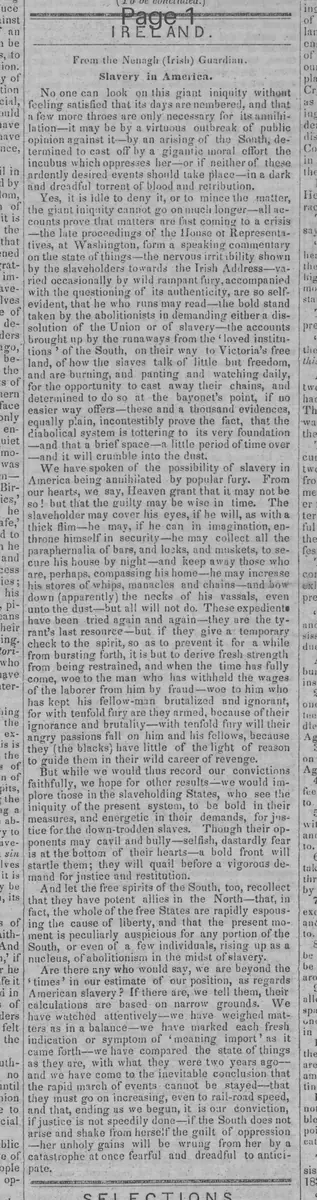
From the Nenagh (Irish) Guardian.
Slavery in America.
No one can look on this giant iniquity without feeling satisfied that its days are numbered, and that a few more throes are only necessary for its annihilation—it may be by a virtuous outbreak of public opinion against it—by an arising of the South, determined to cast off by a gigantic moral effort the incubus which oppresses her—or if neither of these ardently desired events should take place—in a dark and dreadful torrent of blood and retribution.
Yes, it is idle to deny it, or to mince the matter, the giant iniquity cannot go on much longer—all accounts prove that matters are fast coming to a crisis—the late proceedings of the House of Representatives, at Washington, form a speaking commentary on the state of things—the nervous irritability shown by the slaveholders towards the Irish Address—varied occasionally by wild rampant fury, accompanied with the questioning of its authenticity, are so self-evident, that he who runs may read—the bold stand taken by the abolitionists in demanding either a dissolution of the Union or of slavery—the accounts brought up by the runaways from the 'loved institution' of the South, on their way to Victoria's free land, of how the slaves talk of little but freedom, and are burning, and panting and watching daily, for the opportunity to cast away their chains, and determined to do so at the bayonet's point, if no easier way offers—these and a thousand evidences, equally plain, incontestibly prove the fact, that the diabolical system is tottering to its very foundation—and that a brief space—a little period of time over—and it will crumble into the dust.
We have spoken of the possibility of slavery in America being annihilated by popular fury. From our hearts, we say, Heaven grant that it may not be so! but that the guilty may be wise in time. The slaveholder may cover his eyes, if he will, as with a thick film—he may, if he can in imagination, enthrone himself in security—he may collect all the paraphernalia of bars, and locks, and muskets, to secure his house by night—and keep away those who are, perhaps, compassing his home—he may increase his stores of whips, manacles and chains—and bow down (apparently) the necks of his vassals, even unto the dust—but all will not do. These expedients have been tried again and again—they are the tyrant's last resource—but if they give a temporary check to the spirit, so as to prevent it for a while from bursting forth, it is but to derive fresh strength from being restrained, and when the time has fully come, woe to the man who has withheld the wages of the laborer from him by fraud—woe to him who has kept his fellow-man brutalized and ignorant, for with tenfold fury are they armed, because of their ignorance and brutality—with tenfold fury will their angry passions fall on him and his fellows, because they (the blacks) have little of the light of reason to guide them in their wild career of revenge.
But while we would thus record our convictions faithfully, we hope for other results—we would implore those in the slaveholding States, who see the iniquity of the present system, to be bold in their measures, and energetic in their demands, for justice for the down-trodden slaves. Though their opponents may cavil and bully—selfish, dastardly fear is at the bottom of their hearts—a bold front will startle them; they will quail before a vigorous demand for justice and restitution.
And let the free spirits of the South, too, recollect that they have potent allies in the North—that, in fact, the whole of the free States are rapidly espousing the cause of liberty, and that the present moment is peculiarly auspicious for any portion of the South, or even of a few individuals, rising up as a nucleus, of abolitionism in the midst of slavery.
Are there any who would say, we are beyond the 'times' in our estimate of our position, as regards American slavery? If there are, we tell them, their calculations are based on narrow grounds. We have watched attentively—we have weighed matters as in a balance—we have marked each fresh indication or symptom of 'momentous import' as it came forth—we have compared the state of things as they are, with what they were two years ago—and we have come to the inevitable conclusion that the rapid march of events cannot be stayed—that they must go on increasing, even to rail-road speed, and that, ending as we begun, it is our conviction, if justice is not speedily done—if the South does not arise and shake from herself the guilt of oppression—her unholy gains will be wrung from her by a catastrophe at once fearful and dreadful to anticipate.
What sub-type of article is it?
What keywords are associated?
Where did it happen?
Foreign News Details
Primary Location
America
Outcome
speculated annihilation of slavery through public opinion, southern moral effort, or violent retribution; potential dissolution of the union or catastrophe if no reform.
Event Details
Editorial asserts American slavery is nearing collapse due to political crisis in Washington, slaveholder reactions to Irish Address, abolitionist demands, and slave unrest in the South; urges peaceful reform with Northern support to avoid violent uprising.