Thank you for visiting SNEWPapers!
Sign up free
The Key West Citizen
Key West, Monroe County, Florida
What is this article about?
Western allies including the Brussels Pact nations and the US, Britain, and Canada are standardizing military equipment and sharing information to enhance cooperation under the Atlantic Pact, countering Soviet standardization in Eastern Europe.
Clipping
OCR Quality
Full Text
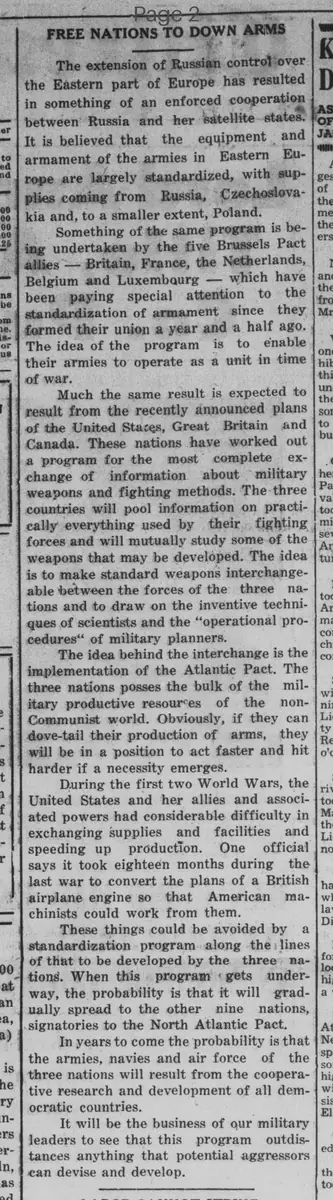
The extension of Russian control over
the Eastern part of Europe has resulted
in something of an enforced cooperation
between Russia and her satellite states.
It is believed that the equipment and
armament of the armies in Eastern Europe
are largely standardized, with supplies
coming from Russia, Czechoslovakia and,
to a smaller extent, Poland.
Something of the same program is being
undertaken by the five Brussels Pact
allies - Britain, France, the Netherlands,
Belgium and Luxembourg — which have
been paying special attention to the
standardization of armament since they
formed their union a year and a half ago.
The idea of the program is to enable
their armies to operate as a unit in time
of war.
Much the same result is expected to
result from the recently announced plans
of the United States, Great Britain and
Canada. These nations have worked out
a program for the most complete exchange
of information about military
weapons and fighting methods. The three
countries will pool information on practically
everything used by their fighting
forces and will mutually study some of the
weapons that may be developed. The idea
is to make standard weapons interchangeable
between the forces of the three nations
and to draw on the inventive techniques
of scientists and the "operational procedures"
of military planners.
The idea behind the interchange is the
implementation of the Atlantic Pact. The
three nations possess the bulk of the military
productive resources of the non-
Communist world. Obviously, if they can
dovetail their production of arms, they
will be in a position to act faster and hit
harder if a necessity emerges.
During the first two World Wars, the
United States and her allies and associated
powers had considerable difficulty in
exchanging supplies and facilities and
speeding up production. One official
says it took eighteen months during the
last war to convert the plans of a British
airplane engine so that American machinists
could work from them.
These things could be avoided by
a standardization program along the lines
of that to be developed by the three nations.
When this program gets underway, the
probability is that it will gradually spread
to the other nine nations signatories to
the North Atlantic Pact.
In years to come the probability is that
the armies, navies and air force of the
three nations will result from the cooperative
research and development of all democratic
countries.
It will be the business of our military
leaders to see that this program outdistances
anything that potential aggressors
can devise and develop.
What sub-type of article is it?
What keywords are associated?
Where did it happen?
Foreign News Details
Primary Location
Europe
Outcome
standardization programs to enable unified operations, interchangeable weapons, and faster production among allies, implementing the atlantic pact and avoiding past wartime delays.
Event Details
Russian control in Eastern Europe leads to standardized armies supplied by Russia, Czechoslovakia, and Poland. In response, Brussels Pact allies (Britain, France, Netherlands, Belgium, Luxembourg) standardize armaments for unified war operations. US, Great Britain, and Canada announce plans to exchange military information, pool resources, and develop interchangeable weapons to implement the Atlantic Pact and enhance non-Communist military production efficiency, with potential spread to other NATO signatories.