Thank you for visiting SNEWPapers!
Sign up free
Story
September 1, 1898
Bridgeton Pioneer
Bridgeton, Cumberland County, New Jersey
What is this article about?
Article details the fur trade of sables in Siberia and Mongolia, where native Syots hunt them and trade cheaply with Siberian merchants for goods like tea and tobacco. Prices escalate from a few pence in Siberia to up to £20 in London, highlighting the markup in the trade.
Clipping
OCR Quality
98%
Excellent
Full Text
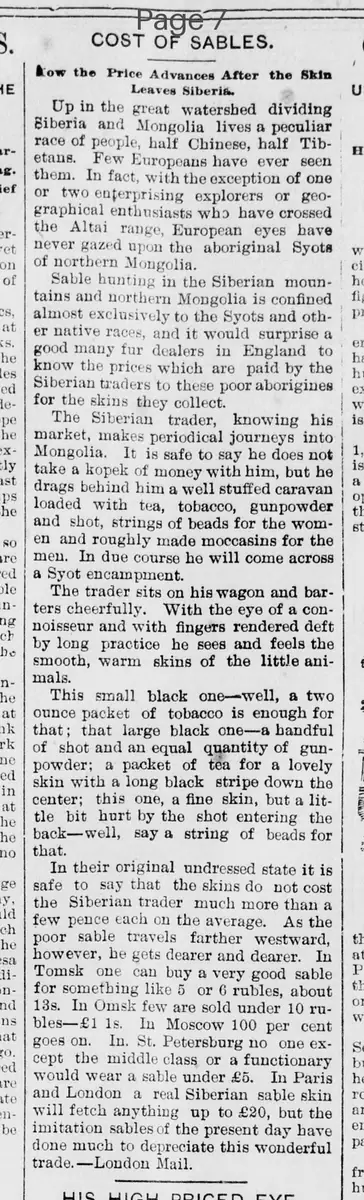
COST OF SABLES.
How the Price Advances After the Skin Leaves Siberia.
Up in the great watershed dividing Siberia and Mongolia lives a peculiar race of people, half Chinese, half Tibetans. Few Europeans have ever seen them. In fact, with the exception of one or two enterprising explorers or geographical enthusiasts who have crossed the Altai range, European eyes have never gazed upon the aboriginal Syots of northern Mongolia.
Sable hunting in the Siberian mountains and northern Mongolia is confined almost exclusively to the Syots and other native races, and it would surprise a good many fur dealers in England to know the prices which are paid by the Siberian traders to these poor aborigines for the skins they collect.
The Siberian trader, knowing his market, makes periodical journeys into Mongolia. It is safe to say he does not take a kopek of money with him, but he drags behind him a well stuffed caravan loaded with tea, tobacco, gunpowder and shot, strings of beads for the women and roughly made moccasins for the men. In due course he will come across a Syot encampment.
The trader sits on his wagon and barters cheerfully. With the eye of a connoisseur and with fingers rendered deft by long practice he sees and feels the smooth, warm skins of the little animals.
This small black one—well, a two ounce packet of tobacco is enough for that; that large black one—a handful of shot and an equal quantity of gunpowder; a packet of tea for a lovely skin with a long black stripe down the center; this one, a fine skin, but a little bit hurt by the shot entering the back—well, say a string of beads for that.
In their original undressed state it is safe to say that the skins do not cost the Siberian trader much more than a few pence each on the average. As the poor sable travels farther westward, however, he gets dearer and dearer. In Tomsk one can buy a very good sable for something like 5 or 6 rubles, about 13s. In Omsk few are sold under 10 rubles—£1 1s. In Moscow 100 per cent goes on. In St. Petersburg no one except the middle class or a functionary would wear a sable under £5. In Paris and London a real Siberian sable skin will fetch anything up to £20, but the imitation sables of the present day have done much to depreciate this wonderful trade.—London Mail.
How the Price Advances After the Skin Leaves Siberia.
Up in the great watershed dividing Siberia and Mongolia lives a peculiar race of people, half Chinese, half Tibetans. Few Europeans have ever seen them. In fact, with the exception of one or two enterprising explorers or geographical enthusiasts who have crossed the Altai range, European eyes have never gazed upon the aboriginal Syots of northern Mongolia.
Sable hunting in the Siberian mountains and northern Mongolia is confined almost exclusively to the Syots and other native races, and it would surprise a good many fur dealers in England to know the prices which are paid by the Siberian traders to these poor aborigines for the skins they collect.
The Siberian trader, knowing his market, makes periodical journeys into Mongolia. It is safe to say he does not take a kopek of money with him, but he drags behind him a well stuffed caravan loaded with tea, tobacco, gunpowder and shot, strings of beads for the women and roughly made moccasins for the men. In due course he will come across a Syot encampment.
The trader sits on his wagon and barters cheerfully. With the eye of a connoisseur and with fingers rendered deft by long practice he sees and feels the smooth, warm skins of the little animals.
This small black one—well, a two ounce packet of tobacco is enough for that; that large black one—a handful of shot and an equal quantity of gunpowder; a packet of tea for a lovely skin with a long black stripe down the center; this one, a fine skin, but a little bit hurt by the shot entering the back—well, say a string of beads for that.
In their original undressed state it is safe to say that the skins do not cost the Siberian trader much more than a few pence each on the average. As the poor sable travels farther westward, however, he gets dearer and dearer. In Tomsk one can buy a very good sable for something like 5 or 6 rubles, about 13s. In Omsk few are sold under 10 rubles—£1 1s. In Moscow 100 per cent goes on. In St. Petersburg no one except the middle class or a functionary would wear a sable under £5. In Paris and London a real Siberian sable skin will fetch anything up to £20, but the imitation sables of the present day have done much to depreciate this wonderful trade.—London Mail.
What sub-type of article is it?
Curiosity
What themes does it cover?
Fortune Reversal
What keywords are associated?
Sable Fur
Siberian Trade
Syots
Barter System
Price Markup
Fur Hunting
Mongolia
Where did it happen?
Siberia, Northern Mongolia, Altai Range, Tomsk, Omsk, Moscow, St. Petersburg, Paris, London
Story Details
Location
Siberia, Northern Mongolia, Altai Range, Tomsk, Omsk, Moscow, St. Petersburg, Paris, London
Story Details
Siberian traders barter cheaply with Syot natives for sable skins using goods like tobacco, tea, and beads, costing pennies each. Prices rise sharply westward: 5-6 rubles in Tomsk, 10 rubles in Omsk, higher in Moscow and St. Petersburg, up to £20 in Paris and London.