Thank you for visiting SNEWPapers!
Sign up free
Editorial
July 11, 1935
White Bluffs Spokesman
White Bluffs, Benton County, Washington
What is this article about?
Editorial advocates for a local cannery in the valley to process surplus farm produce, utilizing federal relief loans for a cooperative. It highlights benefits for farmers, markets, and community prosperity amid fluctuating agricultural prices.
Clipping
OCR Quality
99%
Excellent
Full Text
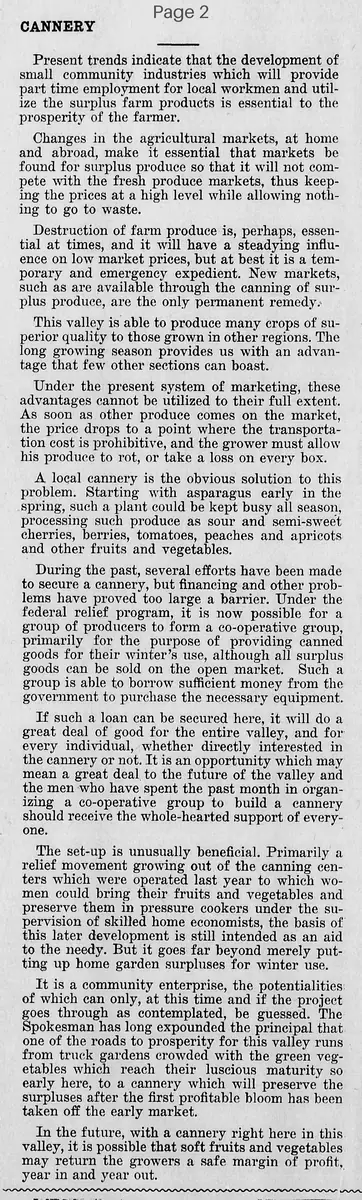
CANNERY
Present trends indicate that the development of small community industries which will provide part time employment for local workmen and utilize the surplus farm products is essential to the prosperity of the farmer.
Changes in the agricultural markets, at home and abroad, make it essential that markets be found for surplus produce so that it will not compete with the fresh produce markets, thus keeping the prices at a high level while allowing nothing to go to waste.
Destruction of farm produce is, perhaps, essential at times, and it will have a steadying influence on low market prices, but at best it is a temporary and emergency expedient. New markets, such as are available through the canning of surplus produce, are the only permanent remedy.
This valley is able to produce many crops of superior quality to those grown in other regions. The long growing season provides us with an advantage that few other sections can boast.
Under the present system of marketing, these advantages cannot be utilized to their full extent. As soon as other produce comes on the market, the price drops to a point where the transportation cost is prohibitive, and the grower must allow his produce to rot, or take a loss on every box.
A local cannery is the obvious solution to this problem. Starting with asparagus early in the spring, such a plant could be kept busy all season, processing such produce as sour and semi-sweet cherries, berries, tomatoes, peaches and apricots and other fruits and vegetables.
During the past, several efforts have been made to secure a cannery, but financing and other problems have proved too large a barrier. Under the federal relief program, it is now possible for a group of producers to form a co-operative group, primarily for the purpose of providing canned goods for their winter's use, although all surplus goods can be sold on the open market. Such a group is able to borrow sufficient money from the government to purchase the necessary equipment.
If such a loan can be secured here, it will do a great deal of good for the entire valley, and for every individual, whether directly interested in the cannery or not. It is an opportunity which may mean a great deal to the future of the valley and the men who have spent the past month in organizing a co-operative group to build a cannery should receive the whole-hearted support of everyone.
The set-up is unusually beneficial. Primarily a relief movement growing out of the canning centers which were operated last year to which women could bring their fruits and vegetables and preserve them in pressure cookers under the supervision of skilled home economists, the basis of this later development is still intended as an aid to the needy. But it goes far beyond merely putting up home garden surpluses for winter use.
It is a community enterprise, the potentialities of which can only, at this time and if the project goes through as contemplated, be guessed. The Spokesman has long expounded the principal that one of the roads to prosperity for this valley runs from truck gardens crowded with the green vegetables which reach their luscious maturity so early here, to a cannery which will preserve the surpluses after the first profitable bloom has been taken off the early market.
In the future, with a cannery right here in this valley, it is possible that soft fruits and vegetables may return the growers a safe margin of profit, year in and year out.
Present trends indicate that the development of small community industries which will provide part time employment for local workmen and utilize the surplus farm products is essential to the prosperity of the farmer.
Changes in the agricultural markets, at home and abroad, make it essential that markets be found for surplus produce so that it will not compete with the fresh produce markets, thus keeping the prices at a high level while allowing nothing to go to waste.
Destruction of farm produce is, perhaps, essential at times, and it will have a steadying influence on low market prices, but at best it is a temporary and emergency expedient. New markets, such as are available through the canning of surplus produce, are the only permanent remedy.
This valley is able to produce many crops of superior quality to those grown in other regions. The long growing season provides us with an advantage that few other sections can boast.
Under the present system of marketing, these advantages cannot be utilized to their full extent. As soon as other produce comes on the market, the price drops to a point where the transportation cost is prohibitive, and the grower must allow his produce to rot, or take a loss on every box.
A local cannery is the obvious solution to this problem. Starting with asparagus early in the spring, such a plant could be kept busy all season, processing such produce as sour and semi-sweet cherries, berries, tomatoes, peaches and apricots and other fruits and vegetables.
During the past, several efforts have been made to secure a cannery, but financing and other problems have proved too large a barrier. Under the federal relief program, it is now possible for a group of producers to form a co-operative group, primarily for the purpose of providing canned goods for their winter's use, although all surplus goods can be sold on the open market. Such a group is able to borrow sufficient money from the government to purchase the necessary equipment.
If such a loan can be secured here, it will do a great deal of good for the entire valley, and for every individual, whether directly interested in the cannery or not. It is an opportunity which may mean a great deal to the future of the valley and the men who have spent the past month in organizing a co-operative group to build a cannery should receive the whole-hearted support of everyone.
The set-up is unusually beneficial. Primarily a relief movement growing out of the canning centers which were operated last year to which women could bring their fruits and vegetables and preserve them in pressure cookers under the supervision of skilled home economists, the basis of this later development is still intended as an aid to the needy. But it goes far beyond merely putting up home garden surpluses for winter use.
It is a community enterprise, the potentialities of which can only, at this time and if the project goes through as contemplated, be guessed. The Spokesman has long expounded the principal that one of the roads to prosperity for this valley runs from truck gardens crowded with the green vegetables which reach their luscious maturity so early here, to a cannery which will preserve the surpluses after the first profitable bloom has been taken off the early market.
In the future, with a cannery right here in this valley, it is possible that soft fruits and vegetables may return the growers a safe margin of profit, year in and year out.
What sub-type of article is it?
Agriculture
Economic Policy
Trade Or Commerce
What keywords are associated?
Cannery
Surplus Produce
Agricultural Markets
Cooperative
Federal Relief
Valley Prosperity
Farm Products
What entities or persons were involved?
Federal Relief Program
Co Operative Group
The Spokesman
Editorial Details
Primary Topic
Establishment Of A Local Cannery For Surplus Farm Produce
Stance / Tone
Strongly Supportive Of Cooperative Cannery Project
Key Figures
Federal Relief Program
Co Operative Group
The Spokesman
Key Arguments
Development Of Small Industries Essential For Farmer Prosperity
Surplus Produce Needs New Markets To Avoid Waste And Maintain Prices
Destruction Of Produce Is Temporary; Canning Provides Permanent Solution
Local Cannery Can Process Seasonal Crops Like Asparagus, Cherries, Berries, Tomatoes, Peaches
Federal Loans Enable Cooperative Formation For Equipment Purchase
Project Aids Needy Through Relief But Benefits Entire Community
Cannery Ensures Year Round Profits For Growers