Thank you for visiting SNEWPapers!
Sign up free
Literary
September 26, 1827
Phenix Gazette
Alexandria, Virginia
What is this article about?
Travel narrative through the Aegean islands in 1827, reflecting on ancient ruins and the Greek War of Independence. Focuses on the emotional impact of Sunium temple, calm seas, and the tragic tale of Phrosine Kalerdji, a young exile surviving the 1822 Scio massacre where her family was slaughtered by Turks.
Clipping
OCR Quality
95%
Excellent
Full Text
Published daily by Snowden & Tornton.
Daily Paper, $8—Country Paper, $5, per annum;
corner Fairfax-street, near Printers' alley,
Tuesdays, Thursdays and Saturdays.
For the country,)
WEDNESDAY, SEPTEMBER 26, 1827.
[From the New Monthly Magazine.]
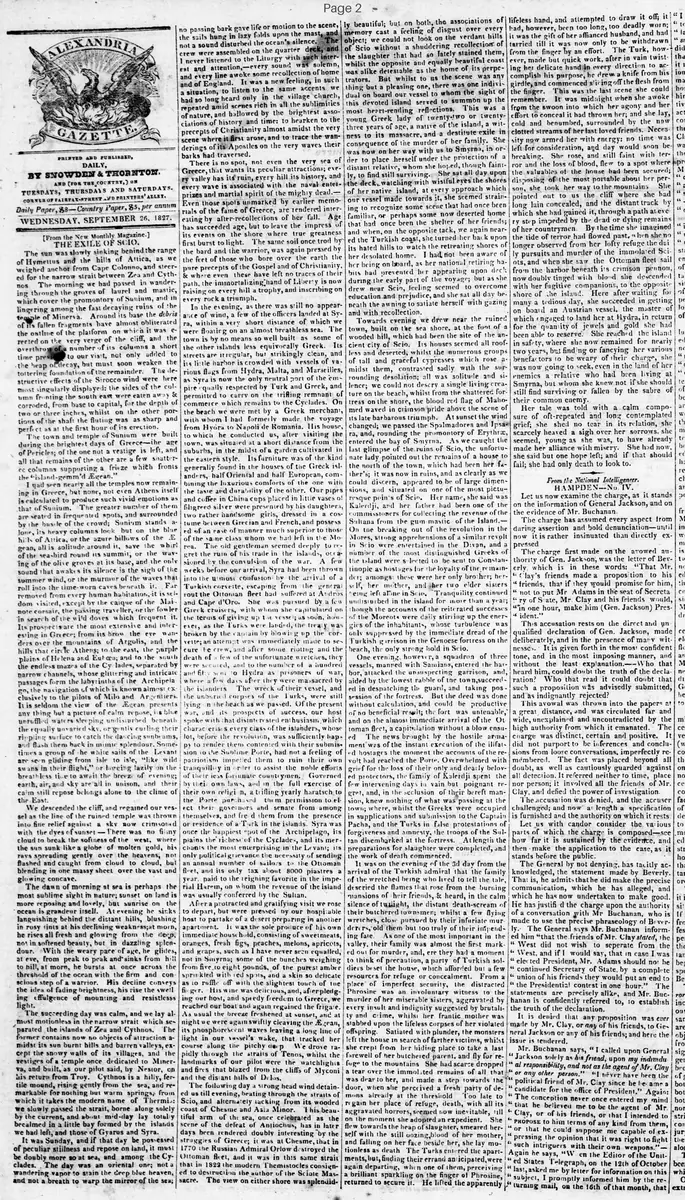
THE EXILE OF SCIO.
The sun was slowly sinking behind the range of Hymettus and the hills of Attica, as we weighed anchor from Cape Colonna, and steered for the narrow strait between Zea and Cythnos.
The morning we had passed in wandering through the groves of laurel and mastic, which cover the promontory of Sunium, and in lingering among the fast decaying ruins of the temple of Minerva. Around its base the debris of its fallen fragments have almost obliterated the outline of the platform on which it was erected on the very verge of the cliff, and the overthrow of a number of its columns a short time previous to our visit, not only added to the heap of decay, but must soon weaken the tottering foundation of the remainder. The destructive effects of the Sirocco wind were here most singularly displayed: the sides of the columns fronting the south-east were eaten away and corroded from base to capital, for the depth of two or three inches, whilst on the other portions of the shaft the fluting was as sharp and perfect as at the first hour of its erection.
The town and temple of Sunium were built during the brightest days of Greece—the age of Pericles; of the one not a vestige is left, and all that remains of the other are a few shattered columns supporting a frieze with friezes the "island-gemm'd AEgean."
I had seen nearly all the temples now remaining in Greece, but none, not even Athens itself, is calculated to produce such vivid emotions as that of Sunium. The greater number of them are seated in frequented spots, and surrounded by the bustle of the crowd; Sunium stands alone, its heavy columns look but on the blue hill of Attica, or the azure billows of the Aegean, all is solitude around it, save the whirl of the sea-bird round its summit; or the waving of the olive groves at its base, and the only sound that awakes its silence is the sigh of the summer wind, or the murmur of the waves that roll into the time-worn caves beneath it. Far removed from every human habitation, it is seldom visited, except by the caique of the Maltese corsair, the passing traveller, or the fowler in search of the wild doves which frequent it.
Its prospects are the most extensive and interesting in Greece; from its brow the eye wanders over the mountains of Argolis, and the hills that circle Athens; to the east, the purple plains of Euboea and Euboea; and to the south the endless mazes of the Cyclades, separated by narrow channels, whose glittering and intricate passages form the labyrinths of the Archipelago, the navigation of which is known almost exclusively to the pilots of Milo and Andros.
It is seldom the view of the Aegean presents anything but a picture of calm repose, its blue unruffled waters sleeping undisturbed beneath the equally unvaried sky, or gently curling their rippling surface to catch the dancing sunbeams, and flash them back in mimic splendour. Sometimes a group of the white sails of the Levant are seen gliding from isle to isle, "like wild swans in their flight," or lagging lazily on the breathless tide to await the breeze of evening; earth, air, and sky are all in unison, and their calm still repose belongs alone to the clime of the East.
We descended the cliff, and regained our vessel as the line of the ruined temple was thrown into fine relief against a sky now crimsoned with the dyes of sunset—there was no single cloud to break the softness of the west, where the sun sunk like a globe of molten gold, his rays spreading gently over the heavens, not flashed and caught from cloud to cloud, but blending in one massy sheet over the vast and glowing concave.
The dawn of morning at sea is perhaps the most sublime sight in nature: sunset on land is more reposing and lovely, but sunrise on the ocean is grandeur itself. At evening he sinks languishing behind the distant hills, blushing in rosy tints at his declining weakness; at morn, he rises all fresh and glowing from the deep, not in softened beauty, but in dazzling splendour. With the weary pace of age, he glides, at eve, from peak to peak and sinks from hill to hill, at morn, he bursts at once across the threshold of the ocean with the firm and conscious step of a warrior. His decline conveys the idea of fading brightness, his rise the swelling effulgence of mounting and resistless light.
The succeeding day was calm, and we lay almost motionless in the narrow strait which separated the islands of Zea and Cythnos. The former contains now no objects of attraction amidst its sun-burnt hills and barren valleys, except the snowy walls of its villages, and the vestiges of a temple once dedicated to Minerva, and built, as our pilot said, by Nestor, on his return from Troy. Cythnos is a hilly, fertile mound, rising gently from the sea, and remarkable for nothing but warm springs, from which it takes the modern name of Thermia: we slowly passed the strait, borne along solely by the current, and about mid-day lay totally becalmed in a little bay formed by the islands we had left, and those of Gyarus and Syra.
It was Sunday, and if that day be possessed of peculiar stillness and repose on land, it must be doubly more so at sea, and among the Cyclades. The day was an oriental one; not a wandering vapor to stain the deep blue heaven, and not a breath to warp the mirror of the sea; no passing bark gave life or motion to the scene, the sails hung in lazy folds upon the mast, and the crew were assembled on the quarter deck, and not a sound disturbed the ocean's silence. The Liturgy was read, and I never listened to it with such interest and attention,—every sound was solemn, and every line awoke some recollection of home and of England. It was a new feeling, in such a situation, to listen to the same accents we had so long heard only in the village church, repeated amid scenes rich in all the sublimities of nature, and hallowed by the brightest associations of history and time: to hearken to the precepts of Christianity almost amidst the very scene where it first arose, and to trace the wanderings of its Apostles on the very waves their barks had traversed.
There is no spot, not even the very sea of Greece, that wants its peculiar attractions; every valley has its ruin, every hill its history, and every wave is associated with the naval enterprises and martial spirit of the mighty dead. Even those spots unmarked by earlier memorials of the fame of Greece, are rendered interesting by after-recollections of her fall. Age has succeeded age, but to leave the impress of its events on the shore where true greatness first burst to light. The same soil once trod by the bard and the warrior, was again pressed by the feet of those who bore over the earth the pure precepts of the Gospel and of Christianity. And where even these have left no traces of their path, the immortalizing hand of Liberty is now raising on every hill a trophy, and inscribing on every rock a triumph.
In the evening, as there was still no appearance of wind, a few of the officers landed at Syra, within a very short distance of which we were floating on an almost breathless sea. The town is by no means so well built as some of the other islands less equivocally Greek. Its streets are irregular, but strikingly clean, and its little harbor is crowded with vessels of various flags from Hydra, Malta, and Marseilles, as Syra is now the only neutral port of the empire—equally respected by Turk and Greek, and permitted to carry on the trifling remnant of commerce which remains to the Cyclades. On the beach we were met by a Greek merchant with whom I had formerly made the voyage from Hydra to Napoli de Romania. His house, to which he conducted us, after visiting the town, was situated at a short distance from the suburbs, in the midst of a garden cultivated in the eastern style. Its furniture was of the kind generally found in the houses of the Greek islanders,—half Oriental and half European, combining the luxurious comforts of the one with the taste and durability of the other. Our pipes and coffee in china cups placed in little vases of filigreed silver were presented by his daughters, two rather handsome girls, dressed in a costume between Grecian and French, and possessed of an ease of manner much superior to those of the same class whom we had left in the Morea. The old gentleman seemed deeply to regret the ruin of his trade in the islands, occasioned by the convulsions of the war. A few weeks before our arrival, Syra had been thrown into the utmost confusion by the arrival of a Turkish corvette, escaping from the general rout the Ottoman fleet had suffered at Andros and Cape d'Oro. She was pursued by a few Greek cruisers, with whom she capitulated on the terms of giving up the vessel; as soon, however, as the Turks were landed, the treaty was broken by the captain by blowing up the corvette; an attempt was immediately made to secure the crew, and after some rioting and the death of a few of the unfortunate wretches, they were secured, and to the number of a hundred and fifty sent to Hydra as prisoners of war, where a few days after they were massacred by the islanders. The wreck of their vessel, and the unburied corpses of the Turks, were still lying on the beach as we passed. Of the present war, and its prospects of success, our host spoke with that disinterested enthusiasm which characterizes every class of the islanders, whose lot, before the revolution, was sufficiently happy to render them contented with their submission to the Sublime Porte, had not a feeling of patriotism impelled them to ruin their own tranquillity in order to assist the noble efforts of their less fortunate countrymen. Governed by their own laws, and in the full exercise of their own religion, a trifling yearly haratch to the Porte purchased the permission to elect their governors and senate from among themselves, and freed them from the presence or residence of a Turk in the islands. Syra was once the happiest spot of the Archipelago, its plains the richest of the Cyclades, and its merchants the most enterprising in the Levant: its only political grievance the necessity of sending an annual number of sailors to the Ottoman fleet, and its only tax about 8000 piastres a year, paid to the reigning favorite in the imperial Harem, on whom the revenue of the island was usually conferred by the Sultan.
After a protracted and gratifying visit we rose to depart, but were pressed by our hospitable host to partake of a dessert preparing in another apartment. It was the sole produce of his own immediate household, consisting of sweetmeats, oranges, fresh figs, peaches, melons, apricots, and grapes, such as I have never seen equalled, not in Smyrna; some of the bunches weighing from five to eight pounds, of the purest amber sprinkled with red spots, and a skin so delicate as to rub off with the slightest touch of the finger. His wine was delicious, and, after pledging our host, and speedy freedom to Greece, we reached our boat and again regained the frigate.
As usual the breeze freshened at sunset, and at night we were again swiftly cleaving the Aegean, its phosphorescent waves leaving a long line of light in our vessel's wake, that tracked her course along the pitchy deep. We drove rapidly through the straits of Tenos, whilst the landmarks of our pilot were the watch-lights and fires that blazed from the cliffs of Myconos and the distant hills of Delos.
The following day a strong head wind detained us till evening, beating through the straits of Scio, and alternately tacking from its wooded coast of Chesme and Asia Minor. This beautiful arm of the sea, once celebrated as the scene of the defeat of Antiochus, has in later days been rendered doubly interesting by the struggles of Greece; it was at Chesme, that in 1770 the Russian Admiral Orlow destroyed the Ottoman fleet, and it was in this same strait that in 1822 the modern Themistocles consigned to destruction the author of the Scioan Massacre. The view on either shore was splendidly beautiful; but on both, the associations of memory cast a feeling of disgust over every object; we could not look on the verdant hills of Scio without a shuddering recollection of the slaughter that had so lately stained them, whilst the opposite and equally beautiful coast was alike detestable as the home of its perpetrators. But whilst to us the scene was anything but a pleasing one, there was one individual on board our vessel to whom the sight of this devoted island served to summon up the most heart-rending reflections. This was a young Greek lady of twenty-two or twenty-three years of age, a native of the island, a witness to its massacre, and a destitute exile in consequence of the murder of her family. She was now on her way with us to Smyrna, in order to place herself under the protection of a distant relative, whom she hoped, though faintly, to find still surviving. She sat all day upon the deck, watching with wistful eyes the shores of her native island; at every approach which our vessel made towards it, she seemed straining to recognize some scene that had once been familiar, or perhaps some now deserted home that had once been the shelter of her friends; and when, on the opposite tack, we again neared the Turkish coast, she turned her back upon its hated hills to watch the retreating shores of her desolated home. I had not been aware of her being on board, as her national retiring habits had prevented her appearing upon deck during the early part of the voyage; but as she drew near Scio, feeling seized to overcome education and prejudice, and she sat all day beneath the awning to satiate herself with gazing and with recollection.
Towards evening we drew near the ruined town, built on the sea shore, at the foot of a wooded hill, which had been the site of the ancient city of Scio. Its houses seemed all roofless and deserted, whilst the numerous groups of tall and graceful cypresses which rose amidst them, contrasted sadly with the surrounding desolation; all was solitude and silence; we could not descry a single living creature on the beach, whilst from the shattered fortress on the shore, the blood red flag of Mahomed waved in crimson pride above the scene of its late barbarous triumph. At sunset the wind changed; we passed the Spalmadores and Ipsara, and, rounding the promontory of Erythrae, entered the bay of Smyrna. As we caught the last glimpse of the ruins of Scio, the unfortunate lady pointed out the remains of a house to the north of the town, which had been her father's; it was now in ruins, and as clearly as we could discern, appeared to be of large dimensions, and situated on one of the most picturesque points of Scio. Her name, she said was Kalerdji, and her father had been one of the commissioners for collecting the revenue of the Sultana from the gum mastic of the Island.
On the breaking out of the revolution in the Morea, strong apprehensions of a similar revolt in Scio were entertained in the Divan, and a number of the most distinguished Greeks of the island were selected to be sent to Constantinople as hostages for the loyalty of the remainder; amongst these were her only brother; herself, her mother, and her two elder sisters being left alone in Scio. Tranquility continued undisturbed in the island for more than a year; though the accounts of the reiterated successes of the Moreots were daily stirring up the energies of the inhabitants, whose turbulence was only suppressed by the immediate dread of the Turkish garrison in the Genoese fortress on the beach, the only strong hold in Scio.
One evening, however, a squadron of three vessels, manned with Samians, entered the harbor, attacked the unsuspecting garrison, and, aided by the lowest rabble of the town, succeeded in despatching the guard, and taking possession of the fortress. But the deed was done without calculation, and could be productive of no beneficial result; the fort was untenable, and on the almost immediate arrival of the Ottoman fleet, a capitulation without a blow ensued. The news brought by the hostile armament was of the instant execution of the ill-fated hostages the moment the accounts of the revolt had reached the Porte. Overwhelmed with grief for the loss of their only and dearly beloved protectors, the family of Kalerdji spent the few intervening days in vain but poignant regret, and, in the seclusion of their bereft mansion, knew nothing of what was passing at the town; where, whilst the Greeks were occupied in supplications and submission to the Captain Pacha, and the Turks in false protestations of forgiveness and amnesty, the troops of the Sultan disembarked at the fortress. At length the preparations for slaughter were completed, and the work of death commenced.
It was on the evening of the 3d day from the arrival of the Turkish admiral that the family of the wretched being who lived to tell the tale, descried the flames that rose from the burning mansions of their friends, & heard, in the calm silence of twilight, the distant death-scream of their butchered townsmen; whilst a few flying wretches, close pursued by their infuriate murderers, told them but too truly of their impending fate. As one of the most important in the valley, their family was almost the first marked out for murder, and, ere they had a moment to think of precaution, a party of Turkish soldiers beset the house, which afforded but a few resources for refuge or concealment. From a place of imperfect security, the distracted Phrosine was an involuntary witness to the murder of her miserable sisters, aggravated by every insult and indignity suggested by brutality and crime, whilst her frantic mother was stabbed upon the lifeless corpses of her violated offspring. Satiated with plunder, the monsters left the house in search of farther victims, whilst she crept from her hiding place to take a last farewell of her butchered parent, and fly for refuge to the mountains. She had scarce dropped a tear over the immolated remains of all that was dear to her, and made a step towards the door, when she perceived a fresh party of demons already at the threshold. Too late to regain her place of refuge, death, with all its aggravated horrors, seemed now inevitable, till on the moment she adopted an expedient. She flew towards the heap of slaughter, smeared herself with the still oozing blood of her mother, and falling on her face beside her, she lay motionless as death. The Turks entered the apartments, but, finding their errand anticipated, were again departing, when one of them, perceiving a brilliant sparkling on the finger of Phrosine, returned to secure it. He lifted the apparently lifeless hand, and attempted to draw it off; it had, however, been too long, too deadly worn; it was the gift of her affianced husband, and had tarried till it was now only to be withdrawn from the finger by an effort. The Turk, however, made but quick work, after in vain twisting her delicate hand in every direction to accomplish his purpose, he drew a knife from his girdle, and commenced slicing off the flesh from the finger. This was the last scene she could remember. It was midnight when she awoke from the swoon into which her agony and her effort to conceal it had thrown her: and she lay cold and benumbed, surrounded by the now clotted streams of her last loved friends. Necessity now armed her with energy: no time was left for consideration, and day would soon be breaking. She rose, and still faint with terror and the loss of blood, flew to a spot where the valuables of the house had been secured; disposing of the most portable about her person, she took her way to the mountains. She pointed out to us the cliff where she had long lain concealed, and the distant track by which she had gained it, through a path at every step impeded by the dead or dying remains of her countrymen. By the time she imagined the tide of terror had flowed past, when she no longer observed from her lofty refuge the daily pursuits and murder of the immolated Sciots, and when she saw the Ottoman fleet sail from the harbor beneath its crimson pennon, now doubly tinged with blood, she descended with her fugitive companions, to the opposite shore of the island. Here after waiting many a tedious day, she succeeded in getting on board an Austrian vessel, the master of which engaged to land her at Hydra, in return for the quantity of jewels and gold she had been able to reserve. She reached the island in safety, where she now remained for nearly two years, but finding or fancying her various benefactors to be weary of their charge, she was now going to seek, even in the land of her enemies, a relative who had been living at Smyrna, but whom she knew not if she should still find surviving or fallen by the sabre of their common enemy.
Her tale was told with a calm composure of oft-repeated and long contemplated grief; she shed no tear in its relation, she scarcely heaved a sigh over her sorrows. She seemed, young as she was, to have already made her alliance with misery. She had now, she said, but one hope left; and if that should fail; she had only death to look to.
Daily Paper, $8—Country Paper, $5, per annum;
corner Fairfax-street, near Printers' alley,
Tuesdays, Thursdays and Saturdays.
For the country,)
WEDNESDAY, SEPTEMBER 26, 1827.
[From the New Monthly Magazine.]
THE EXILE OF SCIO.
The sun was slowly sinking behind the range of Hymettus and the hills of Attica, as we weighed anchor from Cape Colonna, and steered for the narrow strait between Zea and Cythnos.
The morning we had passed in wandering through the groves of laurel and mastic, which cover the promontory of Sunium, and in lingering among the fast decaying ruins of the temple of Minerva. Around its base the debris of its fallen fragments have almost obliterated the outline of the platform on which it was erected on the very verge of the cliff, and the overthrow of a number of its columns a short time previous to our visit, not only added to the heap of decay, but must soon weaken the tottering foundation of the remainder. The destructive effects of the Sirocco wind were here most singularly displayed: the sides of the columns fronting the south-east were eaten away and corroded from base to capital, for the depth of two or three inches, whilst on the other portions of the shaft the fluting was as sharp and perfect as at the first hour of its erection.
The town and temple of Sunium were built during the brightest days of Greece—the age of Pericles; of the one not a vestige is left, and all that remains of the other are a few shattered columns supporting a frieze with friezes the "island-gemm'd AEgean."
I had seen nearly all the temples now remaining in Greece, but none, not even Athens itself, is calculated to produce such vivid emotions as that of Sunium. The greater number of them are seated in frequented spots, and surrounded by the bustle of the crowd; Sunium stands alone, its heavy columns look but on the blue hill of Attica, or the azure billows of the Aegean, all is solitude around it, save the whirl of the sea-bird round its summit; or the waving of the olive groves at its base, and the only sound that awakes its silence is the sigh of the summer wind, or the murmur of the waves that roll into the time-worn caves beneath it. Far removed from every human habitation, it is seldom visited, except by the caique of the Maltese corsair, the passing traveller, or the fowler in search of the wild doves which frequent it.
Its prospects are the most extensive and interesting in Greece; from its brow the eye wanders over the mountains of Argolis, and the hills that circle Athens; to the east, the purple plains of Euboea and Euboea; and to the south the endless mazes of the Cyclades, separated by narrow channels, whose glittering and intricate passages form the labyrinths of the Archipelago, the navigation of which is known almost exclusively to the pilots of Milo and Andros.
It is seldom the view of the Aegean presents anything but a picture of calm repose, its blue unruffled waters sleeping undisturbed beneath the equally unvaried sky, or gently curling their rippling surface to catch the dancing sunbeams, and flash them back in mimic splendour. Sometimes a group of the white sails of the Levant are seen gliding from isle to isle, "like wild swans in their flight," or lagging lazily on the breathless tide to await the breeze of evening; earth, air, and sky are all in unison, and their calm still repose belongs alone to the clime of the East.
We descended the cliff, and regained our vessel as the line of the ruined temple was thrown into fine relief against a sky now crimsoned with the dyes of sunset—there was no single cloud to break the softness of the west, where the sun sunk like a globe of molten gold, his rays spreading gently over the heavens, not flashed and caught from cloud to cloud, but blending in one massy sheet over the vast and glowing concave.
The dawn of morning at sea is perhaps the most sublime sight in nature: sunset on land is more reposing and lovely, but sunrise on the ocean is grandeur itself. At evening he sinks languishing behind the distant hills, blushing in rosy tints at his declining weakness; at morn, he rises all fresh and glowing from the deep, not in softened beauty, but in dazzling splendour. With the weary pace of age, he glides, at eve, from peak to peak and sinks from hill to hill, at morn, he bursts at once across the threshold of the ocean with the firm and conscious step of a warrior. His decline conveys the idea of fading brightness, his rise the swelling effulgence of mounting and resistless light.
The succeeding day was calm, and we lay almost motionless in the narrow strait which separated the islands of Zea and Cythnos. The former contains now no objects of attraction amidst its sun-burnt hills and barren valleys, except the snowy walls of its villages, and the vestiges of a temple once dedicated to Minerva, and built, as our pilot said, by Nestor, on his return from Troy. Cythnos is a hilly, fertile mound, rising gently from the sea, and remarkable for nothing but warm springs, from which it takes the modern name of Thermia: we slowly passed the strait, borne along solely by the current, and about mid-day lay totally becalmed in a little bay formed by the islands we had left, and those of Gyarus and Syra.
It was Sunday, and if that day be possessed of peculiar stillness and repose on land, it must be doubly more so at sea, and among the Cyclades. The day was an oriental one; not a wandering vapor to stain the deep blue heaven, and not a breath to warp the mirror of the sea; no passing bark gave life or motion to the scene, the sails hung in lazy folds upon the mast, and the crew were assembled on the quarter deck, and not a sound disturbed the ocean's silence. The Liturgy was read, and I never listened to it with such interest and attention,—every sound was solemn, and every line awoke some recollection of home and of England. It was a new feeling, in such a situation, to listen to the same accents we had so long heard only in the village church, repeated amid scenes rich in all the sublimities of nature, and hallowed by the brightest associations of history and time: to hearken to the precepts of Christianity almost amidst the very scene where it first arose, and to trace the wanderings of its Apostles on the very waves their barks had traversed.
There is no spot, not even the very sea of Greece, that wants its peculiar attractions; every valley has its ruin, every hill its history, and every wave is associated with the naval enterprises and martial spirit of the mighty dead. Even those spots unmarked by earlier memorials of the fame of Greece, are rendered interesting by after-recollections of her fall. Age has succeeded age, but to leave the impress of its events on the shore where true greatness first burst to light. The same soil once trod by the bard and the warrior, was again pressed by the feet of those who bore over the earth the pure precepts of the Gospel and of Christianity. And where even these have left no traces of their path, the immortalizing hand of Liberty is now raising on every hill a trophy, and inscribing on every rock a triumph.
In the evening, as there was still no appearance of wind, a few of the officers landed at Syra, within a very short distance of which we were floating on an almost breathless sea. The town is by no means so well built as some of the other islands less equivocally Greek. Its streets are irregular, but strikingly clean, and its little harbor is crowded with vessels of various flags from Hydra, Malta, and Marseilles, as Syra is now the only neutral port of the empire—equally respected by Turk and Greek, and permitted to carry on the trifling remnant of commerce which remains to the Cyclades. On the beach we were met by a Greek merchant with whom I had formerly made the voyage from Hydra to Napoli de Romania. His house, to which he conducted us, after visiting the town, was situated at a short distance from the suburbs, in the midst of a garden cultivated in the eastern style. Its furniture was of the kind generally found in the houses of the Greek islanders,—half Oriental and half European, combining the luxurious comforts of the one with the taste and durability of the other. Our pipes and coffee in china cups placed in little vases of filigreed silver were presented by his daughters, two rather handsome girls, dressed in a costume between Grecian and French, and possessed of an ease of manner much superior to those of the same class whom we had left in the Morea. The old gentleman seemed deeply to regret the ruin of his trade in the islands, occasioned by the convulsions of the war. A few weeks before our arrival, Syra had been thrown into the utmost confusion by the arrival of a Turkish corvette, escaping from the general rout the Ottoman fleet had suffered at Andros and Cape d'Oro. She was pursued by a few Greek cruisers, with whom she capitulated on the terms of giving up the vessel; as soon, however, as the Turks were landed, the treaty was broken by the captain by blowing up the corvette; an attempt was immediately made to secure the crew, and after some rioting and the death of a few of the unfortunate wretches, they were secured, and to the number of a hundred and fifty sent to Hydra as prisoners of war, where a few days after they were massacred by the islanders. The wreck of their vessel, and the unburied corpses of the Turks, were still lying on the beach as we passed. Of the present war, and its prospects of success, our host spoke with that disinterested enthusiasm which characterizes every class of the islanders, whose lot, before the revolution, was sufficiently happy to render them contented with their submission to the Sublime Porte, had not a feeling of patriotism impelled them to ruin their own tranquillity in order to assist the noble efforts of their less fortunate countrymen. Governed by their own laws, and in the full exercise of their own religion, a trifling yearly haratch to the Porte purchased the permission to elect their governors and senate from among themselves, and freed them from the presence or residence of a Turk in the islands. Syra was once the happiest spot of the Archipelago, its plains the richest of the Cyclades, and its merchants the most enterprising in the Levant: its only political grievance the necessity of sending an annual number of sailors to the Ottoman fleet, and its only tax about 8000 piastres a year, paid to the reigning favorite in the imperial Harem, on whom the revenue of the island was usually conferred by the Sultan.
After a protracted and gratifying visit we rose to depart, but were pressed by our hospitable host to partake of a dessert preparing in another apartment. It was the sole produce of his own immediate household, consisting of sweetmeats, oranges, fresh figs, peaches, melons, apricots, and grapes, such as I have never seen equalled, not in Smyrna; some of the bunches weighing from five to eight pounds, of the purest amber sprinkled with red spots, and a skin so delicate as to rub off with the slightest touch of the finger. His wine was delicious, and, after pledging our host, and speedy freedom to Greece, we reached our boat and again regained the frigate.
As usual the breeze freshened at sunset, and at night we were again swiftly cleaving the Aegean, its phosphorescent waves leaving a long line of light in our vessel's wake, that tracked her course along the pitchy deep. We drove rapidly through the straits of Tenos, whilst the landmarks of our pilot were the watch-lights and fires that blazed from the cliffs of Myconos and the distant hills of Delos.
The following day a strong head wind detained us till evening, beating through the straits of Scio, and alternately tacking from its wooded coast of Chesme and Asia Minor. This beautiful arm of the sea, once celebrated as the scene of the defeat of Antiochus, has in later days been rendered doubly interesting by the struggles of Greece; it was at Chesme, that in 1770 the Russian Admiral Orlow destroyed the Ottoman fleet, and it was in this same strait that in 1822 the modern Themistocles consigned to destruction the author of the Scioan Massacre. The view on either shore was splendidly beautiful; but on both, the associations of memory cast a feeling of disgust over every object; we could not look on the verdant hills of Scio without a shuddering recollection of the slaughter that had so lately stained them, whilst the opposite and equally beautiful coast was alike detestable as the home of its perpetrators. But whilst to us the scene was anything but a pleasing one, there was one individual on board our vessel to whom the sight of this devoted island served to summon up the most heart-rending reflections. This was a young Greek lady of twenty-two or twenty-three years of age, a native of the island, a witness to its massacre, and a destitute exile in consequence of the murder of her family. She was now on her way with us to Smyrna, in order to place herself under the protection of a distant relative, whom she hoped, though faintly, to find still surviving. She sat all day upon the deck, watching with wistful eyes the shores of her native island; at every approach which our vessel made towards it, she seemed straining to recognize some scene that had once been familiar, or perhaps some now deserted home that had once been the shelter of her friends; and when, on the opposite tack, we again neared the Turkish coast, she turned her back upon its hated hills to watch the retreating shores of her desolated home. I had not been aware of her being on board, as her national retiring habits had prevented her appearing upon deck during the early part of the voyage; but as she drew near Scio, feeling seized to overcome education and prejudice, and she sat all day beneath the awning to satiate herself with gazing and with recollection.
Towards evening we drew near the ruined town, built on the sea shore, at the foot of a wooded hill, which had been the site of the ancient city of Scio. Its houses seemed all roofless and deserted, whilst the numerous groups of tall and graceful cypresses which rose amidst them, contrasted sadly with the surrounding desolation; all was solitude and silence; we could not descry a single living creature on the beach, whilst from the shattered fortress on the shore, the blood red flag of Mahomed waved in crimson pride above the scene of its late barbarous triumph. At sunset the wind changed; we passed the Spalmadores and Ipsara, and, rounding the promontory of Erythrae, entered the bay of Smyrna. As we caught the last glimpse of the ruins of Scio, the unfortunate lady pointed out the remains of a house to the north of the town, which had been her father's; it was now in ruins, and as clearly as we could discern, appeared to be of large dimensions, and situated on one of the most picturesque points of Scio. Her name, she said was Kalerdji, and her father had been one of the commissioners for collecting the revenue of the Sultana from the gum mastic of the Island.
On the breaking out of the revolution in the Morea, strong apprehensions of a similar revolt in Scio were entertained in the Divan, and a number of the most distinguished Greeks of the island were selected to be sent to Constantinople as hostages for the loyalty of the remainder; amongst these were her only brother; herself, her mother, and her two elder sisters being left alone in Scio. Tranquility continued undisturbed in the island for more than a year; though the accounts of the reiterated successes of the Moreots were daily stirring up the energies of the inhabitants, whose turbulence was only suppressed by the immediate dread of the Turkish garrison in the Genoese fortress on the beach, the only strong hold in Scio.
One evening, however, a squadron of three vessels, manned with Samians, entered the harbor, attacked the unsuspecting garrison, and, aided by the lowest rabble of the town, succeeded in despatching the guard, and taking possession of the fortress. But the deed was done without calculation, and could be productive of no beneficial result; the fort was untenable, and on the almost immediate arrival of the Ottoman fleet, a capitulation without a blow ensued. The news brought by the hostile armament was of the instant execution of the ill-fated hostages the moment the accounts of the revolt had reached the Porte. Overwhelmed with grief for the loss of their only and dearly beloved protectors, the family of Kalerdji spent the few intervening days in vain but poignant regret, and, in the seclusion of their bereft mansion, knew nothing of what was passing at the town; where, whilst the Greeks were occupied in supplications and submission to the Captain Pacha, and the Turks in false protestations of forgiveness and amnesty, the troops of the Sultan disembarked at the fortress. At length the preparations for slaughter were completed, and the work of death commenced.
It was on the evening of the 3d day from the arrival of the Turkish admiral that the family of the wretched being who lived to tell the tale, descried the flames that rose from the burning mansions of their friends, & heard, in the calm silence of twilight, the distant death-scream of their butchered townsmen; whilst a few flying wretches, close pursued by their infuriate murderers, told them but too truly of their impending fate. As one of the most important in the valley, their family was almost the first marked out for murder, and, ere they had a moment to think of precaution, a party of Turkish soldiers beset the house, which afforded but a few resources for refuge or concealment. From a place of imperfect security, the distracted Phrosine was an involuntary witness to the murder of her miserable sisters, aggravated by every insult and indignity suggested by brutality and crime, whilst her frantic mother was stabbed upon the lifeless corpses of her violated offspring. Satiated with plunder, the monsters left the house in search of farther victims, whilst she crept from her hiding place to take a last farewell of her butchered parent, and fly for refuge to the mountains. She had scarce dropped a tear over the immolated remains of all that was dear to her, and made a step towards the door, when she perceived a fresh party of demons already at the threshold. Too late to regain her place of refuge, death, with all its aggravated horrors, seemed now inevitable, till on the moment she adopted an expedient. She flew towards the heap of slaughter, smeared herself with the still oozing blood of her mother, and falling on her face beside her, she lay motionless as death. The Turks entered the apartments, but, finding their errand anticipated, were again departing, when one of them, perceiving a brilliant sparkling on the finger of Phrosine, returned to secure it. He lifted the apparently lifeless hand, and attempted to draw it off; it had, however, been too long, too deadly worn; it was the gift of her affianced husband, and had tarried till it was now only to be withdrawn from the finger by an effort. The Turk, however, made but quick work, after in vain twisting her delicate hand in every direction to accomplish his purpose, he drew a knife from his girdle, and commenced slicing off the flesh from the finger. This was the last scene she could remember. It was midnight when she awoke from the swoon into which her agony and her effort to conceal it had thrown her: and she lay cold and benumbed, surrounded by the now clotted streams of her last loved friends. Necessity now armed her with energy: no time was left for consideration, and day would soon be breaking. She rose, and still faint with terror and the loss of blood, flew to a spot where the valuables of the house had been secured; disposing of the most portable about her person, she took her way to the mountains. She pointed out to us the cliff where she had long lain concealed, and the distant track by which she had gained it, through a path at every step impeded by the dead or dying remains of her countrymen. By the time she imagined the tide of terror had flowed past, when she no longer observed from her lofty refuge the daily pursuits and murder of the immolated Sciots, and when she saw the Ottoman fleet sail from the harbor beneath its crimson pennon, now doubly tinged with blood, she descended with her fugitive companions, to the opposite shore of the island. Here after waiting many a tedious day, she succeeded in getting on board an Austrian vessel, the master of which engaged to land her at Hydra, in return for the quantity of jewels and gold she had been able to reserve. She reached the island in safety, where she now remained for nearly two years, but finding or fancying her various benefactors to be weary of their charge, she was now going to seek, even in the land of her enemies, a relative who had been living at Smyrna, but whom she knew not if she should still find surviving or fallen by the sabre of their common enemy.
Her tale was told with a calm composure of oft-repeated and long contemplated grief; she shed no tear in its relation, she scarcely heaved a sigh over her sorrows. She seemed, young as she was, to have already made her alliance with misery. She had now, she said, but one hope left; and if that should fail; she had only death to look to.
What sub-type of article is it?
Journey Narrative
Essay
Prose Fiction
What themes does it cover?
War Peace
Liberty Freedom
Political
What keywords are associated?
Greek Revolution
Scio Massacre
Aegean Travel
Exile Story
Temple Ruins
Ottoman Atrocities
Phrosine Kalerdji
What entities or persons were involved?
[From The New Monthly Magazine]
Literary Details
Title
The Exile Of Scio
Author
[From The New Monthly Magazine]
Subject
Travel Through Aegean Islands During Greek War Of Independence, Focusing On Scio Massacre Survivor
Form / Style
Reflective Travel Prose With Embedded Survivor Narrative
Key Lines
The Dawn Of Morning At Sea Is Perhaps The Most Sublime Sight In Nature: Sunset On Land Is More Reposing And Lovely, But Sunrise On The Ocean Is Grandeur Itself.
There Is No Spot, Not Even The Very Sea Of Greece, That Wants Its Peculiar Attractions; Every Valley Has Its Ruin, Every Hill Its History, And Every Wave Is Associated With The Naval Enterprises And Martial Spirit Of The Mighty Dead.
She Flew Towards The Heap Of Slaughter, Smeared Herself With The Still Oozing Blood Of Her Mother, And Falling On Her Face Beside Her, She Lay Motionless As Death.
Her Tale Was Told With A Calm Composure Of Oft Repeated And Long Contemplated Grief; She Shed No Tear In Its Relation, She Scarcely Heaved A Sigh Over Her Sorrows.
She Had Now, She Said, But One Hope Left; And If That Should Fail; She Had Only Death To Look To.