Thank you for visiting SNEWPapers!
Sign up free
Virginia Advocate
Charlottesville, Virginia
What is this article about?
Historical account of American diplomats in Paris negotiating with Britain for independence during the Revolutionary War, rejecting a French-proposed truce and securing British recognition through Jay's bold letter.
Clipping
OCR Quality
Full Text
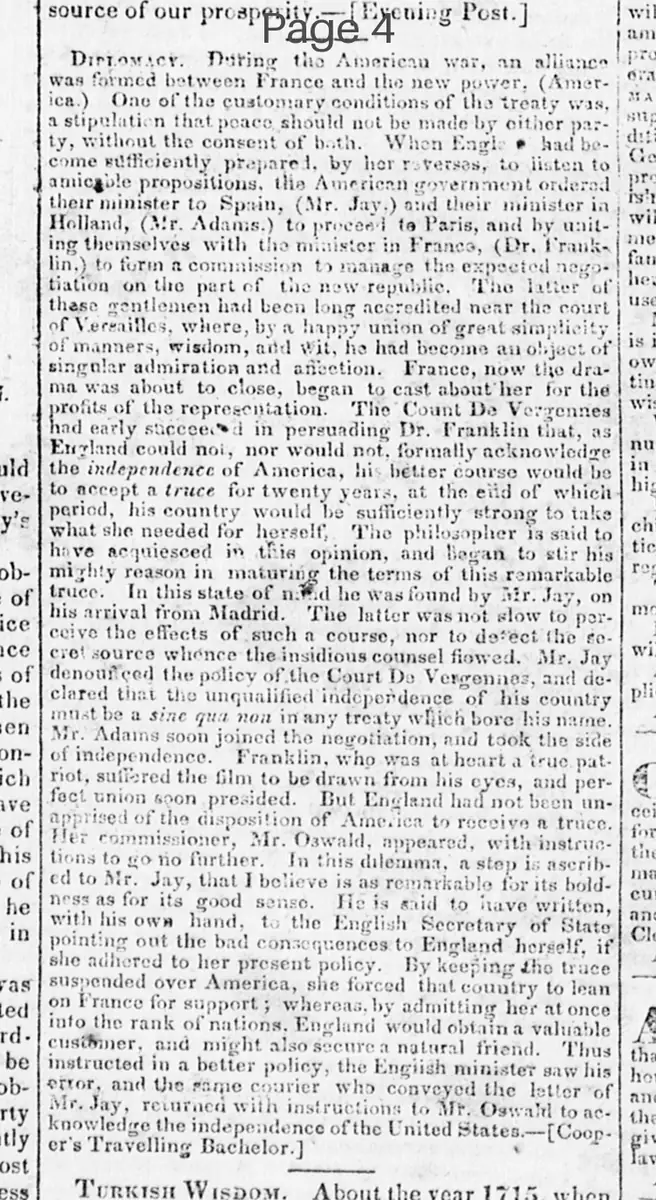
When England had become sufficiently prepared, by her reverses, to listen to amicable propositions, the American government ordered their minister to Spain, (Mr. Jay,) and their minister in Holland, (Mr. Adams,) to proceed to Paris, and by uniting themselves with the minister in France, (Dr. Franklin,) to form a commission to manage the expected negotiation on the part of the new republic.
The latter of these gentlemen had been long accredited near the court of Versailles, where, by a happy union of great simplicity of manners, wisdom, and wit, he had become an object of singular admiration and affection.
France, now the drama was about to close, began to cast about her for the profits of the representation. The Count De Vergennes had early succeeded in persuading Dr. Franklin that, as England could not, nor would not, formally acknowledge the independence of America, his better course would be to accept a truce for twenty years, at the end of which period, his country would be sufficiently strong to take what she needed for herself.
The philosopher is said to have acquiesced in this opinion, and began to stir his mighty reason in maturing the terms of this remarkable truce. In this state of mind he was found by Mr. Jay, on his arrival from Madrid.
The latter was not slow to perceive the effects of such a course, nor to detect the secret source whence the insidious counsel flowed. Mr. Jay denounced the policy of the Court De Vergennes, and declared that the unqualified independence of his country must be a sine qua non in any treaty which bore his name.
Mr. Adams soon joined the negotiation, and took the side of independence. Franklin, who was at heart a true patriot, suffered the film to be drawn from his eyes, and perfect union soon presided.
But England had not been unapprised of the disposition of America to receive a truce. Her commissioner, Mr. Oswald, appeared, with instructions to go no further.
In this dilemma, a step is ascribed to Mr. Jay, that I believe is as remarkable for its boldness as for its good sense. He is said to have written, with his own hand, to the English Secretary of State pointing out the bad consequences to England herself, if she adhered to her present policy.
By keeping the truce suspended over America, she forced that country to lean on France for support; whereas, by admitting her at once into the rank of nations, England would obtain a valuable customer, and might also secure a natural friend.
Thus instructed in a better policy, the English minister saw his error, and the same courier who conveyed the letter of Mr. Jay, returned with instructions to Mr. Oswald to acknowledge the independence of the United States.—[Cooper's Travelling Bachelor.]
What sub-type of article is it?
What keywords are associated?
What entities or persons were involved?
Where did it happen?
Domestic News Details
Primary Location
Paris
Event Date
During The American War
Key Persons
Outcome
england acknowledged the independence of the united states
Event Details
During the American war, an alliance formed between France and America with a treaty condition that peace required consent of both. American ministers Mr. Jay from Spain, Mr. Adams from Holland, and Dr. Franklin in France formed a commission in Paris for negotiations. France suggested a 20-year truce to Dr. Franklin, but Mr. Jay and Mr. Adams advocated for unqualified independence. Mr. Jay wrote to the English Secretary of State arguing for recognition of American independence, leading to instructions for Mr. Oswald to acknowledge it.