Thank you for visiting SNEWPapers!
Sign up free
The Hillsborough Recorder
Hillsboro, Orange County, North Carolina
What is this article about?
Account of the April 19, 1775, events at Lexington and Concord, marking the start of the Revolutionary War. British troops under Gage marched to seize arms, clashed with militia, suffered casualties, and retreated amid American resistance led by figures like Revere and Hancock.
Clipping
OCR Quality
Full Text
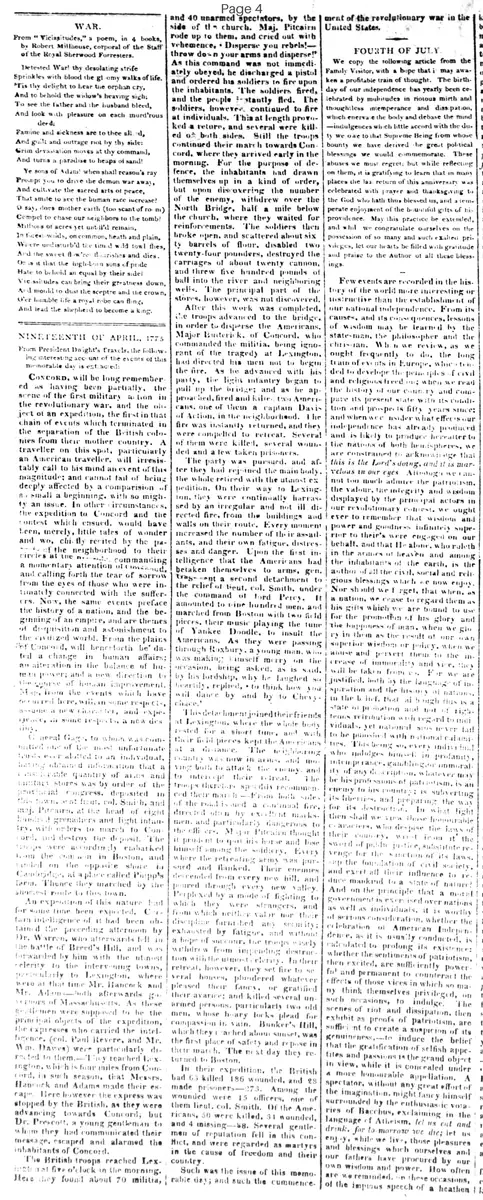
From President Dwight's Travels, the following interesting account of the events of this
memorable day is extracted:
Concord, will be long remembered
as having been partially the
scene of the first military action in
the revolutionary war. and the ob-
ject of an expedition, the first in that
chain of events which terminated in
the separation of the British colo-
nies from their mother country. A
traveller on this spot, particularly
an American traveller. will irresist-
ibly call to his mind an event of this
magnitude; and cannot fail of being
deeply affected by a comparison of
such a beginning. with so mighty
an issue. In other circumstances.
the expedition to Concord and the
contest which ensued. would have
been, merely, little tales of wonder
and woe. chiefly recited by the pa-
rents the neighbourhood to their
children at one time. commanding
a momentary attention commanded.
and calling forth the tear of sorrow
from the eyes of those who were in-
timately connected with: the suffer-
ers, Now. the same events preface
the history of a nation, and the be-
ginning of an empire, and are themes
of admiration and astonishment to
the civilized world. From the plains
of Concord, will henceforth be' da-
ted a change in human affairs:
an alteration in the balance of hu-
men power; and a new direction to
the current of human improvement.
Nigh. from the events which have
occurred here, will, in some respec-
tacles, and expe-
rience, a new des-
tin:.
(General Gage', to whom was con-
mitted our most unfortunate
country, for almost two years to an individual.
Gage obtained information that a
considerable quantity of arms and
military stores was by order of the
provincial congress. deposited in
this town, sent his aid, col. Smith, and
maj. Pitcairn, at the head of eight
hundred grenadiers and light infan-
try, with orders to march to Con-
cord. and destroy the deposit. The
troops were accordingly embarked
from the Common in Boston, and
landed on the opposite shore in.
Cambridge, at a place called Pipe's
farm. Thence they marched by the
shortest route to this town.
An expedition of this nature had
for some time been expected. C-
apt. intelligence of it had been ob-
tained the preceding afternoon by
Dr. Warren, who afterwards fell in
the battle of Breed's Hill. and was
forwarded by him with the utmost
celerity to the interjacent towns,
particularly to Lexington, where
were at that time Mr. Hancock and
Mr. Adams—afterwards go-
vernors of Massachusetts. As these
gentlemen were supposed to be the
principal objects of the expedition.
the expresses also carried the intel-
ligence. (col. Paul Revere, and Mr.
Wm. Dawes) were particularly di-
rected to them.-In I reached Lex-
ington, which is four miles from Con-
cord, in such season, that Messrs.
Hancock and Adams made their es-
cape. Here however the express was
stopped by the British, as they were
advancing towards Concord; but
Dr. Prescott. a young gentleman to
whom they had communicated their
message, escaped and alarmed the
inhabitants of Concord.
The British troops reached Lex-
ington at five o'clock in the morning:
Here they found about 70 militia,
and 40 unarmed spectators, by the
side of the church. Maj. Pitcairn
rode up to them, and cried out with
vehemence, 'Disperse you rebels!—
throw down your arms and dispersr!'
As this command was not immedi-
ately obeyed, he discharged a pistol
and ordered his soldiers to fire upon
the inhabitants. The soldiers fired,
and the people instantly fled. The
soldiers, however. continued to fire
at individuals. This at length provo-
ked a return, and several were kill-
ed on both sides. Still the troops
continued their march towards Con-
cord, where they arrived early in the
morning. For the purpose of de-
fence, the inhabitants had drawn
themselves up in a kind of order,
but upon discovering the number
of the enemy, withdrew over the
North Bridge, half a mile below
the church, where they waited for
reinforcements. The soldiers then
broke open, and scattered about six
ty barrels of flour, disabled two
twenty-four pounders, destroyed the
carriages of about twenty cannon.
and threw five hundred pounds of
ball into the river and neighboring
wells. The principal part of the
stores. however, was not discovered.
After this work was completed.
the troops advanced to the bridge.
in order to disperse the Americans.
Major Buttrick. of Concord. who
commanded the militia. being igno-
rant of the tragedy at Lexington.
had directed his men not to begin
the fire. As he advanced with his
party, the light infantry began to
pull up the bridge; and as he ap-
proached, fired and killed two Ameri-
cans. one of them a captain Davi-
of Acton, in the neighborhood. The
fire was instantly returned, and they
were compelled to retreat. Several
of them were killed, several woun-
ded and a few taken prisoners.
The party was pursued. and af-
ter they had joined the main body.
the whole retired with the utmost ex-
pedition. On their way to Lexing-
ton, they were continually haras-
sed by an irregular and not ill di-
rected fire, from the buildings and
walls on their route. Every moment
increased the number of their assail-
ants, and their own fatigue, distres-
ses and danger. Upon the first in-
telligence that the Americans had
betaken themselves to arms, gen.
Gage sent a second detachment to
the relief of lieut. col. Smith. under
the command of lord Percy. It
amounted to nine hundred men. and
marched from Boston with two field
pieces. their music playing the tune
of Yankee Doodle, to insult the
Americans. As they were passing
through Roxbury. a young man, who
was making himself merry on the
occasion. being asked. as is said.
by his lordship, why he laughed so
heartily, replied, to think how you
will dance by and by to Ches-
terfield.'
This detachment joined their friends
at Lexington. where the whole body
rested for a short time, and with
their field pieces kept the Americans
at a distance. The gathering
militia was now in motion both to attack the enemy. and
to intercept their retreat. The
troops therefore speedily recommenced
their march-From both sides.
of the road issued a continual fire.
directed with excellent marks-
men, and particularly dangerous to
the officers. Maj. Pitcairn thought
it prudent to quit his horse and lose
himself among the soldiery. Every
where the retreating army was pur-
sued and flanked. Their numbers
descended from every new hill. and
poured through every new valley.
Perplexed by a mode of fighting to
which they were strangers. and
for which neither valor nor their
discipline furnished any security:
exhausted by fatigue, and without
a hope of succour, the troops wisely
withdrew from impending destruc-
tion with the utmost celerity. In their
retreat. however. they set fire to se-
veral houses, plundered whatever
pleased their fancy. or gratified
their avarice: and killed several un-
armed persons. particularly two old
men. whose hoary locks pleaded for
compassion in vain. Bunker's Hill,
which they reached about sunset, was
the first place of safety and repose in
their march. The next day they re-
turned to Boston.
In their expedition. the British
had 63 killed 186 wounded. and 28
made prisoners—273. Among the
wounded were 15 officers, one of
them lieut. col. Smith. Of the Ame-
ricans. 50 were killed. 31 wounded.
and 4 missing—85. Several gentle-
men of reputation fell in this con-
flict, and were regarded as martyrs
in the cause of freedom and their
country.
Such was the issue of this memo-
rable day; and such the commence-
ment of the revolutionary war in the
United States.
What sub-type of article is it?
What themes does it cover?
What keywords are associated?
What entities or persons were involved?
Where did it happen?
Story Details
Key Persons
Location
Lexington And Concord, Massachusetts
Event Date
1775 04 19
Story Details
British forces under Gage marched from Boston to Concord to destroy colonial arms stores, clashing with militia at Lexington where they fired first, killing several. At Concord, they destroyed some supplies but were repelled at the North Bridge. Reinforced by Percy, they retreated to Boston under constant American fire, suffering heavy losses.