Thank you for visiting SNEWPapers!
Sign up free
Letter to Editor
May 7, 1819
Alexandria Gazette & Daily Advertiser
Alexandria, Virginia
What is this article about?
A letter to the editors extolling the transformative power of printing, which has made Bibles containing nearly a million words affordable for less than half a day's labor, contrasting with their rarity and high cost in the dark ages. It includes printing efficiency calculations and recommends reading Joel Barlow's Columbiad on the subject.
Clipping
OCR Quality
95%
Excellent
Full Text
TYPOGRAPHIC POWER.—BIBLES.
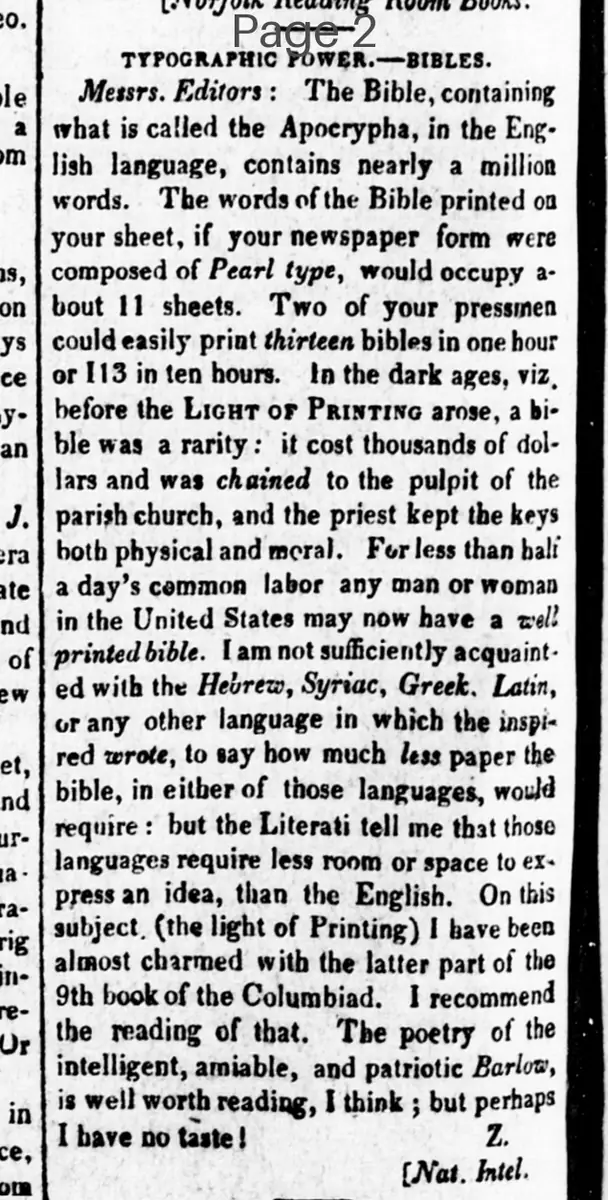
Messrs. Editors: The Bible, containing what is called the Apocrypha, in the English language, contains nearly a million words. The words of the Bible printed on your sheet, if your newspaper form were composed of Pearl type, would occupy about 11 sheets. Two of your pressmen could easily print thirteen bibles in one hour or 130 in ten hours. In the dark ages, viz. before the Light of Printing arose, a bible was a rarity: it cost thousands of dollars and was chained to the pulpit of the parish church, and the priest kept the keys both physical and moral. For less than half a day's common labor any man or woman in the United States may now have a well printed bible. I am not sufficiently acquainted with the Hebrew, Syriac, Greek, Latin, or any other language in which the inspired wrote, to say how much less paper the bible, in either of those languages, would require: but the Literati tell me that those languages require less room or space to express an idea, than the English. On this subject, (the light of Printing) I have been almost charmed with the latter part of the 9th book of the Columbiad. I recommend the reading of that. The poetry of the intelligent, amiable, and patriotic Barlow, is well worth reading, I think; but perhaps I have no taste!
Messrs. Editors: The Bible, containing what is called the Apocrypha, in the English language, contains nearly a million words. The words of the Bible printed on your sheet, if your newspaper form were composed of Pearl type, would occupy about 11 sheets. Two of your pressmen could easily print thirteen bibles in one hour or 130 in ten hours. In the dark ages, viz. before the Light of Printing arose, a bible was a rarity: it cost thousands of dollars and was chained to the pulpit of the parish church, and the priest kept the keys both physical and moral. For less than half a day's common labor any man or woman in the United States may now have a well printed bible. I am not sufficiently acquainted with the Hebrew, Syriac, Greek, Latin, or any other language in which the inspired wrote, to say how much less paper the bible, in either of those languages, would require: but the Literati tell me that those languages require less room or space to express an idea, than the English. On this subject, (the light of Printing) I have been almost charmed with the latter part of the 9th book of the Columbiad. I recommend the reading of that. The poetry of the intelligent, amiable, and patriotic Barlow, is well worth reading, I think; but perhaps I have no taste!
What sub-type of article is it?
Informative
Historical
Reflective
What themes does it cover?
Religion
Science Nature
Press Freedom
What keywords are associated?
Typographic Power
Bible Printing
Dark Ages
Printing History
Columbiad
Joel Barlow
Apocrypha
Press Efficiency
What entities or persons were involved?
Messrs. Editors
Letter to Editor Details
Recipient
Messrs. Editors
Main Argument
the invention of printing has democratized access to the bible, making it affordable and widely available compared to its rarity and expense in the dark ages before printing.
Notable Details
Bible With Apocrypha Contains Nearly A Million Words
Printing Calculation: 13 Bibles Per Hour By Two Pressmen
Bibles Chained To Pulpits In Dark Ages
References Ancient Languages Requiring Less Space
Recommends Latter Part Of 9th Book Of Columbiad By Barlow