Thank you for visiting SNEWPapers!
Sign up free
Concord Register
Concord, Merrimack County, New Hampshire
What is this article about?
Article from the New-England Farmer providing advice on hay making, including timing for cutting grass and clover, weather observation for forecasting, and storage methods to preserve quality. Discusses benefits of early haying and wind patterns indicating rain.
Merged-components note: Continuation of agricultural advice article
Clipping
OCR Quality
Full Text
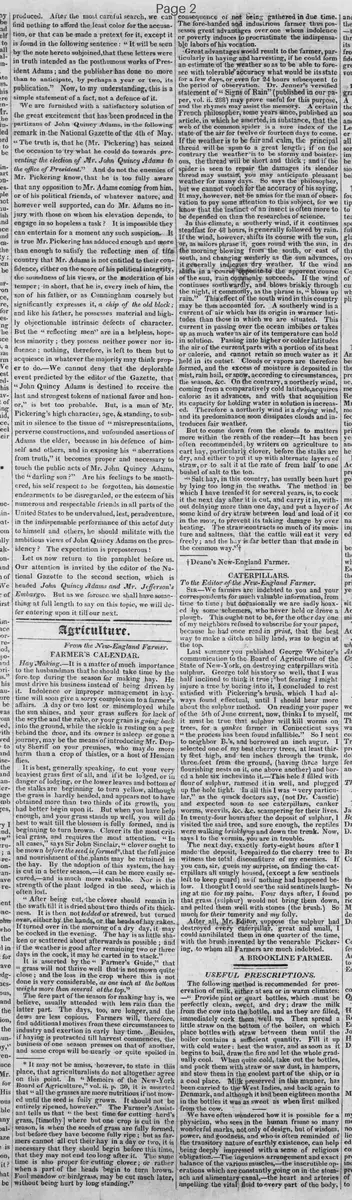
FARMER'S CALENDAR.
Hay Making.—It is a matter of much importance to the husbandman that he should take time by the forelock during the season for making hay. He must drive his business instead of being driven by it. Indolence or improper management in hay-time will soon give a sorry complexion to a farmer's affairs. A day or two lost or misemployed while the sun shines, and your grass suffers for lack of the scythe and the rake, or your grain is going back into the ground, while the sickle is rusting on a peg behind the door, and its owner is asleep or gone a journey, may be the means of introducing Mr. Deputy Sheriff on your premises, who may do more harm than a crop of thistles, or a host of Hessian flies.
It is best, generally speaking, to cut your very heaviest grass first of all, and if it be lodged, or in danger of lodging, or the lower leaves and bottom of the stalks are beginning to turn yellow, although the grass is hardly headed, and appears not to have obtained more than two thirds of its growth, you had better begin upon it. But when you have help enough, and your grass stands up well, you will do best to wait till the blossom is fully formed, and is beginning to turn brown. Clover is the most critical grass, and requires the most attention.
" In all cases," says Sir John Sinclair, "clover ought to be mown before the seed is formed, that the full juice and nourishment of the plants may be retained in the hay. By the adoption of this system, the hay is cut in a better season,—it can be more easily secured,—and is much more valuable. Nor is the strength of the plant lodged in the seed, which is often lost. " After being cut, the clover should remain in the swath till it is dried about two thirds of its thickness. It is then not tedded or strewed, but turned over, either by the hands, or the heads of hay rakes. If turned over in the morning of a dry day, it may be cocked in the evening. The hay is as little shaken or scattered about afterwards as possible ; and if the weather is good after remaining two or three days in the cock, it may be carted in to stack."
It is asserted by the " Farmer's Guide," that " grass will not thrive well that is not mown quite close; and the loss in the crop where this is not done is very considerable, as one inch at the bottom weighs more than several at the top."
The fore part of the season for making hay is, we believe, usually attended with less rain than the latter part. The days, too, are longer, and the dews are less copious. Farmers will, therefore, find additional motives from these circumstances to industry and exertion in early hay time. Besides, if haying is protracted till harvest commences, the business of one season presses on that of another, and some crops will be nearly or quite spoiled in consequence of not being gathered in due time. The fore-handed and industrious farmer thus possesses great advantages over one whom indolence or poverty induces to procrastinate the indispensable labors of his vocation.
Great advantages would result to the farmer, particularly in haying and harvesting, if he could form an estimate of the weather so as to be able to foresee with tolerable accuracy what would be its state for a few days, or even for 24 hours subsequent to the period of observation. Dr. Jenner's versified statement of " Signs of Rain" (published in our paper, vol. ii. 288) may prove useful for this purpose, and the rhymes may assist the memory.
A certain French philosopher, some years since, published an article, in which he asserted, in substance, that the web of the common spider is a sure index of the state of the air for twelve or fourteen days to come. If the weather is to be fair and calm, the principal thread will be spun to a great length; if on the contrary the weather is to be stormy and boisterous, the thread will be short and thick; and if the spider is seen to repair the damages its slender thread may sustain, you may anticipate pleasant weather for many days. So says the philosopher, but we cannot vouch for the accuracy of his saying. It may, however, not be amiss for the man of observation to pay some attention to this subject, for we know that the instinct of an insect is often more to be depended on than the researches of science.
In this climate, a southerly wind, if it continues steadfast for 48 hours, is generally followed by rain. If the wind, however, shifts its course with the sun, or, as sailors phrase it, goes round with the sun, in the morning blowing from the south, or east of south, and changing westerly as the sun advances it generally indicates dry weather. if the wind shifts in a course opposite to the apparent course of the sun, rain commonly succeeds. If the wind continues southwardly, and blows briskly through the night, it commonly, as the phrase is, " blows up rain."
This effect of the south wind in this country may be thus accounted for. A southerly wind is a current of air which has its origin in warmer latitudes than those in which we are situated. This current in passing over the ocean imbibes or takes up as much water as air of its temperature can hold in solution. Passing into higher or colder latitudes the air of the current parts with a portion of its heat or caloric, and cannot retain so much water as it held in its outset. Clouds or vapors are therefore formed, and the excess of moisture is deposited in mist, rain hail, or snow, according to circumstances, the season, &c. On the contrary, a northerly wind, coming from a comparatively cold latitude, acquires caloric as it advances, and with that acquisition its capacity for holding water in solution is increased. Therefore a northerly wind is a drying wind, and its predominance soon dissipates clouds and introduces fair weather.
But to come down from the clouds to matters more within the reach of the reader--It has been often recommended, by writers on agriculture to cart hay, particularly clover, before the stalks are dry, and either to put it up with alternate layers of straw, or to salt it at the rate of from half to one bushel of salt to the ton. Salt hay, in this country, has usually been hurt by lying too long in the swaths. The method in which I have treated it for several years, is, to cock it the next day after it is cut, and carry it in, without delaying more than one day, and put a layer of some kind of dry straw between load and load of it in the mow, to prevent its taking damage by over heating. The straw contracts so much of its moisture and saltness, that the cattle will eat it very freely; and the hay is far better than that made in the common way."*
What sub-type of article is it?
What keywords are associated?
What entities or persons were involved?
Where did it happen?
Domestic News Details
Primary Location
New England
Key Persons
Event Details
Provides detailed advice on optimal timing and methods for hay making, including cutting grass and clover before seed formation, turning and cocking the hay, mowing close to the ground, benefits of early haying, weather forecasting using wind patterns and spider webs, and storage techniques with straw layers to prevent spoilage.