Thank you for visiting SNEWPapers!
Sign up free
Navajo Times
Window Rock, Apache County, Arizona
What is this article about?
Biographical profile of Navajo Sergeant Henry Brown, highlighting his distinguished service in WWII and Korean War with the U.S. Airborne Division, including multiple combat jumps, wounds, and numerous awards, plus his post-service aspirations to study law and aid his people.
Merged-components note: Merging multiple images with the 'A Salute!' story on Henry Brown as they are likely photos related to his military service.
Clipping
OCR Quality
Full Text
Recently a friend of the NAVAJO TIMES suggested a column dedicated or devoted to members of the Navajo Tribe who served with distinction in the Armed Forces, or concerning a Navajo who is now in Service. We would like to continue with such a column. If you have a son, husband, brother, sister (women serve too, now!) who was in service, or is still in service we need the following information; name, age, date and place of birth, service entrance etc., combat, decorations, and any other information you feel would be useful in such a series. We hope to hear from lots of readers with stories of their loved ones, who deserve a Salute.
Our first candidate for this column was recommended by John Dougherty of the Tribe's Legal Department, and a better one we could not have picked.
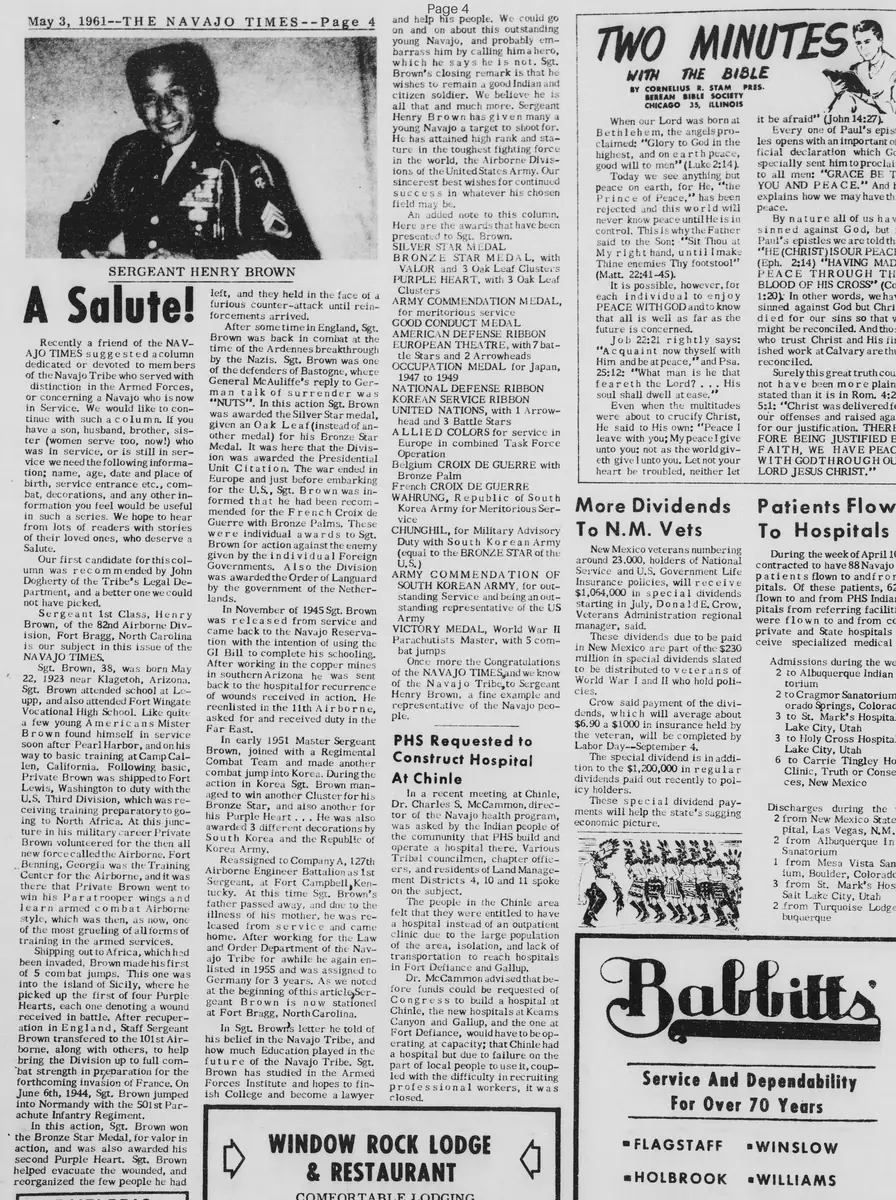
Sergeant 1st Class, Henry Brown, of the 82nd Airborne Division, Fort Bragg, North Carolina is our subject in this issue of the NAVAJO TIMES.
Sgt. Brown, 38, was born May 22, 1923 near Klagetoh, Arizona. Sgt. Brown attended school at Leupp, and also attended Fort Wingate Vocational High School. Like quite a few young Americans Mister Brown found himself in service soon after Pearl Harbor, and on his way to basic training at Camp Callan, California. Following basic, Private Brown was shipped to Fort Lewis, Washington to duty with the U.S. Third Division, which was receiving training preparatory to going to North Africa. At this juncture in his military career Private Brown volunteered for the then all new force called the Airborne. Fort Benning, Georgia was the Training Center for the Airborne, and it was there that Private Brown went to win his Paratrooper wings and learn armed combat Airborne style, which was then, as now, one of the most grueling of all forms of training in the armed services.
Shipping out to Africa, which had been invaded. Brown made his first of 5 combat jumps. This one was into the island of Sicily, where he picked up the first of four Purple Hearts, each one denoting a wound received in battle. After recuperation in England, Staff Sergeant Brown transferred to the 101st Airborne, along with others, to help bring the Division up to full combat strength in preparation for the forthcoming invasion of France. On June 6th, 1944, Sgt. Brown jumped into Normandy with the 501st Parachute Infantry Regiment.
In this action, Sgt. Brown won the Bronze Star Medal, for valor in action, and was also awarded his second Purple Heart. Sgt. Brown helped evacuate the wounded, and reorganized the few people he had left, and they held in the face of a furious counter-attack until reinforcements arrived.
After some time in England, Sgt. Brown was back in combat at the time of the Ardennes breakthrough by the Nazis. Sgt. Brown was one of the defenders of Bastogne, where General McAuliffe's reply to German talk of surrender was "NUTS". In this action Sgt. Brown was awarded the Silver Star medal, given an Oak Leaf (instead of another medal) for his Bronze Star Medal. It was here that the Division was awarded the Presidential Unit Citation. The war ended in Europe and just before embarking for the U.S., Sgt. Brown was informed that he had been recommended for the French Croix de Guerre with Bronze Palms. These were individual awards to Sgt. Brown for action against the enemy given by the individual Foreign Governments. Also the Division was awarded the Order of Orange-Nassau by the government of the Netherlands.
In November of 1945 Sgt. Brown was released from service and came back to the Navajo Reservation with the intention of using the GI Bill to complete his schooling. After working in the copper mines in southern Arizona he was sent back to the hospital for recurrence of wounds received in action. He reenlisted in the 11th Airborne, asked for and received duty in the Far East.
In early 1951 Master Sergeant Brown, joined with a Regimental Combat Team and made another combat jump into Korea. During the action in Korea Sgt. Brown managed to win another Cluster for his Bronze Star, and also another for his Purple Heart. He was also awarded 3 different decorations by South Korea and the Republic of Korea Army.
Reassigned to Company A, 127th Airborne Engineer Battalion as 1st Sergeant, at Fort Campbell Kentucky. At this time Sgt. Brown's father passed away, and due to the illness of his mother, he was released from service and came home. After working for the Law and Order Department of the Navajo Tribe for awhile he again enlisted in 1955 and was assigned to Germany for 3 years. As we noted at the beginning of this article Sergeant Brown is now stationed at Fort Bragg, North Carolina.
In Sgt. Brown's letter he told of his belief in the Navajo Tribe, and how much Education played in the future of the Navajo Tribe. Sgt. Brown has studied in the Armed Forces Institute and hopes to finish College and become a lawyer and help his people. We could go on and on about this outstanding young Navajo, and probably embarrass him by calling him a hero, which he says he is not. Sgt. Brown's closing remark is that he wishes to remain a good Indian and citizen soldier. We believe he is all that and much more. Sergeant Henry Brown has given many a young Navajo a target to shoot for. He has attained high rank and stature in the toughest fighting force in the world, the Airborne Divisions of the United States Army. Our sincerest best wishes for continued success in whatever his chosen field may be.
An added note to this column. Here are the awards that have been presented to Sgt. Brown.
SILVER STAR MEDAL
BRONZE STAR MEDAL, with VALOR and 3 Oak Leaf Clusters
PURPLE HEART, with 3 Oak Leaf Clusters
ARMY COMMENDATION MEDAL for meritorious service
GOOD CONDUCT MEDAL
AMERICAN DEFENSE RIBBON
EUROPEAN THEATRE, with 7 battle Stars and 2 Arrowheads
OCCUPATION MEDAL for Japan, 1947 to 1949
NATIONAL DEFENSE RIBBON
KOREAN SERVICE RIBBON
UNITED NATIONS, with 1 Arrowhead and 3 Battle Stars
ALLIED COLORS for service in Europe in combined Task Force Operation
Belgium CROIX DE GUERRE with Bronze Palm
French CROIX DE GUERRE
WAHRUNG, Republic of South Korea Army for Meritorious Service
CHUNGHIL, for Military Advisory Duty with South Korean Army (equal to the BRONZE STAR of the U.S.)
ARMY COMMENDATION OF SOUTH KOREAN ARMY, for Outstanding Service and being an outstanding representative of the US Army
VICTORY MEDAL. World War II
Parachutists Master, with 5 combat jumps
Once more the Congratulations of the NAVAJO TIMES and we know of the Navajo Tribe to Sergeant Henry Brown, a fine example and representative of the Navajo people.
What sub-type of article is it?
What themes does it cover?
What keywords are associated?
What entities or persons were involved?
Where did it happen?
Story Details
Key Persons
Location
Navajo Reservation, Arizona; Fort Bragg, North Carolina; Sicily; Normandy; Bastogne; Korea; Various U.S. Military Bases
Event Date
Born May 22, 1923; Service From 1942 To Present
Story Details
Henry Brown, a Navajo born in 1923, enlisted post-Pearl Harbor, trained as paratrooper, made five combat jumps in WWII (Sicily, Normandy, Bastogne) earning Silver Star, Bronze Star with clusters, four Purple Hearts, and foreign awards; served in Korea with additional jumps and awards; reenlisted multiple times, now at Fort Bragg, aspiring to law career to help Navajo people.