Thank you for visiting SNEWPapers!
Sign up free
Domestic News
August 29, 1816
Daily National Intelligencer
Washington, District Of Columbia
What is this article about?
Editorial from the Essex Register contrasts early American emigration challenges with modern advantages in navigation, knowledge, and society, promoting migration as wise and beneficial, citing historical examples like Ohio settlements post-1783.
Clipping
OCR Quality
98%
Excellent
Full Text
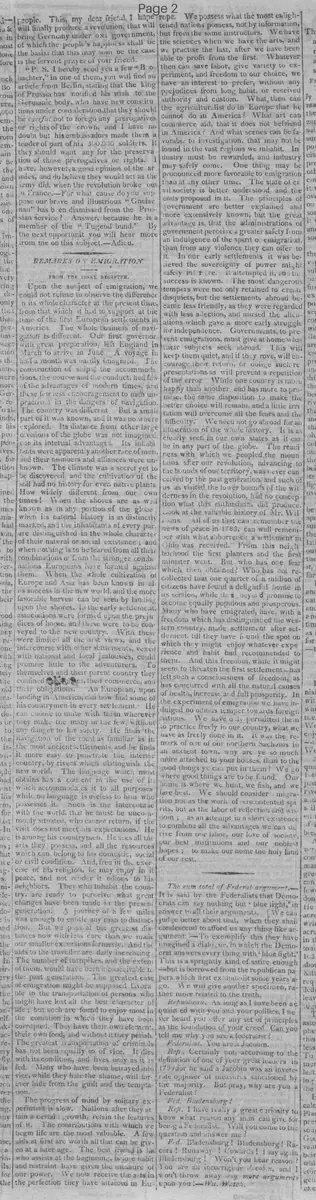
REMARKS ON EMIGRATION
FROM THE ESSEX REGISTER.
Upon the subject of emigration, we could not refuse to observe the difference in its whole character at the present time, from that which it had to support at the time of the first European settlements in America. The whole business of navigation is different. Our first governor with great preparation, left England in March to arrive in June. A voyage in half a month was badly imagined. The construction of ships, the accommodations, the course and the conduct, had few of the advantages of modern times, and these few lessened encouragement to men unpractised in the dangers of navigation.
The country was different. But a small part of it was known, and it was nowhere explored. Its distance from other large divisions of the globe was not imagined nor its internal advantages. Its inhabitants were apparently another race of men, and their numbers and alliances were unknown. The climate was a secret yet to be discovered, and the cultivation of the soil had no history for even native plants.
How widely different from our own times! When the shores are as well known as in any portion of the globe when its natural history is as distinctly marked, and the inhabitants of every part are distinguished in the whole character of their natural or social existence; and when nothing is to be feared from all their combinations or from the stronger combinations Europeans have formed against them. When the whole cultivation of Europe and Asia has been known in all its success in the new world, and the more favorable harvest can be seen by landing upon the shores. In the early settlement, associations were formed upon the prejudices of home, and these were to be conveyed to the new country. With these were limited all the best views, and the intercourse with other settlements. Vexed with national and local jealousies, could promise little to the adventurers. To themselves and their parent country they confined their hopes, their commerce, and their obligations. An European, upon landing in America, can now find some of his countrymen in every settlement. He can choose to unite with them wherever they make the many or the few, without any danger to his safety. He finds the navigation of the coast as familiar as in the most ancient settlements, and he finds it more easy to penetrate the interior country, by rivers which distinguish the new world. The language which most obtains has a convenience in the use of it, which accommodates it to all purposes while no language is useless to him who possesses it. Such is the intercourse with the world, that he must be uncommonly situated, who cannot return, if the visit does not meet his expectations. He is among his countrymen. He sees all the arts they possess, and all the resources which can belong to his domestic, social or civil condition. And, free in the exercise of his religion, he may enjoy in it peace, and not render it odious to his neighbors.
They who inhabit the country, are ready to perceive what great changes have been made in the present generation. A journey of a few miles was enough to entitle any man to distinction. But we pass at the greatest distances now with less care than we made our smaller excursions formerly. And the aids to the traveller are daily increasing. The number of turnpikes, and the extent of them, would have been inconceivable to the past generation. The greatest ease of emigration might be supposed favorable to the transportation of persons who might have lost all the best character of life; but such are found to enjoy most in the condition in which they have been corrupted. They have their own element, their own food, and without it they perish. The greatest transportation of criminals has not been equally so of vice. It dies with its condition, and lives only as it is fed. Many who have been betrayed into vice, while they hate the shame, will forever hide from the guilt and the temptation.
The progress of mind by solitary experiment is slow. Nations after they attain a certain growth, retain the features of it. The contributions with which we begin life are the most valuable. A few aids at first are worth all that can be given at a later age. The best friend is he who assists at the beginning, before habit and restraint have given the measure of our power. We now receive the arts in the perfection they have attained in Europe. We possess what the most enlightened nations possess, not by information, but from the same instructors. We have the sciences when we have the arts, and we practise the last, after we have been able to profit from the first. Whatever then can save labor, give variety to experiment, and freedom to our choice, we have an interest to prefer, without any prejudices from long habit, or received authority and custom. What then can the agriculturalist do in Europe that he cannot do in America? What art can commerce aid, that it does not befriend in America? And what scenes can be favorable to investigation, that may not be found in the vast regions we inhabit. Industry must be rewarded, and industry may safely come. One thing may be pronounced more favorable to emigration than at any other time. The state of civil society is better understood, and the ends proposed in it. The principles of government are better explained and more extensively known, but the great advantage is, that the administrations of government perceive a greater safety from an indulgence of the spirit of emigration, than from any violence they can offer to it. In our early settlements it was believed the sovereignty of power might safely interpose. It attempted it, and the success is known. The most dangerous tempers were not only retained to create disquiets, but the settlements abroad became less friendly, as they were regarded with less affection, and nursed the alienations which gave a more early struggle for independence. Governments, to prevent emigrations, must give at home what their subjects seek abroad. This will keep them quiet, and if they rove, will encourage their return, or bring such representations as will prevent a repetition of the error. While one country is more happy than another, and has more to promise, the same disposition to make the better choice will remain, and a little irritation will overcome all the fears and the difficulty. We need not go abroad for an illustration of the whole history. It is as clearly seen in our own states as it can be in any part of the globe. The readiness with which we peopled the mountains after our revolution, advancing to the bounds of our territory, was never conceived by the past generation, and such of us as visited the lower bounds of the wilderness in the revolution, had no conception what this enthusiasm did produce.
Look at the valuable history of Mr. Williams. All of us that can remember the news of peace in 1783, can well remember with what abhorrence a settlement in Ohio was received. From this neighborhood the first planters and the first minister went. But who has one fear which then obtained? Who has not recollected that one quarter of a million of citizens have found a delightful home in its section, while this beyond promise to become equally populous and prosperous.
Many who have emigrated, have, with a freedom which has distinguished the western country, made settlement after settlement, till they have found the spot on which they might enjoy whatever experience and habit had recommended to them. And this freedom, while it might seem to threaten the first settlements, has left such a consciousness of freedom, as has concurred with all the natural causes of health, increase and full prosperity.
In the experiment of emigration we have indulged no odious temper towards foreign nations. We have only permitted them to practice freely in our country, what we have as freely done in it. It was the remark of one of our northern Sachems in an ancient town, why are ye so much more attached to your houses, than to the good things ye can put in them? We go where good things are to be found. Our home is where we hunt, we fish, and we fare best. We should consider migration not as the work of discontented spirits, but as the labor of reflection and wisdom; as an attempt in a short existence to combine all the advantages we can derive from our labor, our love of society, our best institutions and our noblest hopes; to make our home the holy land of our rest.
FROM THE ESSEX REGISTER.
Upon the subject of emigration, we could not refuse to observe the difference in its whole character at the present time, from that which it had to support at the time of the first European settlements in America. The whole business of navigation is different. Our first governor with great preparation, left England in March to arrive in June. A voyage in half a month was badly imagined. The construction of ships, the accommodations, the course and the conduct, had few of the advantages of modern times, and these few lessened encouragement to men unpractised in the dangers of navigation.
The country was different. But a small part of it was known, and it was nowhere explored. Its distance from other large divisions of the globe was not imagined nor its internal advantages. Its inhabitants were apparently another race of men, and their numbers and alliances were unknown. The climate was a secret yet to be discovered, and the cultivation of the soil had no history for even native plants.
How widely different from our own times! When the shores are as well known as in any portion of the globe when its natural history is as distinctly marked, and the inhabitants of every part are distinguished in the whole character of their natural or social existence; and when nothing is to be feared from all their combinations or from the stronger combinations Europeans have formed against them. When the whole cultivation of Europe and Asia has been known in all its success in the new world, and the more favorable harvest can be seen by landing upon the shores. In the early settlement, associations were formed upon the prejudices of home, and these were to be conveyed to the new country. With these were limited all the best views, and the intercourse with other settlements. Vexed with national and local jealousies, could promise little to the adventurers. To themselves and their parent country they confined their hopes, their commerce, and their obligations. An European, upon landing in America, can now find some of his countrymen in every settlement. He can choose to unite with them wherever they make the many or the few, without any danger to his safety. He finds the navigation of the coast as familiar as in the most ancient settlements, and he finds it more easy to penetrate the interior country, by rivers which distinguish the new world. The language which most obtains has a convenience in the use of it, which accommodates it to all purposes while no language is useless to him who possesses it. Such is the intercourse with the world, that he must be uncommonly situated, who cannot return, if the visit does not meet his expectations. He is among his countrymen. He sees all the arts they possess, and all the resources which can belong to his domestic, social or civil condition. And, free in the exercise of his religion, he may enjoy in it peace, and not render it odious to his neighbors.
They who inhabit the country, are ready to perceive what great changes have been made in the present generation. A journey of a few miles was enough to entitle any man to distinction. But we pass at the greatest distances now with less care than we made our smaller excursions formerly. And the aids to the traveller are daily increasing. The number of turnpikes, and the extent of them, would have been inconceivable to the past generation. The greatest ease of emigration might be supposed favorable to the transportation of persons who might have lost all the best character of life; but such are found to enjoy most in the condition in which they have been corrupted. They have their own element, their own food, and without it they perish. The greatest transportation of criminals has not been equally so of vice. It dies with its condition, and lives only as it is fed. Many who have been betrayed into vice, while they hate the shame, will forever hide from the guilt and the temptation.
The progress of mind by solitary experiment is slow. Nations after they attain a certain growth, retain the features of it. The contributions with which we begin life are the most valuable. A few aids at first are worth all that can be given at a later age. The best friend is he who assists at the beginning, before habit and restraint have given the measure of our power. We now receive the arts in the perfection they have attained in Europe. We possess what the most enlightened nations possess, not by information, but from the same instructors. We have the sciences when we have the arts, and we practise the last, after we have been able to profit from the first. Whatever then can save labor, give variety to experiment, and freedom to our choice, we have an interest to prefer, without any prejudices from long habit, or received authority and custom. What then can the agriculturalist do in Europe that he cannot do in America? What art can commerce aid, that it does not befriend in America? And what scenes can be favorable to investigation, that may not be found in the vast regions we inhabit. Industry must be rewarded, and industry may safely come. One thing may be pronounced more favorable to emigration than at any other time. The state of civil society is better understood, and the ends proposed in it. The principles of government are better explained and more extensively known, but the great advantage is, that the administrations of government perceive a greater safety from an indulgence of the spirit of emigration, than from any violence they can offer to it. In our early settlements it was believed the sovereignty of power might safely interpose. It attempted it, and the success is known. The most dangerous tempers were not only retained to create disquiets, but the settlements abroad became less friendly, as they were regarded with less affection, and nursed the alienations which gave a more early struggle for independence. Governments, to prevent emigrations, must give at home what their subjects seek abroad. This will keep them quiet, and if they rove, will encourage their return, or bring such representations as will prevent a repetition of the error. While one country is more happy than another, and has more to promise, the same disposition to make the better choice will remain, and a little irritation will overcome all the fears and the difficulty. We need not go abroad for an illustration of the whole history. It is as clearly seen in our own states as it can be in any part of the globe. The readiness with which we peopled the mountains after our revolution, advancing to the bounds of our territory, was never conceived by the past generation, and such of us as visited the lower bounds of the wilderness in the revolution, had no conception what this enthusiasm did produce.
Look at the valuable history of Mr. Williams. All of us that can remember the news of peace in 1783, can well remember with what abhorrence a settlement in Ohio was received. From this neighborhood the first planters and the first minister went. But who has one fear which then obtained? Who has not recollected that one quarter of a million of citizens have found a delightful home in its section, while this beyond promise to become equally populous and prosperous.
Many who have emigrated, have, with a freedom which has distinguished the western country, made settlement after settlement, till they have found the spot on which they might enjoy whatever experience and habit had recommended to them. And this freedom, while it might seem to threaten the first settlements, has left such a consciousness of freedom, as has concurred with all the natural causes of health, increase and full prosperity.
In the experiment of emigration we have indulged no odious temper towards foreign nations. We have only permitted them to practice freely in our country, what we have as freely done in it. It was the remark of one of our northern Sachems in an ancient town, why are ye so much more attached to your houses, than to the good things ye can put in them? We go where good things are to be found. Our home is where we hunt, we fish, and we fare best. We should consider migration not as the work of discontented spirits, but as the labor of reflection and wisdom; as an attempt in a short existence to combine all the advantages we can derive from our labor, our love of society, our best institutions and our noblest hopes; to make our home the holy land of our rest.
What sub-type of article is it?
Migration Or Settlement
What keywords are associated?
Emigration
American Settlements
Navigation Improvements
Ohio Settlement
Western Migration
What entities or persons were involved?
Mr. Williams
Domestic News Details
Key Persons
Mr. Williams
Event Details
Remarks on emigration contrasting early European settlements in America with modern times, highlighting improved navigation, knowledge of the country, ease of travel, and societal conditions that make emigration more favorable and less risky, encouraging industry and settlement.