Thank you for visiting SNEWPapers!
Sign up free
Letter to Editor
February 28, 1751
The Virginia Gazette
Richmond, Williamsburg, Richmond County, Virginia
What is this article about?
A submission by W.T. to printer Hunter of an essay praising religion's role in elevating human nature above brutes, its honors, beauties, sublime pleasures from a good conscience, resilience against life's interruptions, and benefits through charity to others. Dated Feb. 19, 1750-1.
Clipping
OCR Quality
98%
Excellent
Full Text
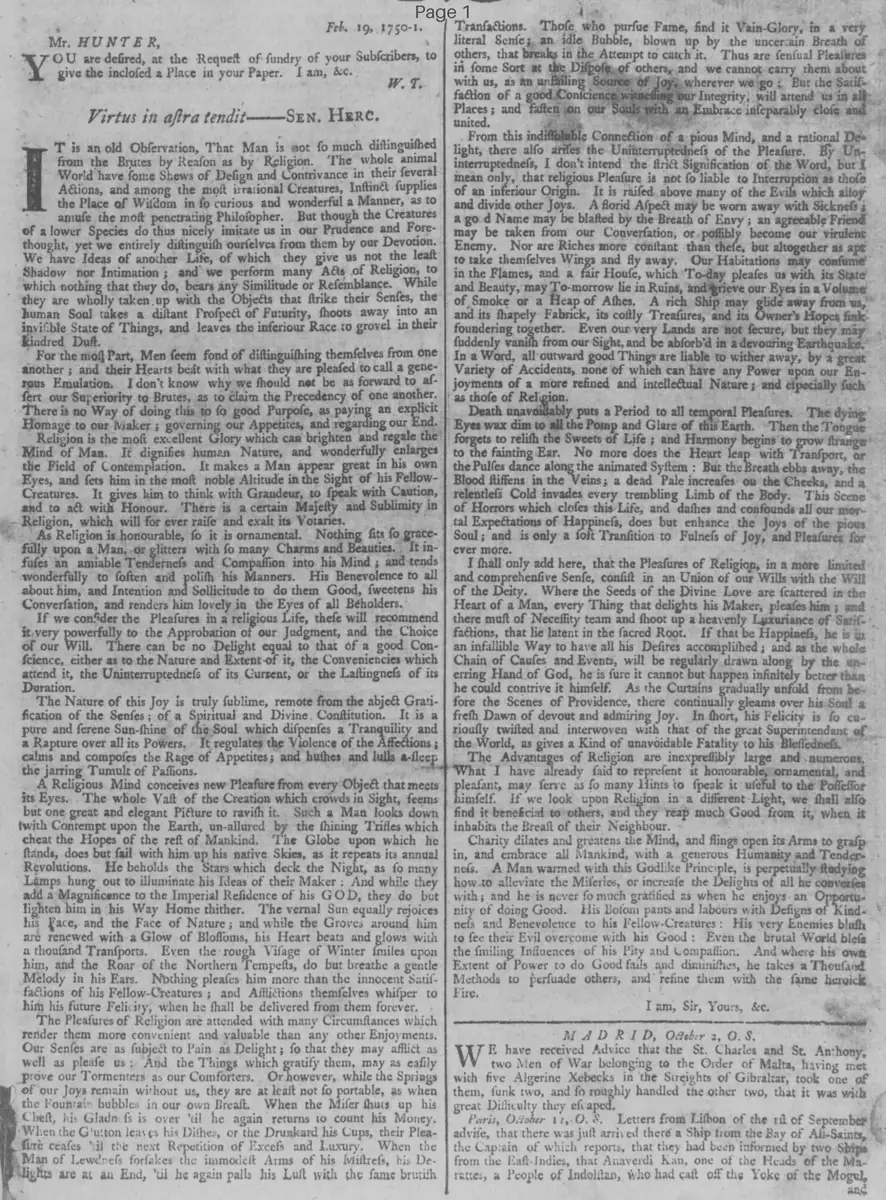
Feb. 19, 1750-1.
Mr. HUNTER.
You are desired, at the Request of sundry of your Subscribers, to
give the enclosed a Place in your Paper. I am, &c.
W. T.
Virtus in arctis tendit sen. Herc.
It is an old Observation, That Man is not so much distinguished
from the Brutes by Reason as by Religion. The whole animal
World have some Shews of Design and Contrivance in their several
Actions, and among the most irrational Creatures, Instinct supplies
the Place of Wisdom in so curious and wonderful a Manner, as to
amuse the most penetrating Philosopher. But though the Creatures
of a lower Species do thus nicely imitate us in our Prudence and Fore-
thought, yet we entirely distinguish ourselves from them by our Devotion.
We have Ideas of another Life, of which they give us not the least
Shadow nor Intimation; and we perform many Acts of Religion, to
which nothing that they do, bears any Similitude or Resemblance. While
they are wholly taken up with the Objects that strike their Senses, the
human Soul takes a distant Prospect of Futurity, shoots away into an
invisible State of Things, and leaves the inferior Race to grovel in their
Kindred Dust.
For the most Part, Men seem fond of distinguishing themselves from one
another; and their Hearts beat with what they are pleased to call a gene-
rous Emulation. I don't know why we should not be as forward to as-
ser our Superiority to Brutes, as to claim the Precedency of one another.
There is no Way of doing this to so good Purpose, as paying an explicit
Homage to our Maker; governing our Appetites, and regarding our End.
Religion is the most excellent Glory which can brighten and regale the
Mind of Man. It dignifies human Nature, and wonderfully enlarges
the Field of Contemplation. It makes a Man appear great in his own
Eyes, and sets him in the most noble Altitude in the Sight of his Fellow-
Creatures. It gives him to think with Grandeur, to speak with Caution,
and to act with Honour. There is a certain Majesty and Sublimity in
Religion, which will for ever raise and exalt its Votaries.
As Religion is honourable, so it is ornamental. Nothing sits so grace-
fully upon a Man, or glitters with so many Charms and Beauties. It in-
fuses an amiable Tenderness and Compassion into his Mind; and tends
wonderfully to soften and polish his Manners. His Benevolence to all
about him, and Intention and Sollicitude to do them Good, sweetens his
Conversation, and renders him lovely in the Eyes of all Beholders.
If we consider the Pleasures in a religious Life, these will recommend
it very powerfully to the Approbation of our Judgment, and the Choice
of our Will. There can be no Delight equal to that of a good Con-
science, either as to the Nature and Extent of it, the Conveniences which
attend it, the Uninterruptedness of its Current, or the Lastingness of its
Duration.
The Nature of this Joy is truly sublime, remote from the abject Grati-
fication of the Senses; of a Spiritual and Divine Constitution. It is a
pure and serene Sun-shine of the Soul which dispenses a Tranquility and
a Rapture over all its Powers. It regulates the Violence of the Affections;
calms and composes the Rage of Appetites; and hushes and lulls a-
sleep the jarring Tumult of Passions.
A Religious Mind conceives new Pleasure from every Object that meets
its Eyes. The whole Vast of the Creation which crowds in Sight, seems
but one great and elegant Picture to ravish it. Such a Man looks down
with Contempt upon the Earth, unallured by the shining Trifles which
cheat the Hopes of the rest of Mankind. The Globe upon which he
stands, does but sail with him up his native Skies, as it repeats its annual
Revolutions. He beholds the Stars which deck the Night, as so many
Lamps hung out to illuminate his Ideas of their Maker: And while they
add a Magnificence to the Imperial Residence of his GOD, they do but
lighten him in his Way Home thither. The vernal Sun equally rejoices
his Face, and the Face of Nature; and while the Groves around him
are renewed with a Glow of Blooms, his Heart beats and glows with
a thousand Transports. Even the rough Visage of Winter smiles upon
him, and the Roar of the Northern Tempests, do but breathe a gentle
Melody in his Ears. Nothing pleases him more than the innocent Satis-
factions of his Fellow-Creatures; and Afflictions themselves whisper to
him his future Felicity, when he shall be delivered from them forever.
The Pleasures of Religion are attended with many Circumstances which
render them more convenient and valuable than any other Enjoyments.
Our Senses are as subject to Pain as Delight; so that they may afflict as
well as please us: And the Things which gratify them, may as easily
prove our Tormenters as our Comforters. Or however, while the Springs
of our Joys remain without us, they are at least not so portable, as when
the Fountain bubbles in our own Breast. When the Miser shuts up his
Chest, his Gladness is over 'til he again returns to count his Money.
When the Glutton leaves his Dishes, or the Drunkard his Cups, their Plea-
sure ceases 'til the next Repetition of Excess and Luxury. When the
Man of Lewdness forsakes the immodest Arms of his Mistresses, his De-
lights are at an End, 'til he again pall his Lust with the same brutish
Transactions. Those who pursue Fame, find it Vain-Glory, in a very
literal Sense; an idle Bubble, blown up by the uncertain Breath of
others, that breaks in the Attempt to catch it. Thus are sensual Pleasures
in some Sort at the Disposal of others, and we cannot carry them about
with us, as an unfailing Source of Joy, wherever we go: But the Satis-
faction of a good Conscience witnessing our Integrity, will attend us in all
Places; and fasten on our Souls with an Embrace incomparably close and
united.
From this indissoluble Connection of a pious Mind and a rational De-
light, there also arises the Uninterruptedness of the Pleasure. By Un-
interruptedness, I don't intend the strict Signification of the Word, but
I mean only, that religious Pleasure is not so liable to Interruption as those
of an inferior Origin. It is raised above many of the Evils which alloy
and divide other Joys. A florid Aspect may be worn away with Sickness;
a good Name may be blasted by the Breath of Envy; an agreeable Friend
may be taken from our Conversation, or possibly become our virulent
Enemy. Nor are Riches more constant than these, but altogether as apt
to take themselves Wings and fly away. Our Habitations may consume
in the Flames, and a fair House, which To-day pleases us with its State
and Beauty, may To-morrow lie in Ruins, and grieve our Eyes in a Volume
of Smoke or a Heap of Ashes. A rich Ship may glide away from us,
and its shapely Fabrick, its costly Treasures, and its Owner's Hopes sink
foundering together. Even our very Lands are not secure, but they may
suddenly vanish from our Sight, and be absorb'd in a devouring Earthquake.
In a Word, all outward good Things are liable to wither away, by a great
Variety of Accidents, none of which can have any Power upon our En-
joyments of a more refined and intellectual Nature; and especially such
as those of Religion.
Death unavoidably puts a Period to all temporal Pleasures. The dying
Eyes wax dim to all the Pomp and Glare of this Earth. Then the Tongue
forgets to relish the Sweets of Life; and Harmony begins to grow strange
to the fainting Ear. No more does the Heart leap with Transport, or
the Pulse dance along the animated System: But the Breath ebbs away, the
Blood stiffens in the Veins; a dead Pale increases on the Cheeks, and a
relentless Cold invades every trembling Limb of the Body. This Scene
of Horrors which closes this Life, and dashes and confounds all our mor-
tal Expectations of Happiness, does but enhance the Joys of the pious
Soul; and is only a soft Transition to Fulness of Joy, and Pleasures for
ever more.
I shall only add here, that the Pleasures of Religion, in a more limited
and comprehensive Sense, consist in an Union of our Wills with the Will
of the Deity. Where the Seeds of the Divine Love are scattered in the
Heart of a Man, every Thing that delights his Maker, pleases him; and
there must of Necessity teem and shoot up a heavenly Luxuriance of Sati-
sfactions, that lie latent in the sacred Root. If that be Happiness, he is in
an infallible Way to have all his Desires accomplished; and as the whole
Chain of Causes and Events, will be regularly drawn along by the un-
erring Hand of God, he is sure it cannot but happen infinitely better than
he could contrive it himself. As the Curtains gradually unfold from be-
fore the Scenes of Providence, there continually gleams over his Soul a
fresh Dawn of devout and admiring Joy. In short, his Felicity is so cu-
riously twined and interwoven with that of the great Superintendant of
the World, as gives a Kind of unavoidable Fatality to his Blessedness.
The Advantages of Religion are inexpressibly large and numerous.
What I have already said to represent it honourable, ornamental, and
pleasant, may serve as so many Hints to speak it useful to the Possessor
himself. If we look upon Religion in a different Light, we shall also
find it beneficial to others, and they reap much Good from it, when it
inhabits the Breast of their Neighbour.
Charity dilates and greatens the Mind, and flings open its Arms to grasp
in, and embrace all Mankind, with a generous Humanity and Tender-
ness. A Man warmed with this Godlike Principle, is perpetually studying
how to alleviate the Miseries, or increase the Delights of all he converses
with; and he is never so much gratified as when he enjoys an Opportu-
nity of doing Good. His Bosom pants and labours with Designs of Kind-
ness and Benevolence to his Fellow-Creatures: His very Enemies blush
to see their Evil overcome with his Good: Even the brutal World bless
the smiling Influences of his Pity and Compassion. And where his own
Extent of Power to do Good fails and diminishes, he takes a Thousand
Methods to persuade others, and refine them with the same heroick
Fire.
I am, Sir, Yours, &c.
Mr. HUNTER.
You are desired, at the Request of sundry of your Subscribers, to
give the enclosed a Place in your Paper. I am, &c.
W. T.
Virtus in arctis tendit sen. Herc.
It is an old Observation, That Man is not so much distinguished
from the Brutes by Reason as by Religion. The whole animal
World have some Shews of Design and Contrivance in their several
Actions, and among the most irrational Creatures, Instinct supplies
the Place of Wisdom in so curious and wonderful a Manner, as to
amuse the most penetrating Philosopher. But though the Creatures
of a lower Species do thus nicely imitate us in our Prudence and Fore-
thought, yet we entirely distinguish ourselves from them by our Devotion.
We have Ideas of another Life, of which they give us not the least
Shadow nor Intimation; and we perform many Acts of Religion, to
which nothing that they do, bears any Similitude or Resemblance. While
they are wholly taken up with the Objects that strike their Senses, the
human Soul takes a distant Prospect of Futurity, shoots away into an
invisible State of Things, and leaves the inferior Race to grovel in their
Kindred Dust.
For the most Part, Men seem fond of distinguishing themselves from one
another; and their Hearts beat with what they are pleased to call a gene-
rous Emulation. I don't know why we should not be as forward to as-
ser our Superiority to Brutes, as to claim the Precedency of one another.
There is no Way of doing this to so good Purpose, as paying an explicit
Homage to our Maker; governing our Appetites, and regarding our End.
Religion is the most excellent Glory which can brighten and regale the
Mind of Man. It dignifies human Nature, and wonderfully enlarges
the Field of Contemplation. It makes a Man appear great in his own
Eyes, and sets him in the most noble Altitude in the Sight of his Fellow-
Creatures. It gives him to think with Grandeur, to speak with Caution,
and to act with Honour. There is a certain Majesty and Sublimity in
Religion, which will for ever raise and exalt its Votaries.
As Religion is honourable, so it is ornamental. Nothing sits so grace-
fully upon a Man, or glitters with so many Charms and Beauties. It in-
fuses an amiable Tenderness and Compassion into his Mind; and tends
wonderfully to soften and polish his Manners. His Benevolence to all
about him, and Intention and Sollicitude to do them Good, sweetens his
Conversation, and renders him lovely in the Eyes of all Beholders.
If we consider the Pleasures in a religious Life, these will recommend
it very powerfully to the Approbation of our Judgment, and the Choice
of our Will. There can be no Delight equal to that of a good Con-
science, either as to the Nature and Extent of it, the Conveniences which
attend it, the Uninterruptedness of its Current, or the Lastingness of its
Duration.
The Nature of this Joy is truly sublime, remote from the abject Grati-
fication of the Senses; of a Spiritual and Divine Constitution. It is a
pure and serene Sun-shine of the Soul which dispenses a Tranquility and
a Rapture over all its Powers. It regulates the Violence of the Affections;
calms and composes the Rage of Appetites; and hushes and lulls a-
sleep the jarring Tumult of Passions.
A Religious Mind conceives new Pleasure from every Object that meets
its Eyes. The whole Vast of the Creation which crowds in Sight, seems
but one great and elegant Picture to ravish it. Such a Man looks down
with Contempt upon the Earth, unallured by the shining Trifles which
cheat the Hopes of the rest of Mankind. The Globe upon which he
stands, does but sail with him up his native Skies, as it repeats its annual
Revolutions. He beholds the Stars which deck the Night, as so many
Lamps hung out to illuminate his Ideas of their Maker: And while they
add a Magnificence to the Imperial Residence of his GOD, they do but
lighten him in his Way Home thither. The vernal Sun equally rejoices
his Face, and the Face of Nature; and while the Groves around him
are renewed with a Glow of Blooms, his Heart beats and glows with
a thousand Transports. Even the rough Visage of Winter smiles upon
him, and the Roar of the Northern Tempests, do but breathe a gentle
Melody in his Ears. Nothing pleases him more than the innocent Satis-
factions of his Fellow-Creatures; and Afflictions themselves whisper to
him his future Felicity, when he shall be delivered from them forever.
The Pleasures of Religion are attended with many Circumstances which
render them more convenient and valuable than any other Enjoyments.
Our Senses are as subject to Pain as Delight; so that they may afflict as
well as please us: And the Things which gratify them, may as easily
prove our Tormenters as our Comforters. Or however, while the Springs
of our Joys remain without us, they are at least not so portable, as when
the Fountain bubbles in our own Breast. When the Miser shuts up his
Chest, his Gladness is over 'til he again returns to count his Money.
When the Glutton leaves his Dishes, or the Drunkard his Cups, their Plea-
sure ceases 'til the next Repetition of Excess and Luxury. When the
Man of Lewdness forsakes the immodest Arms of his Mistresses, his De-
lights are at an End, 'til he again pall his Lust with the same brutish
Transactions. Those who pursue Fame, find it Vain-Glory, in a very
literal Sense; an idle Bubble, blown up by the uncertain Breath of
others, that breaks in the Attempt to catch it. Thus are sensual Pleasures
in some Sort at the Disposal of others, and we cannot carry them about
with us, as an unfailing Source of Joy, wherever we go: But the Satis-
faction of a good Conscience witnessing our Integrity, will attend us in all
Places; and fasten on our Souls with an Embrace incomparably close and
united.
From this indissoluble Connection of a pious Mind and a rational De-
light, there also arises the Uninterruptedness of the Pleasure. By Un-
interruptedness, I don't intend the strict Signification of the Word, but
I mean only, that religious Pleasure is not so liable to Interruption as those
of an inferior Origin. It is raised above many of the Evils which alloy
and divide other Joys. A florid Aspect may be worn away with Sickness;
a good Name may be blasted by the Breath of Envy; an agreeable Friend
may be taken from our Conversation, or possibly become our virulent
Enemy. Nor are Riches more constant than these, but altogether as apt
to take themselves Wings and fly away. Our Habitations may consume
in the Flames, and a fair House, which To-day pleases us with its State
and Beauty, may To-morrow lie in Ruins, and grieve our Eyes in a Volume
of Smoke or a Heap of Ashes. A rich Ship may glide away from us,
and its shapely Fabrick, its costly Treasures, and its Owner's Hopes sink
foundering together. Even our very Lands are not secure, but they may
suddenly vanish from our Sight, and be absorb'd in a devouring Earthquake.
In a Word, all outward good Things are liable to wither away, by a great
Variety of Accidents, none of which can have any Power upon our En-
joyments of a more refined and intellectual Nature; and especially such
as those of Religion.
Death unavoidably puts a Period to all temporal Pleasures. The dying
Eyes wax dim to all the Pomp and Glare of this Earth. Then the Tongue
forgets to relish the Sweets of Life; and Harmony begins to grow strange
to the fainting Ear. No more does the Heart leap with Transport, or
the Pulse dance along the animated System: But the Breath ebbs away, the
Blood stiffens in the Veins; a dead Pale increases on the Cheeks, and a
relentless Cold invades every trembling Limb of the Body. This Scene
of Horrors which closes this Life, and dashes and confounds all our mor-
tal Expectations of Happiness, does but enhance the Joys of the pious
Soul; and is only a soft Transition to Fulness of Joy, and Pleasures for
ever more.
I shall only add here, that the Pleasures of Religion, in a more limited
and comprehensive Sense, consist in an Union of our Wills with the Will
of the Deity. Where the Seeds of the Divine Love are scattered in the
Heart of a Man, every Thing that delights his Maker, pleases him; and
there must of Necessity teem and shoot up a heavenly Luxuriance of Sati-
sfactions, that lie latent in the sacred Root. If that be Happiness, he is in
an infallible Way to have all his Desires accomplished; and as the whole
Chain of Causes and Events, will be regularly drawn along by the un-
erring Hand of God, he is sure it cannot but happen infinitely better than
he could contrive it himself. As the Curtains gradually unfold from be-
fore the Scenes of Providence, there continually gleams over his Soul a
fresh Dawn of devout and admiring Joy. In short, his Felicity is so cu-
riously twined and interwoven with that of the great Superintendant of
the World, as gives a Kind of unavoidable Fatality to his Blessedness.
The Advantages of Religion are inexpressibly large and numerous.
What I have already said to represent it honourable, ornamental, and
pleasant, may serve as so many Hints to speak it useful to the Possessor
himself. If we look upon Religion in a different Light, we shall also
find it beneficial to others, and they reap much Good from it, when it
inhabits the Breast of their Neighbour.
Charity dilates and greatens the Mind, and flings open its Arms to grasp
in, and embrace all Mankind, with a generous Humanity and Tender-
ness. A Man warmed with this Godlike Principle, is perpetually studying
how to alleviate the Miseries, or increase the Delights of all he converses
with; and he is never so much gratified as when he enjoys an Opportu-
nity of doing Good. His Bosom pants and labours with Designs of Kind-
ness and Benevolence to his Fellow-Creatures: His very Enemies blush
to see their Evil overcome with his Good: Even the brutal World bless
the smiling Influences of his Pity and Compassion. And where his own
Extent of Power to do Good fails and diminishes, he takes a Thousand
Methods to persuade others, and refine them with the same heroick
Fire.
I am, Sir, Yours, &c.
What sub-type of article is it?
Philosophical
Reflective
Religious
What themes does it cover?
Religion
Morality
What keywords are associated?
Religion
Human Superiority
Pleasures Of Religion
Good Conscience
Divine Love
Charity
Benevolence
What entities or persons were involved?
W. T.
Mr. Hunter
Letter to Editor Details
Author
W. T.
Recipient
Mr. Hunter
Main Argument
religion distinguishes humans from brutes through devotion and ideas of an afterlife; it is honorable, ornamental, pleasurable with a good conscience, uninterrupted, lasting beyond death, and beneficial to self and others through charity and benevolence.
Notable Details
Quotes 'Virtus In Arctis Tendit Sen. Herc.'
Contrasts Human Religion With Animal Instinct
Describes Pleasures Of Religion As Sublime And Internal
Discusses Interruptions To Temporal Pleasures Vs. Religious Joys
Emphasizes Union Of Human Will With Divine Will