Thank you for visiting SNEWPapers!
Sign up free
Story
February 4, 1919
Norwich Bulletin
Norwich, New London County, Connecticut
What is this article about?
During World War I, the U.S. government guaranteed wheat prices at $2.26 per bushel to increase production for allies, doubling output. After the war ended early, with market prices falling due to other sources, the government faces losses but must honor the promise to farmers.
Clipping
OCR Quality
98%
Excellent
Full Text
DUE TO THE WAR.
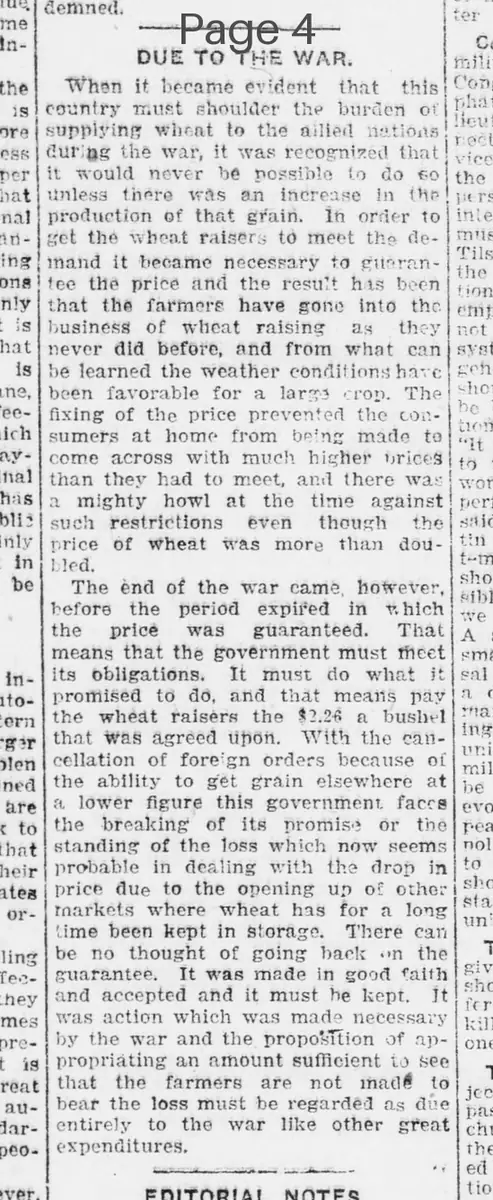
When it became evident that this country must shoulder the burden of supplying wheat to the allied nations during the war, it was recognized that it would never be possible to do so unless there was an increase in the production of that grain. In order to get the wheat raisers to meet the demand it became necessary to guarantee the price and the result has been that the farmers have gone into the business of wheat raising as they never did before, and from what can be learned the weather conditions have been favorable for a large crop. The fixing of the price prevented the consumers at home from being made to come across with much higher prices than they had to meet, and there was a mighty howl at the time against such restrictions even though the price of wheat was more than doubled.
The end of the war came, however, before the period expired in which the price was guaranteed. That means that the government must meet its obligations. It must do what it promised to do, and that means pay the wheat raisers the $2.26 a bushel that was agreed upon. With the cancellation of foreign orders because of the ability to get grain elsewhere at a lower figure this government faces the breaking of its promise or the standing of the loss which now seems probable in dealing with the drop in price due to the opening up of other markets where wheat has for a long time been kept in storage. There can be no thought of going back on the guarantee. It was made in good faith and accepted and it must be kept. It was action which was made necessary by the war and the proposition of appropriating an amount sufficient to see that the farmers are not made to bear the loss must be regarded as due entirely to the war like other great expenditures.
When it became evident that this country must shoulder the burden of supplying wheat to the allied nations during the war, it was recognized that it would never be possible to do so unless there was an increase in the production of that grain. In order to get the wheat raisers to meet the demand it became necessary to guarantee the price and the result has been that the farmers have gone into the business of wheat raising as they never did before, and from what can be learned the weather conditions have been favorable for a large crop. The fixing of the price prevented the consumers at home from being made to come across with much higher prices than they had to meet, and there was a mighty howl at the time against such restrictions even though the price of wheat was more than doubled.
The end of the war came, however, before the period expired in which the price was guaranteed. That means that the government must meet its obligations. It must do what it promised to do, and that means pay the wheat raisers the $2.26 a bushel that was agreed upon. With the cancellation of foreign orders because of the ability to get grain elsewhere at a lower figure this government faces the breaking of its promise or the standing of the loss which now seems probable in dealing with the drop in price due to the opening up of other markets where wheat has for a long time been kept in storage. There can be no thought of going back on the guarantee. It was made in good faith and accepted and it must be kept. It was action which was made necessary by the war and the proposition of appropriating an amount sufficient to see that the farmers are not made to bear the loss must be regarded as due entirely to the war like other great expenditures.
What sub-type of article is it?
Historical Event
What themes does it cover?
Justice
Fortune Reversal
What keywords are associated?
Wheat Production
Price Guarantee
Government Obligation
Post War Economy
War Agriculture
Story Details
Event Date
During And After The War
Story Details
Government guaranteed wheat price at $2.26 per bushel to boost production for allied nations during the war, leading to increased farming. Post-war, with price drops and canceled orders, government must honor the guarantee despite losses, as required by wartime necessity.