Thank you for visiting SNEWPapers!
Sign up free
Literary
June 12, 1821
Richmond Enquirer
Richmond, Richmond County, Virginia
What is this article about?
Satirical ode by Anti-Parasitus mocking Philobomos, a New York polymath, for flattering the Russian Emperor with a plough gift in 1821 and receiving a valuable diamond ring, critiquing autocratic flattery and questioning customs duties on the return gift. Includes explanatory notes and legal queries.
Clipping
OCR Quality
70%
Good
Full Text
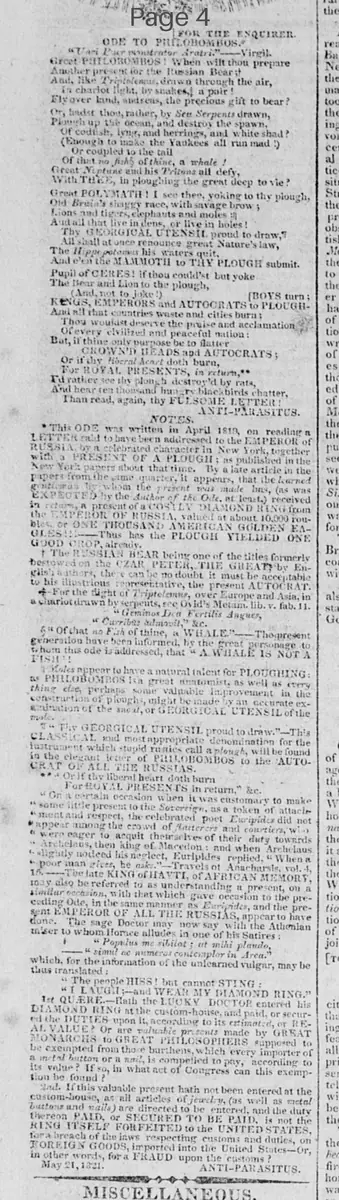
Ode to Philobomos.
"Tali luro monycater siratri"—Virgil
Grant, Parcae, woes: When wilt thou prepare
Another verse to the Russian Czar
And, like Triptolemus, drive on through the air.
In chariot light, so silent a power!
Fly over land, awaking, the precious grain to bear?
Or, wouldst thou, rather, by Sea Serpents drawn,
Plough up the ocean, and destroy the spawn.
Of codfish, longs, and herring, and white shad?
(Enough to make the Yankees all run mad)
Or coupled to the tail
Of that no fish of thine, a whale!
Great Neptune and his Tritons all defy.
With thee, in ploughing the great deep to vie?
Great POLYMATH! I see thee, yoking to thy plough,
Old Briareus' shaggy race, with savage brow;
Lions and tigers, elephants and moles:
And all that live in dens, or live in holes!
Thy GEORGICAL UTENSIL proud to draw,
All shall at once renounce great Nature's law,
The Hippopotamus his waters quit,
And e'en the MAMMOTH to THY PLOUGH submit.
Pupil of CERES! if thou could'st but yoke
The Bear and Lion to the plough,
(And, not to joke?)
Kings turn;
Kings, Emperors and Autocrats to plough-
And all that countries waste and cities burn;
Thou wouldst deserve the praise and acclamation
Of every civilized and peaceful nation:
But, if thine only purpose be to flatter
CROWN'D HEADS and AUTOCRATS
Or if thy liberal heart doth burn,
For ROYAL PRESENTS, in return,
I'd rather see thy plough destroy'd by rats,
And hear ten thousand hungry black birds chatter.
Than read, again, thy FULSOME LETTER!
ANTI-PARASITUS.
NOTES.
This ODE was written in April 1821, on reading a
LETTER said to have been addressed to the EMPEROR of
RUSSIA, by a celebrated character in New York, together
with a PRESENT OF A PLOUGH; as published in the
New York papers about that time. By a late article in the
papers from the same quarter, it appears, that the learned
gentleman by whom the present was made has, (as was
EXPECTED
by
the
Author
of
the
Ode
at
least)
received in return, a present of a COSTLY DIAMOND RING from
the EMPEROR OF RUSSIA, valued at about 10,000 ROUB-
LES, or ONE THOUSAND AMERICAN GOLDEN EA-
GLES!--Thus has the PLOUGH YIELDED ONE
GOOD CROP, already.
1 The RUSSIAN BEAR being one of the titles formerly
BESTOWED on the CZAR PETER, THE GREAT by Eng-
lish writers, there can be no doubt it must be acceptable
to his illustrious representative, the present AUTOCRAT.
2 For the flight of Triptolemus, over Europe and Asia, in
a chariot drawn by serpents, see Ovid's Metam. lib. v. fab. 11.
"Geminus dea fertiles angues,
"Currus trahit," &c.
3 "Of that no Fish of thine, a WHALE."--The present
generation have been informed, by the great personage to
whom this ode is addressed, that "A WHALE IS NOT A
FISH!".
4 Moles appear to have a natural talent for PLOUGHING:
as PHILOBOMOS is a great anatomist, as well as every-
thing else, perhaps some valuable Improvement in the
construction of ploughs, might be made by an accurate ex-
amination of the said, or GEORGICAL UTENSIL of the
mole.
5 "Thy GEORGICAL UTENSIL proud to draw."--This
CLASSICAL and most appropriate denomination for the
instrument which stupid rustics call a plough, will be found
in the elegant letter of PHILOBOMBOS to the AUTO-
CRAT OF ALL THE RUSSIAS.
"Or if thy liberal heart doth burn
For ROYAL PRESENTS in return," &c.
"On a certain occasion when it was customary to make
"some little present to the Sovereign, as a token of attach-
"ment and respect, the celebrated poet Euripides did not
"appear among the crowd of flatterers and courtiers, who
"were eager to acquit themselves of their duty towards
"Archelaus, then king of Macedon: and when Archelaus
"slightly noticed his neglect, Euripides replied, "When a
"poor man gives, he asks."--Travels of Anacharsis, vol.4,
p.15. --The late KING OF HAYTI, of AFRICAN MEMORY.
may also be referred to as understanding a present, on a
similar occasion, with that which gave occasion to the pre-
ceding Ode, in the same manner as Euripides, and the pre-
sent EMPEROR OF ALL THE RUSSIAS, appear to have
done. The sage Doctor may now say with the Athenian
miser to whom Horace alludes in one of his Satires:
"Populus me sibilat; at mihi plaudo,
"Ipse domi, numerosque fingo et censeo in arca."
which, for the information of the unlearned vulgar, may be
thus translated:
"The people HISS! but cannot STING:
"I LAUGH--And WEAR MY DIAMOND RING."
1st QUERY.—Hath the LUCKY DOCTOR entered his
DIAMOND RING at the custom-house, and paid, or secur-
ed the DUTIES upon it, according to its estimated, or REAL
VALUE? Or are valuable presents made by GREAT
MONARCHS to GREAT PHILOSOPHERS supposed to
be exempted from those burdens, which every importer of
a metal button or a nail, is compelled to pay, according to
its value? If so, in what act of Congress can this exemp-
tion be found?
2nd. If this valuable present hath not been entered at the
custom-house, as all articles of jewelry, (as well as metal
buttons and nails) are directed to be entered, and the duty
thereon PAID, or SECURED TO BE PAID, is not the
RING ITSELF FORFEITED to the UNITED STATES,
for a breach of the laws respecting customs and duties, on
FOREIGN GOODS, imported into the United States--Or,
in other words, for a FRAUD upon the customs?
May 21, 1821.
ANTI-PARASITUS.
"Tali luro monycater siratri"—Virgil
Grant, Parcae, woes: When wilt thou prepare
Another verse to the Russian Czar
And, like Triptolemus, drive on through the air.
In chariot light, so silent a power!
Fly over land, awaking, the precious grain to bear?
Or, wouldst thou, rather, by Sea Serpents drawn,
Plough up the ocean, and destroy the spawn.
Of codfish, longs, and herring, and white shad?
(Enough to make the Yankees all run mad)
Or coupled to the tail
Of that no fish of thine, a whale!
Great Neptune and his Tritons all defy.
With thee, in ploughing the great deep to vie?
Great POLYMATH! I see thee, yoking to thy plough,
Old Briareus' shaggy race, with savage brow;
Lions and tigers, elephants and moles:
And all that live in dens, or live in holes!
Thy GEORGICAL UTENSIL proud to draw,
All shall at once renounce great Nature's law,
The Hippopotamus his waters quit,
And e'en the MAMMOTH to THY PLOUGH submit.
Pupil of CERES! if thou could'st but yoke
The Bear and Lion to the plough,
(And, not to joke?)
Kings turn;
Kings, Emperors and Autocrats to plough-
And all that countries waste and cities burn;
Thou wouldst deserve the praise and acclamation
Of every civilized and peaceful nation:
But, if thine only purpose be to flatter
CROWN'D HEADS and AUTOCRATS
Or if thy liberal heart doth burn,
For ROYAL PRESENTS, in return,
I'd rather see thy plough destroy'd by rats,
And hear ten thousand hungry black birds chatter.
Than read, again, thy FULSOME LETTER!
ANTI-PARASITUS.
NOTES.
This ODE was written in April 1821, on reading a
LETTER said to have been addressed to the EMPEROR of
RUSSIA, by a celebrated character in New York, together
with a PRESENT OF A PLOUGH; as published in the
New York papers about that time. By a late article in the
papers from the same quarter, it appears, that the learned
gentleman by whom the present was made has, (as was
EXPECTED
by
the
Author
of
the
Ode
at
least)
received in return, a present of a COSTLY DIAMOND RING from
the EMPEROR OF RUSSIA, valued at about 10,000 ROUB-
LES, or ONE THOUSAND AMERICAN GOLDEN EA-
GLES!--Thus has the PLOUGH YIELDED ONE
GOOD CROP, already.
1 The RUSSIAN BEAR being one of the titles formerly
BESTOWED on the CZAR PETER, THE GREAT by Eng-
lish writers, there can be no doubt it must be acceptable
to his illustrious representative, the present AUTOCRAT.
2 For the flight of Triptolemus, over Europe and Asia, in
a chariot drawn by serpents, see Ovid's Metam. lib. v. fab. 11.
"Geminus dea fertiles angues,
"Currus trahit," &c.
3 "Of that no Fish of thine, a WHALE."--The present
generation have been informed, by the great personage to
whom this ode is addressed, that "A WHALE IS NOT A
FISH!".
4 Moles appear to have a natural talent for PLOUGHING:
as PHILOBOMOS is a great anatomist, as well as every-
thing else, perhaps some valuable Improvement in the
construction of ploughs, might be made by an accurate ex-
amination of the said, or GEORGICAL UTENSIL of the
mole.
5 "Thy GEORGICAL UTENSIL proud to draw."--This
CLASSICAL and most appropriate denomination for the
instrument which stupid rustics call a plough, will be found
in the elegant letter of PHILOBOMBOS to the AUTO-
CRAT OF ALL THE RUSSIAS.
"Or if thy liberal heart doth burn
For ROYAL PRESENTS in return," &c.
"On a certain occasion when it was customary to make
"some little present to the Sovereign, as a token of attach-
"ment and respect, the celebrated poet Euripides did not
"appear among the crowd of flatterers and courtiers, who
"were eager to acquit themselves of their duty towards
"Archelaus, then king of Macedon: and when Archelaus
"slightly noticed his neglect, Euripides replied, "When a
"poor man gives, he asks."--Travels of Anacharsis, vol.4,
p.15. --The late KING OF HAYTI, of AFRICAN MEMORY.
may also be referred to as understanding a present, on a
similar occasion, with that which gave occasion to the pre-
ceding Ode, in the same manner as Euripides, and the pre-
sent EMPEROR OF ALL THE RUSSIAS, appear to have
done. The sage Doctor may now say with the Athenian
miser to whom Horace alludes in one of his Satires:
"Populus me sibilat; at mihi plaudo,
"Ipse domi, numerosque fingo et censeo in arca."
which, for the information of the unlearned vulgar, may be
thus translated:
"The people HISS! but cannot STING:
"I LAUGH--And WEAR MY DIAMOND RING."
1st QUERY.—Hath the LUCKY DOCTOR entered his
DIAMOND RING at the custom-house, and paid, or secur-
ed the DUTIES upon it, according to its estimated, or REAL
VALUE? Or are valuable presents made by GREAT
MONARCHS to GREAT PHILOSOPHERS supposed to
be exempted from those burdens, which every importer of
a metal button or a nail, is compelled to pay, according to
its value? If so, in what act of Congress can this exemp-
tion be found?
2nd. If this valuable present hath not been entered at the
custom-house, as all articles of jewelry, (as well as metal
buttons and nails) are directed to be entered, and the duty
thereon PAID, or SECURED TO BE PAID, is not the
RING ITSELF FORFEITED to the UNITED STATES,
for a breach of the laws respecting customs and duties, on
FOREIGN GOODS, imported into the United States--Or,
in other words, for a FRAUD upon the customs?
May 21, 1821.
ANTI-PARASITUS.
What sub-type of article is it?
Satire
Poem
What themes does it cover?
Political
Taxation Oppression
Liberty Freedom
What keywords are associated?
Satirical Ode
Philobomos
Russian Emperor
Plough Gift
Diamond Ring
Flattery
Customs Duty
What entities or persons were involved?
Anti Parasitus
Literary Details
Title
Ode To Philobomos.
Author
Anti Parasitus
Subject
On Reading A Letter Addressed To The Emperor Of Russia By A Celebrated Character In New York, Together With A Present Of A Plough
Key Lines
Great Polymath! I See Thee, Yoking To Thy Plough,\Nold Briareus' Shaggy Race, With Savage Brow;\Nlions And Tigers, Elephants And Moles:\Nand All That Live In Dens, Or Live In Holes!
Pupil Of Ceres! If Thou Could'st But Yoke\Nthe Bear And Lion To The Plough,\N(and, Not To Joke?)\Nkings Turn;\Nkings, Emperors And Autocrats To Plough
But, If Thine Only Purpose Be To Flatter\Ncrown'd Heads And Autocrats\Nor If Thy Liberal Heart Doth Burn,\Nfor Royal Presents, In Return,
I'd Rather See Thy Plough Destroy'd By Rats,\Nand Hear Ten Thousand Hungry Black Birds Chatter.\Nthan Read, Again, Thy Fulsome Letter!