Thank you for visiting SNEWPapers!
Sign up free
National Gazette
Philadelphia, Philadelphia County, Pennsylvania
What is this article about?
Extracts from Dublin letters detail Irish Catholic agitation for repeal of penal laws excluding them from government and land ownership. Large meetings pass resolutions; they seek relief via Parliament, which opens Jan 19, 1792, but offers limited concessions, sparking counter-addresses and tension while Catholics remain relatively quiet.
Clipping
OCR Quality
Full Text
APRIL 12, 1792.
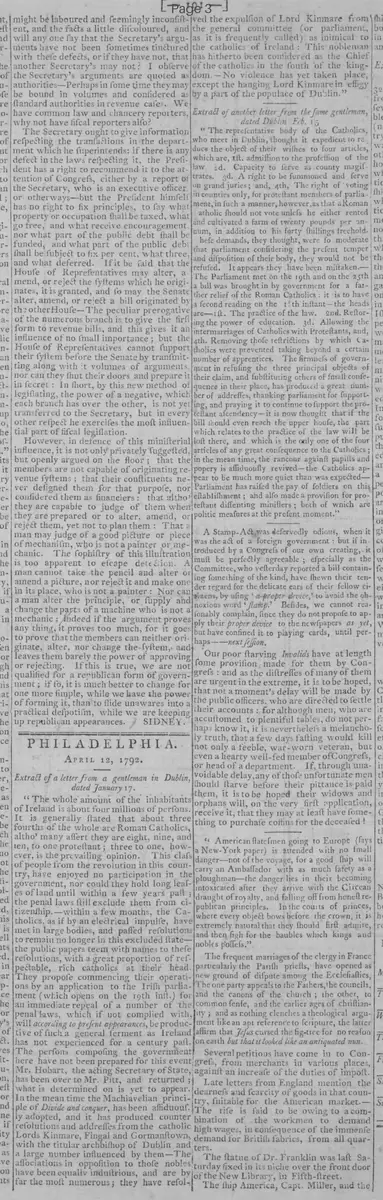
Extract of a letter from a gentleman in Dublin,
dated January 17.
" The whole amount of the inhabitants
of Ireland is about four millions of persons.
It is generally stated that about three
fourths of the whole are Roman Catholics,
altho' many assert they are eight, nine, and
ten, to one protestant; three to one, how-
ever, is the prevailing opinion. This class
of people from the revolution in this coun-
try, have enjoyed no participation in the
government, nor could they hold long leases
of land until within a few years past ;
the penal laws still exclude them from ci-
tizenship.—within a few months, the Ca-
tholics, as if by an electrical impulse, have
met in large bodies, and passed resolutions
to remain no longer in this excluded state—
the public papers teem with names to these
resolutions, with a great proportion of res.
pectable, rich catholics at their head.
They propose commencing their operati-
ons by an application to the Irish parlia-
ment (which opens on the 19th inst.) for
an immediate repeal of a number of the
penal laws, which if not complied with
will according to present appearances, be produc-
tive of such a general ferment as Ireland
has not experienced for a century past.
The persons composing the government
here have not been prepared for this event
Mr. Hobart, the acting Secretary of State,
has been over to Mr. Pitt, and returned ;
what is determined on is yet to appear.
In the mean time the Machiavelian princi-
ple of Divide and conquer, has been assiduously
adopted, and it has produced counter
resolutions and addresses from the catholic
Lords Kenmare, Fingal and Gormanstown,
with the titular archbishop of Dublin and
a large number influenced by them—The
associations in opposition to those nobles
have been equally industrious, and are by
far the most numerous; they have reso-
ved the expulsion of Lord Kenmare from
the general committee (or parliament,
as it is frequently called) as inimical to
the catholics of Ireland : This nobleman
has hitherto been considered as the Chief
of the catholics in the south of the king-
dom.—No violence has yet taken place,
except the hanging Lord Kenmare in effigy
by a part of the populace of Dublin."
Extract of another letter from the same gentleman,
dated Dublin Feb. 15
" The representative body of the Catholics,
who meet in Dublin, thought it expedient to re-
duce the object of their wishes to four articles,
which are, 1st, admission to the profession of the
law 2d. Capacity to serve as county magis-
trates. 3d. A right to be summoned and serve
on grand juries; and, 4th, The right of voting
in counties only, for protestant members of parlia-
ment, in such a manner, however, as that a Roman
Catholic should not vote unless he either rented
and cultivated a farm of twenty pounds per an-
num, in addition to his forty shillings freehold.
These demands, they thought, were so moderate
that parliament considering the present temper
and disposition of their body, they would not be
refused. It appears they have been mistaken.—
The Parliament met on the 19th and on the 25th
a bill was brought in by government for a far-
ther relief of the Roman Catholics : it is to have
a second reading on the 1st instant—the heads
are—1st. The practice of the law. 2nd. Restor-
ing the power of education. 3d. Allowing the
intermarriages of Catholics with Protestants, and.
4th. Removing those restrictions by which (Ca-
tholics were prevented taking beyond a certain
number of apprentices. The firmness of govern-
ment in refusing the three principal objects of
their claim, and substituting others of small conse-
quence in their place, has produced a great num-
ber of addresses, thanking parliament for support-
ing, and praying it to continue to support the pro-
testant ascendency—it is now thought that if the
bill should even reach the upper house, the part
which relates to the practice of the law will be
lost there, and which is the only one of the four
articles of any great consequence to the Catholics :
in the mean time, the rancour against papists and
popery is assiduously revived—the Catholics ap-
pear to be much more quiet than was expected—
Parliament has raised the pay of soldiers on this
establishment; and also made a provision for pro-
testant dissenting ministers: both of which are
politic measures at the present moment."
What sub-type of article is it?
What keywords are associated?
What entities or persons were involved?
Where did it happen?
Foreign News Details
Primary Location
Dublin, Ireland
Event Date
January 17 To February 15, 1792
Key Persons
Outcome
no violence except hanging lord kenmare in effigy; parliament introduces limited relief bill refusing main catholic demands, leading to addresses supporting protestant ascendency; catholics quieter than expected; soldier pay raised and provision for protestant dissenting ministers.
Event Details
Irish Catholics, comprising about three-fourths of the population, agitate for repeal of penal laws excluding them from government participation and citizenship. Large meetings pass resolutions; they plan to petition Irish Parliament opening January 19 for relief. Government unprepared; Mr. Hobart consults Mr. Pitt. Divide-and-conquer tactics yield counter-resolutions from Catholic lords and archbishop. Opposing associations more numerous, resolve to expel Lord Kenmare. Later update: Catholics reduce demands to four moderate articles on law, magistracy, juries, and limited voting, but Parliament's bill grants lesser relief on law practice, education, intermarriage, and apprenticeships, refusing core claims, reviving anti-Catholic sentiment.