Thank you for visiting SNEWPapers!
Sign up free
Herald Of The United States
Warren, Bristol County, Rhode Island
What is this article about?
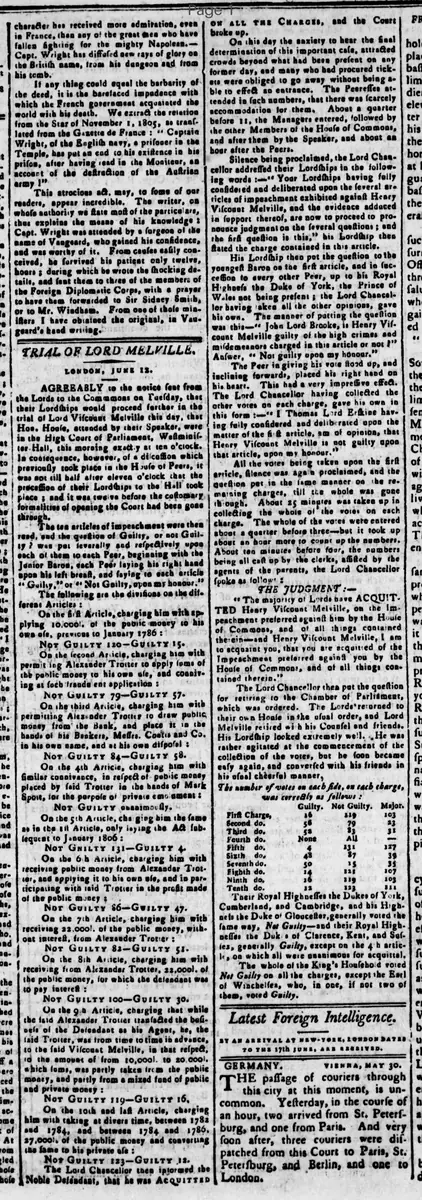
In London on June 12, the House of Lords conducted the impeachment trial of Henry Viscount Melville on ten articles related to misuse of public money. After voting on each charge, he was acquitted on all counts with majorities ranging from unanimous to 103 votes.
Merged-components note: The table summarizes the vote divisions in the Lord Melville trial story; spatial overlap and content match indicate it belongs to this foreign news article.
Clipping
OCR Quality
Full Text
London, June 12.
Agreeably to the notice sent from the Lords to the Commons on Tuesday, that their Lordships would proceed further in the trial of Lord Viscount Melville this day, that Hon. House, attended by their Speaker, were in the High Court of Parliament, Westminster-Hall, this morning exactly at ten o'clock. In consequence, however, of discussion which previously took place in the House of Peers, it was not till half after eleven o'clock that the procession of their Lordships to the Hall took place; and it was twelve before the customary formalities of opening the Court had been gone through.
The ten articles of impeachment were then read, and the question of Guilty, or not Guilty? was put severally and respectively upon each of them to each Peer, beginning with the Junior Baron, each Peer laying his right hand upon his left breast, and saying to each article "Guilty." or "Not Guilty, upon my honour."
The following are the divisions on the different Articles:
On the first Article, charging him with applying to his own use £.? of the public money previous to January 1786:
Not Guilty 119-Guilty 15.
On the second Article, charging him with permitting Alexander Trotter to apply some of the public money to his own use, and conniving at such fraudulent application:
Not Guilty 79-Guilty 57.
On the third Article, charging him with permitting Alexander Trotter to draw public money from the Bank, and place it in the hands of his Bankers, Messrs. Coutts and Co. in his own name, and at his own disposal:
Not Guilty 84-Guilty 58.
On the 4th Article, charging him with similar connivance, in respect of public money placed by said Trotter in the hands of Mark Sprott, for the purpose of private accommodation:
Not Guilty unanimously.
On the 5th Article, charging him the same as in the 6th Article, only saying the act subsequent to January 1806:
Not Guilty 131-Guilty ?.
On the 6th Article, charging him with receiving public money from Alexander Trotter, and applying it to his own use, and in participating with said Trotter in the profit made of the public money:
Not Guilty 86-Guilty 47.
On the 7th Article, charging him with receiving £22,000 of the public money, with out interest, from Alexander Trotter:
Not Guilty 82-Guilty 51.
On the 8th Article, charging him with receiving from Alexander Trotter, £22,000 of the public money, for which the defendant was to pay interest:
Not Guilty 100-Guilty 30.
On the 9th Article, charging that while the said Alexander Trotter transacted the business of the Defendant as his Agent, he, the said Trotter, was from time to time in advance, to the said Viscount Melville, in that respect, in the amounts of from £10,000 to £20,000, which loans was partly taken from the public money, and partly from a mixed fund of public and private money:
Not Guilty 119-Guilty 16.
On the tenth and last Article, charging him with taking at divers times, between 1782 and 1784, and between 1784 and 1786, £27,000 of the public money and converting the same to his private use:
Not Guilty 123-Guilty 12.
The Lord Chancellor then informed the Noble Defendant that he was Acquitted on all the Charges, and the Court broke up.
On this day the anxiety to hear the final determination of this important case, attracted crowds beyond what had been present on any former day, and many who had procured tickets were obliged to go away without being able to effect an entrance. The Peeresses attended in such numbers that there was scarcely accommodation for them. About a quarter before 11, the Managers entered, followed by the other Members of the House of Commons, and after them by the Speaker, and about an hour after the Peers.
Silence being proclaimed, the Lord Chancellor addressed their Lordships in the following words: "Your Lordships having fully considered and deliberated upon the several articles of impeachment exhibited against Henry Viscount Melville, and the evidence adduced in support thereof, are now to proceed to pronounce judgment on the several questions; and the first question is this," his Lordship then stated the charge contained in this article.
His Lordship then put the question to the youngest Baron on the first article, and in succession to every other Peer, up to his Royal Highness the Duke of York, the Prince of Wales not being present; the Lord Chancellor having taken all the other opinions, gave his own. The manner of putting the question was this- "John Lord Brooke, is Henry Viscount Melville guilty of the high crimes and misdemeanors charged in this article or not?" Answer, "Not guilty upon my honour."
The Peer in giving his vote stood up, and inclining forwards, placed his right hand on his heart. This had a very impressive effect.
The Lord Chancellor having collected the other votes on each charge, gave his own in this form: "I Thomas Lord Erskine having fully considered and deliberated upon the matter of the first article, am of opinion, that Henry Viscount Melville is not guilty upon that article, upon my honour."
All the votes being taken upon the first article, silence was again proclaimed, and the question put in the same manner on the remaining charges, till the whole was gone through. About 25 minutes was taken up in collecting the whole of the vote on each charge.
The whole of the votes were entered about a quarter before three--but it took up about an hour more to count up the numbers. About ten minutes before four, the numbers being all cast up by the clerks, assisted by the agents of the parties, the Lord Chancellor spoke as follows:
THE JUDGMENT:
"The majority of Lords have ACQUITTED Henry Viscount Melville, on the Impeachment preferred against him by the House of Commons, and of all things contained therein--and Henry Viscount Melville, I am to acquaint you, that you are acquitted of the Impeachment preferred against you by the House of Commons, and of all things contained therein."
The Lord Chancellor then put the question for retiring to the Chamber of Parliament, which was ordered. The Lords returned to their own House in the usual order, and Lord Melville retired to his Counsel and friends. His Lordship looked extremely well. He was rather agitated at the commencement of the collection of the votes, but he soon became easy again, and conversed with his friends in his usual cheerful manner.
Their Royal Highnesses the Dukes of York, Cumberland, and Cambridge, and his Highness the Duke of Gloucester, generally voted Not Guilty--and their Royal Highnesses the Dukes of Clarence, Kent, and Sussex, generally Guilty, except on the 4th article, on which all were unanimous for acquittal. The whole of the King's Household voted Not Guilty on all the charges, except the Earl of Winchilsea, who, in one, if not two of them, voted Guilty.
| Guilty. | Not Guilty. | Major. | |
| First Charge, | 16 | 119 | 103 |
| Second do. | 58 | 79 | 23 |
| Third do. | 52 | 83 | 31 |
| Fourth do. | None | All | — |
| Fifth do. | 4 | 131 | 127 |
| Sixth do. | 48 | 87 | 39 |
| Seventh do. | 50 | 15 | 35 |
| Eighth do. | 14 | 121 | 107 |
| Ninth do. | 16 | 119 | 103 |
| Tenth do. | 12 | 123 | 111 |
What sub-type of article is it?
What keywords are associated?
What entities or persons were involved?
Where did it happen?
Foreign News Details
Primary Location
London
Event Date
June 12
Key Persons
Outcome
acquitted on all ten articles of impeachment by the house of lords, with vote majorities for not guilty ranging from unanimous on the fourth to 21 on the second.
Event Details
The House of Lords held the impeachment trial of Henry Viscount Melville on ten articles charging misuse and fraudulent application of public money involving Alexander Trotter. Each peer voted individually on the charges, with the Lord Chancellor presiding. After votes were collected and tallied, the Lord Chancellor announced the acquittal on all charges.