Thank you for visiting SNEWPapers!
Sign up free
Editorial
July 19, 1834
The Daily Cincinnati Republican, And Commercial Register
Cincinnati, Hamilton County, Ohio
What is this article about?
Editorial from Albany Argus defends Richard Rush against attacks from Bank and Clay-aligned press, attributing the hostility to his opposition to the Bank of the United States. Highlights prior praise from figures like Seward and contrasts it with current vilification.
Clipping
OCR Quality
98%
Excellent
Full Text
From the Albany Argus,
RICHARD RUSH,
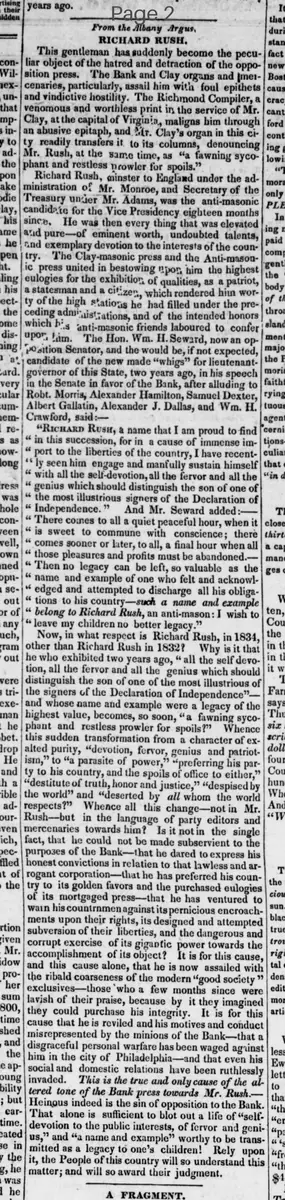
This gentleman has suddenly become the peculiar object of the hatred and detraction of the opposition press. The Bank and Clay organs and mercenaries, particularly, assail him with foul epithets and vindictive hostility. The Richmond Compiler, a venomous and worthless print in the service of Mr. Clay, at the capital of Virginia, maligns him through an abusive epitaph, and Mr. Clay's organ in this city readily transfers it to its columns, denouncing Mr. Rush, at the same time, as "a fawning sycophant and restless prowler for spoils."
Richard Rush, minister to England under the administration of Mr. Monroe, and Secretary of the Treasury under Mr. Adams, was the anti-masonic candidate for the Vice Presidency eighteen months since. He was then every thing that was elevated and pure—of eminent worth, undoubted talents, and exemplary devotion to the interests of the country. The Clay-masonic press and the Anti-masonic press united in bestowing upon him the highest eulogies for the exhibition of qualities, as a patriot, a statesman and a citizen, which rendered him worthy of the high stations he had filled under the preceding administrations, and of the intended honors which his anti-masonic friends laboured to confer upon him. The Hon. Wm. H. Seward, now an opposition Senator, and the would be, if not expected, candidate of the new made "whigs" for lieutenant-governor of this State, two years ago, in his speech in the Senate in favor of the Bank, after alluding to Robt. Morris, Alexander Hamilton, Samuel Dexter, Albert Gallatin, Alexander J. Dallas, and Wm. H. Crawford, said:
"Richard Rush, a name that I am proud to find in this succession, for in a cause of immense import to the liberties of the country, I have recently seen him engage and manfully sustain himself with all the self-devotion, all the fervor and all the genius which should distinguish the son of one of the most illustrious signers of the Declaration of Independence." And Mr. Seward added:
"There comes to all a quiet peaceful hour, when it is sweet to commune with conscience; there comes sooner or later, to all, a final hour when all those pleasures and profits must be abandoned.— Then no legacy can be left, so valuable as the name and example of one who felt and acknowledged and attempted to discharge all his obligations to his country—such a name and example belong to Richard Rush, an anti-mason: I wish to leave my children no better legacy."
Now, in what respect is Richard Rush, in 1834, other than Richard Rush in 1832? Why is it that he who exhibited two years ago, "all the self devotion, all the fervor and all the genius which should distinguish the son of one of the most illustrious of the signers of the Declaration of Independence"— and whose name and example were a legacy of the highest value, becomes, so soon, "a fawning sycophant and restless prowler for spoils?" Whence this sudden transformation from a character of exalted purity, "devotion, fervor, genius and patriotism," to "a parasite of power," preferring his party to his country, and the spoils of office to either," "destitute of truth, honor and justice," "despised by the world" and "deserted by all whom the world respects?" Whence all this change—not in Mr. Rush—but in the language of party editors and mercenaries towards him? Is it not in the single fact, that he could not be made subservient to the purposes of the Bank—that he dared to express his honest convictions in relation to that lawless and arrogant corporation—that he has preferred his country to its golden favors and the purchased eulogies of its mortgaged press—that he has ventured to warn his countrymen against its pernicious encroachments upon their rights, its designed and attempted subversion of their liberties, and the dangerous and corrupt exercise of its gigantic power towards the accomplishment of its object? It is for this cause, and this cause alone, that he is now assailed with the ribald coarseness of the modern "good society" exclusives—those who a few months since were lavish of their praise, because by it they imagined they could purchase his integrity. It is for this cause that he is reviled and his motives and conduct misrepresented by the minions of the Bank—that a disgraceful personal warfare has been waged against him in the city of Philadelphia—and that even his social and domestic relations have been ruthlessly invaded. This is the true and only cause of the altered tone of the Bank press towards Mr. Rush.— Heinous indeed is the sin of opposition to the Bank. That alone is sufficient to blot out a life of "self devotion to the public interests, of fervor and genius," and "a name and example" worthy to be transmitted as a legacy to one's children! Rely upon it, the People of this country will so understand this matter; and will so award their judgment.
RICHARD RUSH,
This gentleman has suddenly become the peculiar object of the hatred and detraction of the opposition press. The Bank and Clay organs and mercenaries, particularly, assail him with foul epithets and vindictive hostility. The Richmond Compiler, a venomous and worthless print in the service of Mr. Clay, at the capital of Virginia, maligns him through an abusive epitaph, and Mr. Clay's organ in this city readily transfers it to its columns, denouncing Mr. Rush, at the same time, as "a fawning sycophant and restless prowler for spoils."
Richard Rush, minister to England under the administration of Mr. Monroe, and Secretary of the Treasury under Mr. Adams, was the anti-masonic candidate for the Vice Presidency eighteen months since. He was then every thing that was elevated and pure—of eminent worth, undoubted talents, and exemplary devotion to the interests of the country. The Clay-masonic press and the Anti-masonic press united in bestowing upon him the highest eulogies for the exhibition of qualities, as a patriot, a statesman and a citizen, which rendered him worthy of the high stations he had filled under the preceding administrations, and of the intended honors which his anti-masonic friends laboured to confer upon him. The Hon. Wm. H. Seward, now an opposition Senator, and the would be, if not expected, candidate of the new made "whigs" for lieutenant-governor of this State, two years ago, in his speech in the Senate in favor of the Bank, after alluding to Robt. Morris, Alexander Hamilton, Samuel Dexter, Albert Gallatin, Alexander J. Dallas, and Wm. H. Crawford, said:
"Richard Rush, a name that I am proud to find in this succession, for in a cause of immense import to the liberties of the country, I have recently seen him engage and manfully sustain himself with all the self-devotion, all the fervor and all the genius which should distinguish the son of one of the most illustrious signers of the Declaration of Independence." And Mr. Seward added:
"There comes to all a quiet peaceful hour, when it is sweet to commune with conscience; there comes sooner or later, to all, a final hour when all those pleasures and profits must be abandoned.— Then no legacy can be left, so valuable as the name and example of one who felt and acknowledged and attempted to discharge all his obligations to his country—such a name and example belong to Richard Rush, an anti-mason: I wish to leave my children no better legacy."
Now, in what respect is Richard Rush, in 1834, other than Richard Rush in 1832? Why is it that he who exhibited two years ago, "all the self devotion, all the fervor and all the genius which should distinguish the son of one of the most illustrious of the signers of the Declaration of Independence"— and whose name and example were a legacy of the highest value, becomes, so soon, "a fawning sycophant and restless prowler for spoils?" Whence this sudden transformation from a character of exalted purity, "devotion, fervor, genius and patriotism," to "a parasite of power," preferring his party to his country, and the spoils of office to either," "destitute of truth, honor and justice," "despised by the world" and "deserted by all whom the world respects?" Whence all this change—not in Mr. Rush—but in the language of party editors and mercenaries towards him? Is it not in the single fact, that he could not be made subservient to the purposes of the Bank—that he dared to express his honest convictions in relation to that lawless and arrogant corporation—that he has preferred his country to its golden favors and the purchased eulogies of its mortgaged press—that he has ventured to warn his countrymen against its pernicious encroachments upon their rights, its designed and attempted subversion of their liberties, and the dangerous and corrupt exercise of its gigantic power towards the accomplishment of its object? It is for this cause, and this cause alone, that he is now assailed with the ribald coarseness of the modern "good society" exclusives—those who a few months since were lavish of their praise, because by it they imagined they could purchase his integrity. It is for this cause that he is reviled and his motives and conduct misrepresented by the minions of the Bank—that a disgraceful personal warfare has been waged against him in the city of Philadelphia—and that even his social and domestic relations have been ruthlessly invaded. This is the true and only cause of the altered tone of the Bank press towards Mr. Rush.— Heinous indeed is the sin of opposition to the Bank. That alone is sufficient to blot out a life of "self devotion to the public interests, of fervor and genius," and "a name and example" worthy to be transmitted as a legacy to one's children! Rely upon it, the People of this country will so understand this matter; and will so award their judgment.
What sub-type of article is it?
Partisan Politics
Economic Policy
What keywords are associated?
Richard Rush
Bank Opposition
Clay Press
Partisan Attacks
Anti Masonic
Political Vilification
What entities or persons were involved?
Richard Rush
Mr. Clay
Bank
Richmond Compiler
Wm. H. Seward
Albany Argus
Editorial Details
Primary Topic
Defense Of Richard Rush Against Bank And Clay Press Attacks
Stance / Tone
Supportive Of Rush, Critical Of Bank Supporters
Key Figures
Richard Rush
Mr. Clay
Bank
Richmond Compiler
Wm. H. Seward
Albany Argus
Key Arguments
Sudden Shift In Opposition Press From Praise To Vilification Of Rush
Prior Eulogies From Clay Masonic And Anti Masonic Press Highlighting His Patriotism And Genius
Seward's 1832 Senate Speech Praising Rush As A Legacy Worthy Figure
Change Due Solely To Rush's Opposition To The Bank Of The United States
Rush Preferred Country Over Bank's Favors And Warned Against Its Encroachments
Attacks Reveal Bank's Intolerance For Dissent And Corruption