Thank you for visiting SNEWPapers!
Sign up free
The Daily Union
Washington, District Of Columbia
What is this article about?
Reports suggest France and England are considering re-establishing an independent Kingdom of Poland to counter Russian influence in Europe and the Eastern Question. A Paris pamphlet argues that only restoring Poland can truly weaken Russia's power, as military victories alone won't suffice.
Clipping
OCR Quality
Full Text
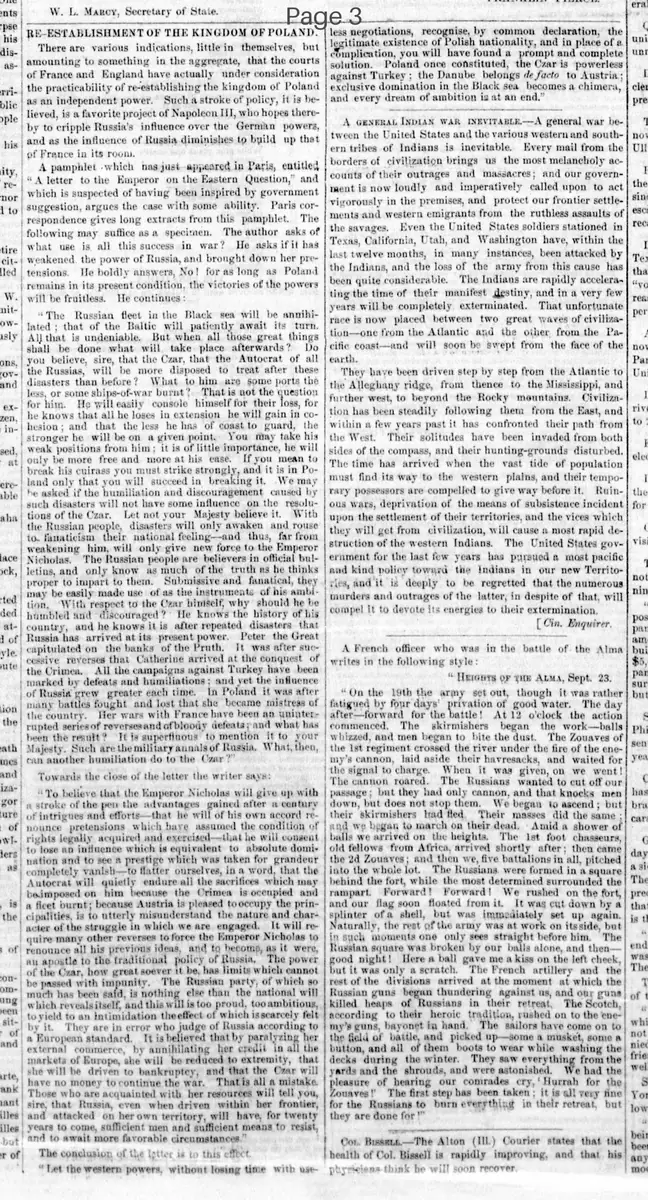
There are various indications, little in themselves, but amounting to something in the aggregate, that the courts of France and England have actually under consideration the practicability of re-establishing the kingdom of Poland as an independent power. Such a stroke of policy, it is believed, is a favorite project of Napoleon III, who hopes thereby to cripple Russia's influence over the German powers, and as the influence of Russia diminishes to build up that of France in its room.
A pamphlet which has just appeared in Paris, entitled "A letter to the Emperor on the Eastern Question," and which is suspected of having been inspired by government suggestion, argues the case with some ability. Paris correspondence gives long extracts from this pamphlet. The following may suffice as a specimen. The author asks of what use is all this success in war? He asks if it has weakened the power of Russia, and brought down her pretensions. He boldly answers, No! for as long as Poland remains in its present condition, the victories of the powers will be fruitless. He continues:
"The Russian fleet in the Black Sea will be annihilated: that of the Baltic will patiently await its turn. All that is undeniable. But when all those great things shall be done what will take place afterwards? Do you believe, sire, that the Czar, that the Autocrat of all the Russias, will be more disposed to treat after these disasters than before? What to him are some ports the less, or some ships-of-war burnt? That is not the question for him. He will easily console himself for their loss, for he knows that all he loses in extension he will gain in cohesion; and that the less he has of coast to guard, the stronger he will be on a given point. You may take his weak positions from him; it is of little importance, he will only be more free and more at his ease. If you mean to break his cuirass you must strike strongly, and it is in Poland only that you will succeed in breaking it."
We may be asked if the humiliation and discouragement caused by such disasters will not have some influence on the resolutions of the Czar. Let not your Majesty believe it. With the Russian people, disasters will only awaken and rouse to fanaticism their national feeling—and thus, far from weakening him, will only give new force to the Emperor Nicholas. The Russian people are believers in official bulletins, and only know as much of the truth as he thinks proper to impart to them. Submissive and fanatical, they may be easily made use of as the instruments of his ambition. With respect to the Czar himself, why should he be humbled and discouraged? He knows the history of his country, and he knows it is after repeated disasters that Russia has arrived at its present power. Peter the Great capitulated on the banks of the Pruth. It was after successive reverses that Catherine arrived at the conquest of the Crimea. All the campaigns against Turkey have been marked by defeats and humiliations; and yet the influence of Russia grew greater each time. In Poland it was after many battles fought and lost that she became mistress of the country. Her wars with France have been an uninterrupted series of reverses and of bloody defeats; and what has been the result? It is superfluous to mention it to your Majesty. Such are the military annals of Russia. What, then, can another humiliation do to the Czar?
Towards the close of the letter the writer says:
"To believe that the Emperor Nicholas will give up with a stroke of the pen the advantages gained after a century of intrigues and efforts—that he will of his own accord renounce pretensions which have assumed the condition of rights legally acquired and exercised—that he will consent to lose an influence which is equivalent to absolute domination and to see a prestige which was taken for grandeur completely vanish—to flatter ourselves, in a word, that the Autocrat will quietly endure all the sacrifices which may be imposed on him because the Crimea is occupied and a fleet burnt; because Austria is pleased to occupy the principalities, is to utterly misunderstand the nature and character of the struggle in which we are engaged. It will require many other reverses to force the Emperor Nicholas to renounce all his previous ideas, and to become, as it were, an apostle to the traditional policy of Russia. The power of the Czar, how great soever it be, has limits which cannot be passed with impunity. The Russian party, of which so much has been said, is nothing else than the national will which reveals itself, and this will is too proud, too ambitious, to yield to an intimidation the effect of which is scarcely felt by it. They are in error who judge of Russia according to a European standard. It is believed that by paralyzing her external commerce, by annihilating her credit in all the markets of Europe, she will be reduced to extremity, that she will be driven to bankruptcy, and that the Czar will have no money to continue the war. That is all a mistake. Those who are acquainted with her resources will tell you, sire, that Russia, even when driven within her frontier, and attacked on her own territory, will have, for twenty years to come, sufficient men and sufficient means to resist and to await more favorable circumstances."
The conclusion of the letter is to this effect:
"Let the western powers, without losing time with useless negotiations, recognise, by common declaration, the legitimate existence of Polish nationality, and in place of a complication, you will have found a prompt and complete solution. Poland once constituted, the Czar is powerless against Turkey; the Danube belongs de facto to Austria; exclusive domination in the Black Sea becomes a chimera, and every dream of ambition is at an end."
What sub-type of article is it?
What keywords are associated?
What entities or persons were involved?
Where did it happen?
Foreign News Details
Primary Location
Poland
Key Persons
Outcome
proposed re-establishment of independent poland to weaken russian influence, rendering russia powerless against turkey and ending ambitions in the black sea.
Event Details
Indications suggest France and England are considering re-establishing the Kingdom of Poland as an independent power, a project favored by Napoleon III to counter Russia's influence. A Paris pamphlet argues that military successes against Russia are insufficient without restoring Poland, as Russia's history shows resilience after defeats, and only breaking its hold on Poland can truly weaken it. The pamphlet urges Western powers to recognize Polish nationality for a swift resolution to the Eastern Question.