Thank you for visiting SNEWPapers!
Sign up free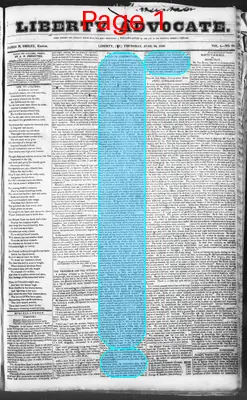
Editorial
June 24, 1839
Liberty Advocate
Liberty, Amite County, Mississippi
What is this article about?
An editorial from the Alexandria Gazette defends corporations, especially banks, against denunciations by the President and Administration party, arguing they promote prosperity, democracy, and equal opportunity, while criticizing the hostility as demagoguery aimed at the poor against the rich.
Clipping
OCR Quality
98%
Excellent
Full Text
From the Alexandria Gazette.
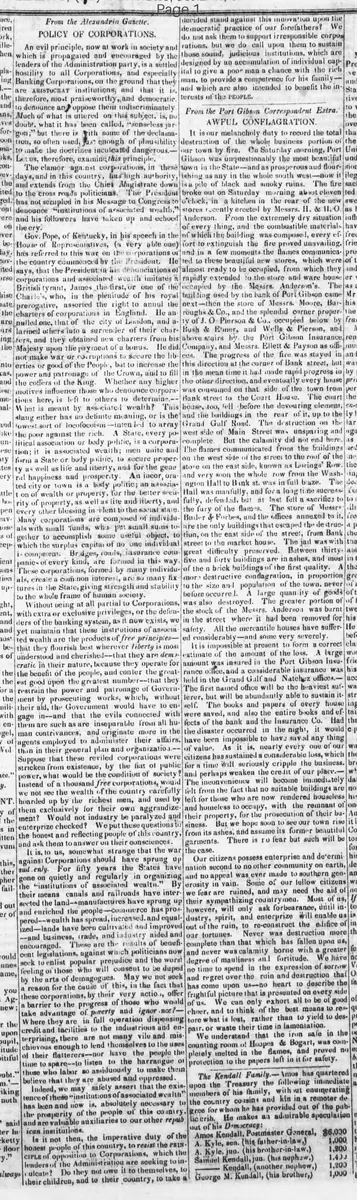
POLICY OF CORPORATIONS.
An evil principle, now at work in society and which is propagated and encouraged by the leaders of the Administration party, is a settled hostility to all Corporations, and especially Banking Corporations, on the ground that they are Aristocratic institutions, and that it is, therefore, most praiseworthy, and democratic, to denounce and oppose them indiscriminately. Much of what is uttered on this subject, is, no doubt, what it has been called, "senseless jargon;" but there is in some of the declamation, so often used, enough of plausibility to make the doctrines inculcated dangerous.—Let us, therefore, examine this principle.
The clamor against corporations, in these days, and in this country, has high authority, and extends from the Chief Magistrate down to the cross roads politicians. The President has not scrupled in his Message to Congress to denounce "institutions of associated wealth," and his followers have taken up and echoed the cry.
Gov. Pope, of Kentucky, in his speech in the House of Representatives, (a very able one) has referred to this war on the corporations of the country commenced by the President. He says, that the President in his denunciations of corporations and associated wealth imitates British tyrant, James the first, or one of the Charles's, who, in the plenitude of his royal prerogative, asserted the right to annul the charters of corporations in England. He annulled one, that of the city of London, and alarmed others into a surrender of their charters, and they obtained new charters from his Majesty upon the payment of a bonus. He did not make war on corporations to secure the liberties or good of the People, but to increase the power and patronage of the Crown, and to fill the coffers of the King. Whether any higher motives influence those who denounce corporations here, is left to others to determine.—What is meant by associated wealth? This slang either has no definite meaning, or is the lowest sort of locofocoism—intended to array the poor against the rich. A State, every political association or body politic, is a corporation; it is associated wealth; men unite and form a State or body politic, to secure property as well as life and liberty, and for the general happiness and prosperity. An incorporated city or town is a body politic; an association of wealth or property, for the better security of property, as well as life and liberty, and every other blessing incident to the social state.
Many corporations are composed of individuals with small funds, who put small sums together to accomplish some useful object, to which the surplus capital of no one individual is competent. Bridges, roads, insurance companies of every kind, are formed in this way. These corporations, formed by many individuals, create a common interest, are so many ligaments in the State, giving strength and stability to the whole frame of human society.
Without being at all partial to Corporations, with extra or exclusive privileges, or the defenders of the banking system, as it now exists, we yet maintain that these institutions of associated wealth are the products of free principles—that they flourish best wherever liberty is most understood and cherished—that they are democratic in their nature, because they operate for the benefit of the people, and confer the greatest good upon the greatest number—that they restrain the power and patronage of Government by prosecuting works, which, without their aid, the Government would have to engage in—and that the evils connected with them are such as are inseparable from all human contrivances, and originate more in the agents employed to administer their affairs, than in their general plan and organization.—Suppose that these reviled corporations were stricken from existence, by the fiat of public power, what would be the condition of society? Instead of a thousand free corporations, would we not see the wealth of the country carefully hoarded up by the richest men, and used by them exclusively for their own aggrandizement? Would not industry be paralyzed and enterprize checked? We put these questions to the honest and reflecting people of this country, and ask them to answer on their consciences.
It is, to us, somewhat strange that the war against Corporations should have sprung up suddenly. For fifty years the States have gone on quietly and regularly in organizing the "institutions of associated wealth." By their means canals and railroads have intersected the land—manufactures have sprung up and enriched the people—commerce has prospered—wealth has spread, increased, and equalized—lands have been cultivated and improved—and business, trade, and industry aided and encouraged. These are the results of beneficent legislations, against which politicians now seek to enlist popular prejudice and the worst feeling of those who will consent to be duped by the arts of demagogues. May we not seek a reason for the cause of this, in the fact that these corporations, by their very action, offer a barrier to the progress of those who would take advantage of poverty and ignorance?—Where they are in full operation dispensing credit and facilities to the industrious and enterprising, there are not many vile and mischievous enough to lend themselves to the uses of their flatterers—nor have the people the time to spare—to listen to the harangue of those who labor so assiduously to make them believe that they are abused and oppressed.
Indeed, we may safely assert that the existence of these "institutions of associated wealth" has been and now is, absolutely necessary to the prosperity of the people of this country, and are valuable auxiliaries to our other republican institutions.
Is it not then, the imperative duty of the honest people of this country, to resist the principle of opposition to Corporations, which the leaders of the Administration are seeking to inculcate? Do they not owe it to themselves, to their children, and to their country, to take a decided stand against this innovation upon the democratic practice of our forefathers? We do not ask them to support irresponsible corporations, but we do call upon them to sustain those sound, judicious institutions, which are designed by an accumulation of individual capital to give a poor man a chance with the rich man, to provide a competence for his family—and which are also intended to benefit the interests of the PEOPLE.
POLICY OF CORPORATIONS.
An evil principle, now at work in society and which is propagated and encouraged by the leaders of the Administration party, is a settled hostility to all Corporations, and especially Banking Corporations, on the ground that they are Aristocratic institutions, and that it is, therefore, most praiseworthy, and democratic, to denounce and oppose them indiscriminately. Much of what is uttered on this subject, is, no doubt, what it has been called, "senseless jargon;" but there is in some of the declamation, so often used, enough of plausibility to make the doctrines inculcated dangerous.—Let us, therefore, examine this principle.
The clamor against corporations, in these days, and in this country, has high authority, and extends from the Chief Magistrate down to the cross roads politicians. The President has not scrupled in his Message to Congress to denounce "institutions of associated wealth," and his followers have taken up and echoed the cry.
Gov. Pope, of Kentucky, in his speech in the House of Representatives, (a very able one) has referred to this war on the corporations of the country commenced by the President. He says, that the President in his denunciations of corporations and associated wealth imitates British tyrant, James the first, or one of the Charles's, who, in the plenitude of his royal prerogative, asserted the right to annul the charters of corporations in England. He annulled one, that of the city of London, and alarmed others into a surrender of their charters, and they obtained new charters from his Majesty upon the payment of a bonus. He did not make war on corporations to secure the liberties or good of the People, but to increase the power and patronage of the Crown, and to fill the coffers of the King. Whether any higher motives influence those who denounce corporations here, is left to others to determine.—What is meant by associated wealth? This slang either has no definite meaning, or is the lowest sort of locofocoism—intended to array the poor against the rich. A State, every political association or body politic, is a corporation; it is associated wealth; men unite and form a State or body politic, to secure property as well as life and liberty, and for the general happiness and prosperity. An incorporated city or town is a body politic; an association of wealth or property, for the better security of property, as well as life and liberty, and every other blessing incident to the social state.
Many corporations are composed of individuals with small funds, who put small sums together to accomplish some useful object, to which the surplus capital of no one individual is competent. Bridges, roads, insurance companies of every kind, are formed in this way. These corporations, formed by many individuals, create a common interest, are so many ligaments in the State, giving strength and stability to the whole frame of human society.
Without being at all partial to Corporations, with extra or exclusive privileges, or the defenders of the banking system, as it now exists, we yet maintain that these institutions of associated wealth are the products of free principles—that they flourish best wherever liberty is most understood and cherished—that they are democratic in their nature, because they operate for the benefit of the people, and confer the greatest good upon the greatest number—that they restrain the power and patronage of Government by prosecuting works, which, without their aid, the Government would have to engage in—and that the evils connected with them are such as are inseparable from all human contrivances, and originate more in the agents employed to administer their affairs, than in their general plan and organization.—Suppose that these reviled corporations were stricken from existence, by the fiat of public power, what would be the condition of society? Instead of a thousand free corporations, would we not see the wealth of the country carefully hoarded up by the richest men, and used by them exclusively for their own aggrandizement? Would not industry be paralyzed and enterprize checked? We put these questions to the honest and reflecting people of this country, and ask them to answer on their consciences.
It is, to us, somewhat strange that the war against Corporations should have sprung up suddenly. For fifty years the States have gone on quietly and regularly in organizing the "institutions of associated wealth." By their means canals and railroads have intersected the land—manufactures have sprung up and enriched the people—commerce has prospered—wealth has spread, increased, and equalized—lands have been cultivated and improved—and business, trade, and industry aided and encouraged. These are the results of beneficent legislations, against which politicians now seek to enlist popular prejudice and the worst feeling of those who will consent to be duped by the arts of demagogues. May we not seek a reason for the cause of this, in the fact that these corporations, by their very action, offer a barrier to the progress of those who would take advantage of poverty and ignorance?—Where they are in full operation dispensing credit and facilities to the industrious and enterprising, there are not many vile and mischievous enough to lend themselves to the uses of their flatterers—nor have the people the time to spare—to listen to the harangue of those who labor so assiduously to make them believe that they are abused and oppressed.
Indeed, we may safely assert that the existence of these "institutions of associated wealth" has been and now is, absolutely necessary to the prosperity of the people of this country, and are valuable auxiliaries to our other republican institutions.
Is it not then, the imperative duty of the honest people of this country, to resist the principle of opposition to Corporations, which the leaders of the Administration are seeking to inculcate? Do they not owe it to themselves, to their children, and to their country, to take a decided stand against this innovation upon the democratic practice of our forefathers? We do not ask them to support irresponsible corporations, but we do call upon them to sustain those sound, judicious institutions, which are designed by an accumulation of individual capital to give a poor man a chance with the rich man, to provide a competence for his family—and which are also intended to benefit the interests of the PEOPLE.
What sub-type of article is it?
Economic Policy
Partisan Politics
What keywords are associated?
Corporations
Banking Institutions
Associated Wealth
Administration Party
Economic Prosperity
Demagoguery
Partisan Politics
What entities or persons were involved?
President
Administration Party
Gov. Pope Of Kentucky
British Tyrants James I Or Charles
Editorial Details
Primary Topic
Defense Of Corporations Against Administration Hostility
Stance / Tone
Supportive Of Corporations, Critical Of Administration Demagoguery
Key Figures
President
Administration Party
Gov. Pope Of Kentucky
British Tyrants James I Or Charles
Key Arguments
Corporations Are Democratic Institutions Benefiting The People And Greatest Number.
Hostility To Corporations Arrays Poor Against Rich And Imitates Tyrannical Monarchs.
Corporations Enable Small Investors To Achieve Useful Projects Like Bridges And Roads.
Without Corporations, Wealth Would Be Hoarded By The Rich, Paralyzing Industry.
Corporations Have Driven Prosperity Through Canals, Railroads, And Commerce For 50 Years.
Opposition To Corporations Is A Demagogic Barrier To Exploiting Poverty And Ignorance.
People Should Resist This Anti Corporate Principle To Uphold Democratic Practices.