Thank you for visiting SNEWPapers!
Sign up free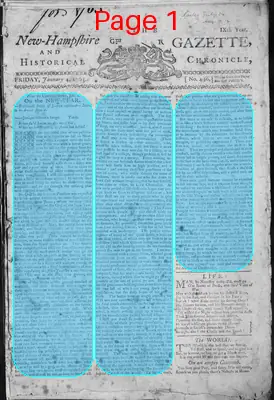
Literary
January 4, 1765
The New Hampshire Gazette And Historical Chronicle
Portsmouth, Greenland, Rockingham County, New Hampshire
What is this article about?
An essay from The Connoisseur on the New Year, using the two-faced god Janus as an emblem for moral prudence: reflecting on the past to guide the future. It critiques rash optimism, excessive retrospection, and thoughtlessness, urging readers to learn from experience for happiness and virtue, ending with religious awe.
Clipping
OCR Quality
98%
Excellent
Full Text
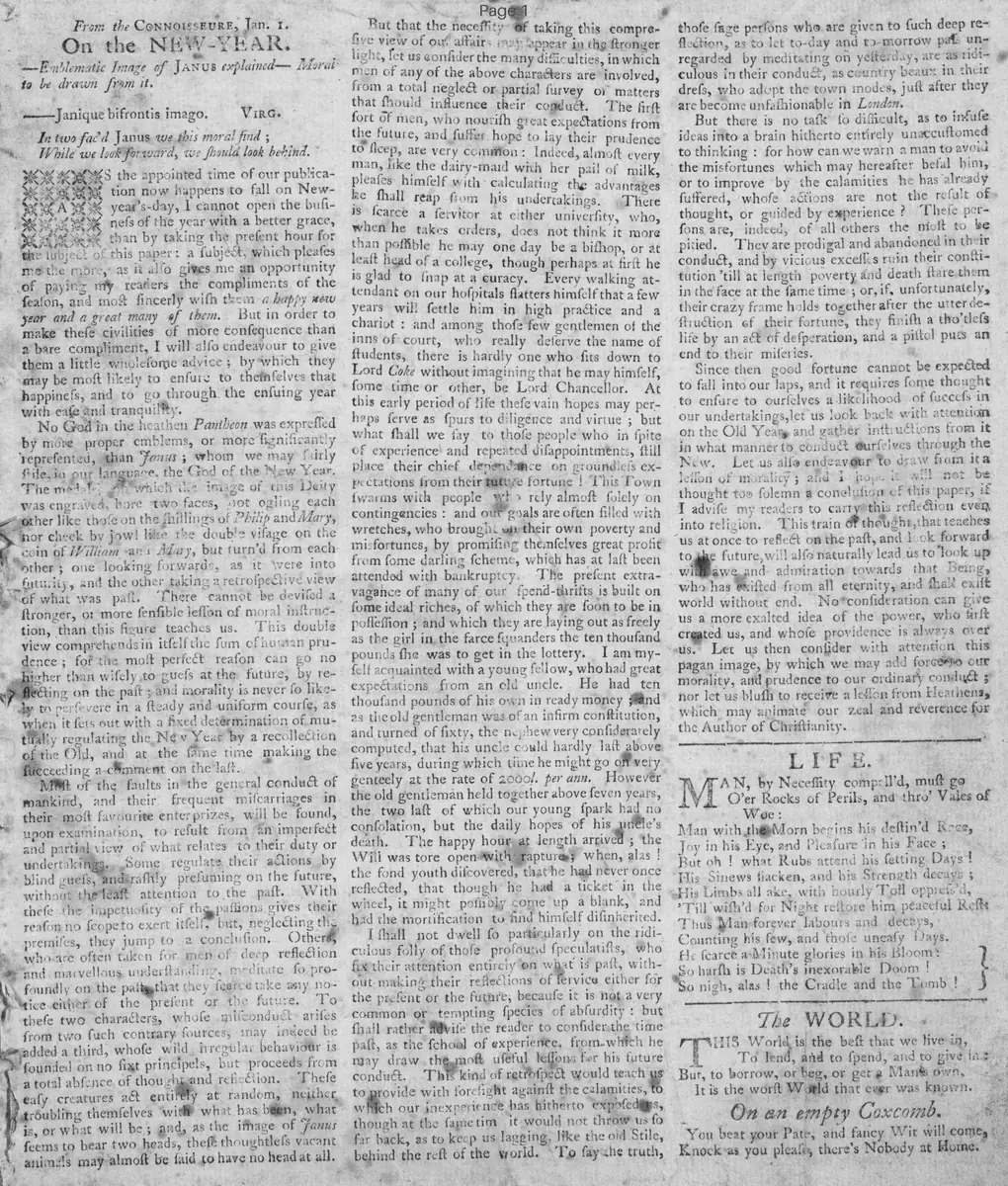
From the Connoisseur, Jan. I.
On the NEW-YEAR.
Emblematic Image of Janus explained-- Moral to be drawn from it.
--Janique bifrontis imago.
VIRG.
In two fac'd Janus we this moral find :
While we look forward, we should look behind.
As the appointed time of our publication now happens to fall on New-Year's-Day, I cannot open the business of the year with a better grace, than by taking the present hour for the subject of this paper: a subject, which pleases me the more, as it also gives me an opportunity of paying my readers the compliments of the season, and most sincerely wish them a happy new year and a great many of them. But in order to make these civilities of more consequence than a bare compliment, I will also endeavour to give them a little wholesome advice ; by which they may be most likely to ensure to themselves that happiness, and to go through the ensuing year with ease and tranquility.
No God in the heathen Pantheon was expressed by more proper emblems, or more significantly represented, than Janus ; whom we may fairly style, in our language, the God of the New Year. The medal, of which the image of this Deity was engraved, bore two faces, not ogling each other like those on the shillings of Philip and Mary, nor cheek by jowl like the double visage on the coin of William and Mary, but turn'd from each other ; one looking forwards, as it were into futurity, and the other taking a retrospective view of what was past. There cannot be devised a stronger, or more sensible lesson of moral instruction, than this figure teaches us. This double view comprehends in itself the sum of human prudence : for the most perfect reason can go no higher than wisely to guess at the future, by reflecting on the past ; and morality is never so likely to persevere in a steady and uniform course, as when it sets out with a fixed determination of mutually regulating the New Year by a recollection of the Old, and at the same time making the succeeding a comment on the last.
Most of the faults in the general conduct of mankind, and their frequent miscarriages in their most favourite enterprizes, will be found, upon examination, to result from an imperfect and partial view of what relates to their duty or undertakings. Some regulate their actions by blind guess, and rashly presuming on the future, without the least attention to the past. With these the impetuosity of the passions gives their reason no opportunity to exert itself, but, neglecting the premises, they jump to a conclusion. Others, who are often taken for men of deep reflection and marvellous understanding, meditate so profoundly on the past, that they scarce take any notice either of the present or the future. To these two characters, whose misconduct arises from two such contrary sources, may indeed be added a third, whose wild irregular behaviour is founded on no fixed principles, but proceeds from a total absence of thought and reflection. These easy creatures act entirely at random, neither troubling themselves with what has been, what is, or what will be; and, as the image of Janus seems to bear two heads, these thoughtless vacant animals may almost be said to have no head at all.
But that the necessity of taking this comprehensive view of our affairs may appear in the stronger light, let us consider the many difficulties, in which men of any of the above characters are involved, from a total neglect or partial survey of matters that should influence their conduct. The first sort of men, who nourish great expectations from the future, and suffer hope to lay their prudence to sleep, are very common : Indeed, almost every man, like the dairy-maid with her pail of milk, pleases himself with calculating the advantages he shall reap from his undertakings. There is scarce a servitor at either university, who, when he takes orders, does not think it more than possible he may one day be a bishop, or at least head of a college, though perhaps at first he is glad to snap at a curacy. Every walking attendant on our hospitals flatters himself that a few years will settle him in high practice and a chariot : and among those few gentlemen of the inns of-court, who really deserve the name of students, there is hardly one who sits down to Lord Coke without imagining that he may himself, some time or other, be Lord Chancellor. At this early period of life these vain hopes may perhaps serve as spurs to diligence and virtue ; but what shall we say to those people who in spite of experience and repeated disappointments, still place their chief dependance on groundless expectations from their future fortune ! This Town swarms with people who rely almost solely on contingencies : and our goals are often filled with wretches, who brought on their own poverty and misfortunes, by promising themselves great profit from some darling scheme, which has at last been attended with bankruptcy. The present extravagance of many of our spend-thrifts is built on some ideal riches, of which they are soon to be in possession ; and which they are laying out as freely as the girl in the farce squanders the ten thousand pounds she was to get in the lottery. I am myself acquainted with a young fellow, who had great expectations from an old uncle. He had ten thousand pounds of his own in ready money ; and as the old gentleman was of an infirm constitution, and turned of sixty, the nephew very considerately computed, that his uncle could hardly last above five years, during which time he might go on very genteely at the rate of 2000l. per ann. However the old gentleman held together above seven years, the two last of which our young spark had no consolation, but the daily hopes of his uncle's death. The happy hour at length arrived ; the Will was tore open with rapture ; when, alas ! the fond youth discovered, that he had never once reflected, that though he had a ticket in the wheel, it might possibly come up a blank, and had the mortification to find himself disinherited.
I shall not dwell so particularly on the ridiculous folly of those profound speculatists, who fix their attention entirely on what is past, without making their reflections of service either for the present or the future, because it is not a very common or tempting species of absurdity : but shall rather advise the reader to consider the time past, as the school of experience, from which he may draw the most useful lessons for his future conduct. This kind of retrospective would teach us to provide with foresight against the calamities, to which our inexperience has hitherto exposed us, though at the same time it would not throw us so far back, as to keep us lagging, like the old Style, behind the rest of the world. To say the truth, those aged persons who are given to such deep reflection, as to let to-day and to-morrow pass unregarded by meditating on yesterday, are as ridiculous in their conduct, as country beaux in their dress, who adopt the town modes, just after they are become unfashionable in London.
But there is no task so difficult, as to infuse ideas into a brain hitherto entirely unaccustomed to thinking : for how can we warn a man to avoid the misfortunes which may hereafter befall him, or to improve by the calamities he has already suffered, whose actions are not the result of thought, or guided by experience ? These persons are, indeed, of all others the most to be pitied. They are prodigal and abandoned in their conduct, and by vicious excesses ruin their constitution 'till at length poverty and death stare them in the face at the same time ; or, if, unfortunately, their crazy frame holds together after the utter destruction of their fortune, they finish a thoughtless life by an act of desperation, and a pistol puts an end to their miseries.
Since then good fortune cannot be expected to fall into our laps, and it requires some thought to ensure to ourselves a likelihood of success in our undertakings, let us look back with attention on the Old Year and gather instructions from it in what manner to conduct ourselves through the New. Let us also endeavour to draw from it a lesson of morality ; and I hope it will not be thought too solemn a conclusion of this paper, if I advise my readers to carry this reflection even into religion. This train of thought, that teaches us at once to reflect on the past, and look forward to the future, will also naturally lead us to look up with awe and admiration towards that Being, who has existed from all eternity, and shall exist world without end. No consideration can give us a more exalted idea of the power, who first created us, and whose providence is always over us. Let us then consider with attention this pagan image, by which we may add force to our morality, and prudence to our ordinary conduct ; nor let us blush to receive a lesson from Heathens, which may animate our zeal and reverence for the Author of Christianity.
On the NEW-YEAR.
Emblematic Image of Janus explained-- Moral to be drawn from it.
--Janique bifrontis imago.
VIRG.
In two fac'd Janus we this moral find :
While we look forward, we should look behind.
As the appointed time of our publication now happens to fall on New-Year's-Day, I cannot open the business of the year with a better grace, than by taking the present hour for the subject of this paper: a subject, which pleases me the more, as it also gives me an opportunity of paying my readers the compliments of the season, and most sincerely wish them a happy new year and a great many of them. But in order to make these civilities of more consequence than a bare compliment, I will also endeavour to give them a little wholesome advice ; by which they may be most likely to ensure to themselves that happiness, and to go through the ensuing year with ease and tranquility.
No God in the heathen Pantheon was expressed by more proper emblems, or more significantly represented, than Janus ; whom we may fairly style, in our language, the God of the New Year. The medal, of which the image of this Deity was engraved, bore two faces, not ogling each other like those on the shillings of Philip and Mary, nor cheek by jowl like the double visage on the coin of William and Mary, but turn'd from each other ; one looking forwards, as it were into futurity, and the other taking a retrospective view of what was past. There cannot be devised a stronger, or more sensible lesson of moral instruction, than this figure teaches us. This double view comprehends in itself the sum of human prudence : for the most perfect reason can go no higher than wisely to guess at the future, by reflecting on the past ; and morality is never so likely to persevere in a steady and uniform course, as when it sets out with a fixed determination of mutually regulating the New Year by a recollection of the Old, and at the same time making the succeeding a comment on the last.
Most of the faults in the general conduct of mankind, and their frequent miscarriages in their most favourite enterprizes, will be found, upon examination, to result from an imperfect and partial view of what relates to their duty or undertakings. Some regulate their actions by blind guess, and rashly presuming on the future, without the least attention to the past. With these the impetuosity of the passions gives their reason no opportunity to exert itself, but, neglecting the premises, they jump to a conclusion. Others, who are often taken for men of deep reflection and marvellous understanding, meditate so profoundly on the past, that they scarce take any notice either of the present or the future. To these two characters, whose misconduct arises from two such contrary sources, may indeed be added a third, whose wild irregular behaviour is founded on no fixed principles, but proceeds from a total absence of thought and reflection. These easy creatures act entirely at random, neither troubling themselves with what has been, what is, or what will be; and, as the image of Janus seems to bear two heads, these thoughtless vacant animals may almost be said to have no head at all.
But that the necessity of taking this comprehensive view of our affairs may appear in the stronger light, let us consider the many difficulties, in which men of any of the above characters are involved, from a total neglect or partial survey of matters that should influence their conduct. The first sort of men, who nourish great expectations from the future, and suffer hope to lay their prudence to sleep, are very common : Indeed, almost every man, like the dairy-maid with her pail of milk, pleases himself with calculating the advantages he shall reap from his undertakings. There is scarce a servitor at either university, who, when he takes orders, does not think it more than possible he may one day be a bishop, or at least head of a college, though perhaps at first he is glad to snap at a curacy. Every walking attendant on our hospitals flatters himself that a few years will settle him in high practice and a chariot : and among those few gentlemen of the inns of-court, who really deserve the name of students, there is hardly one who sits down to Lord Coke without imagining that he may himself, some time or other, be Lord Chancellor. At this early period of life these vain hopes may perhaps serve as spurs to diligence and virtue ; but what shall we say to those people who in spite of experience and repeated disappointments, still place their chief dependance on groundless expectations from their future fortune ! This Town swarms with people who rely almost solely on contingencies : and our goals are often filled with wretches, who brought on their own poverty and misfortunes, by promising themselves great profit from some darling scheme, which has at last been attended with bankruptcy. The present extravagance of many of our spend-thrifts is built on some ideal riches, of which they are soon to be in possession ; and which they are laying out as freely as the girl in the farce squanders the ten thousand pounds she was to get in the lottery. I am myself acquainted with a young fellow, who had great expectations from an old uncle. He had ten thousand pounds of his own in ready money ; and as the old gentleman was of an infirm constitution, and turned of sixty, the nephew very considerately computed, that his uncle could hardly last above five years, during which time he might go on very genteely at the rate of 2000l. per ann. However the old gentleman held together above seven years, the two last of which our young spark had no consolation, but the daily hopes of his uncle's death. The happy hour at length arrived ; the Will was tore open with rapture ; when, alas ! the fond youth discovered, that he had never once reflected, that though he had a ticket in the wheel, it might possibly come up a blank, and had the mortification to find himself disinherited.
I shall not dwell so particularly on the ridiculous folly of those profound speculatists, who fix their attention entirely on what is past, without making their reflections of service either for the present or the future, because it is not a very common or tempting species of absurdity : but shall rather advise the reader to consider the time past, as the school of experience, from which he may draw the most useful lessons for his future conduct. This kind of retrospective would teach us to provide with foresight against the calamities, to which our inexperience has hitherto exposed us, though at the same time it would not throw us so far back, as to keep us lagging, like the old Style, behind the rest of the world. To say the truth, those aged persons who are given to such deep reflection, as to let to-day and to-morrow pass unregarded by meditating on yesterday, are as ridiculous in their conduct, as country beaux in their dress, who adopt the town modes, just after they are become unfashionable in London.
But there is no task so difficult, as to infuse ideas into a brain hitherto entirely unaccustomed to thinking : for how can we warn a man to avoid the misfortunes which may hereafter befall him, or to improve by the calamities he has already suffered, whose actions are not the result of thought, or guided by experience ? These persons are, indeed, of all others the most to be pitied. They are prodigal and abandoned in their conduct, and by vicious excesses ruin their constitution 'till at length poverty and death stare them in the face at the same time ; or, if, unfortunately, their crazy frame holds together after the utter destruction of their fortune, they finish a thoughtless life by an act of desperation, and a pistol puts an end to their miseries.
Since then good fortune cannot be expected to fall into our laps, and it requires some thought to ensure to ourselves a likelihood of success in our undertakings, let us look back with attention on the Old Year and gather instructions from it in what manner to conduct ourselves through the New. Let us also endeavour to draw from it a lesson of morality ; and I hope it will not be thought too solemn a conclusion of this paper, if I advise my readers to carry this reflection even into religion. This train of thought, that teaches us at once to reflect on the past, and look forward to the future, will also naturally lead us to look up with awe and admiration towards that Being, who has existed from all eternity, and shall exist world without end. No consideration can give us a more exalted idea of the power, who first created us, and whose providence is always over us. Let us then consider with attention this pagan image, by which we may add force to our morality, and prudence to our ordinary conduct ; nor let us blush to receive a lesson from Heathens, which may animate our zeal and reverence for the Author of Christianity.
What sub-type of article is it?
Essay
What themes does it cover?
Moral Virtue
Religious
Seasonal Cycle
What keywords are associated?
Janus
New Year
Moral Prudence
Retrospection
Future Guidance
Human Faults
Religious Reflection
What entities or persons were involved?
From The Connoisseur
Literary Details
Title
On The New Year.
Author
From The Connoisseur
Subject
Emblematic Image Of Janus Explained Moral To Be Drawn From It.
Key Lines
Janique Bifrontis Imago.
Virg.
In Two Fac'd Janus We This Moral Find :
While We Look Forward, We Should Look Behind.
This Double View Comprehends In Itself The Sum Of Human Prudence : For The Most Perfect Reason Can Go No Higher Than Wisely To Guess At The Future, By Reflecting On The Past ; And Morality Is Never So Likely To Persevere In A Steady And Uniform Course, As When It Sets Out With A Fixed Determination Of Mutually Regulating The New Year By A Recollection Of The Old, And At The Same Time Making The Succeeding A Comment On The Last.
Let Us Then Consider With Attention This Pagan Image, By Which We May Add Force To Our Morality, And Prudence To Our Ordinary Conduct ; Nor Let Us Blush To Receive A Lesson From Heathens, Which May Animate Our Zeal And Reverence For The Author Of Christianity.