Thank you for visiting SNEWPapers!
Sign up free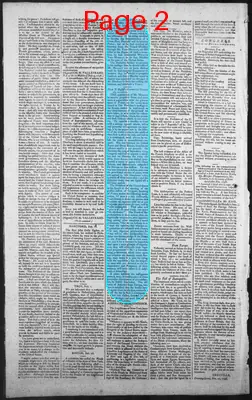
The New Hampshire Gazette
Portsmouth, Rockingham County, New Hampshire
What is this article about?
US President nominates William Vans Murray as Minister to France with conditions for proper reception and equal negotiations, amid ongoing war preparations; commentary affirms no relaxation of defenses, drawing historical parallels.
Clipping

OCR Quality
Full Text
The President yesterday sent a message to the Senate, in which he informed them, that he continued faithful to his declaration never to send another Minister to France, unless he had assurances of his being received as became the Representative of a Great, Free, Powerful and Independent Nation: but as he had received assurances from the French Minister, through Mr. Vans Murray, our Minister at the Hague, of such a reception, he had nominated William Vans Murray, to be that Minister on the part of the United States. The President further mentioned, in his message that he should instruct Mr. Murray not to leave Holland until he had received Unequivocal assurances that he would be properly received, and that a Minister equal in dignity was appointed on the part of the Directory to settle the existing differences, and conclude a Treaty.
From F. Russell's Commercial Gazette.
MR. RUSSELL,
THE nomination of Mr. MURRAY to receive proposals from, and enter upon a negociation with the government of France, on the terms mentioned in The President's message to the Senate, cannot be considered as any abandonment of the ground we have taken, or as a reason for relaxation in that system, which, has produced such salutary effects to our country. To appoint a minister to treat with a nation, against whom, active and powerful arrangements are making, is by no means new in the history of the world; even in the midst of war, such is often the case, and before it is terminated, must always be unless the result is unconditional conquest. The war between the United States and Great Britain, furnishes an instance exactly to our purpose. On Saturday the 25th of September 1779, Congress resolved to appoint a minister, and on Monday the 27th, the Hon. John Adams was elected, to negotiate a treaty of peace with Great Britain, and immediately embarked for Europe on that mission. Yet the war was continued as before, and even the provisional articles of peace, were not agreed to, 'till December 1782, upwards of three years after; and the definitive treaty was not signed till a still later period,
The President of the United States in his speech at the opening of the present session of Congress, speaking of France, makes the following declaration, "I deem it a duty deliberately, and solemnly to declare my opinion, that whether we negotiate with her or not; vigorous preparations for war, will be alike indispensable. These alone will give to us, an equal treaty, and insure its observance." The House of Representatives in their answer, thus energetically reciprocate, after approbating among other measures a naval armament, "Nor do we hesitate to adopt the opinion, that whether negotiations are resumed with France, or not, vigorous preparations for war will be alike indispensable."
After this solemn pledge of the House to the President, and to their country, can it for a moment be supposed, that upon a mere glimpse of negociation, they will relinquish those vigorous preparations'? No! a few trimming go-betweens, whose votes upon any occasion are scarcely worth having, may make it a plea for siding with the opposition; but the majority, men who are devoted to the Independence and Prosperity of their country, will never resort to so despicable a subterfuge.
A peace between the belligerent powers, may, in consequence of some particular concurrence of circumstances, be hastily concluded. The distance of America from Europe, renders it necessary that she should have an agent there on the spot, authorized to act for her in such a contingency, to assert her claims, demand redress for her wrongs, and avail himself of different conjunctures.
What sub-type of article is it?
What keywords are associated?
What entities or persons were involved?
Where did it happen?
Foreign News Details
Primary Location
France
Event Date
Feb. 19
Key Persons
Event Details
The President sent a message to the Senate nominating William Vans Murray as Minister to France after receiving assurances from the French Minister through Mr. Vans Murray at the Hague of proper reception. Instructions for Mr. Murray include not leaving Holland without unequivocal assurances of proper reception and appointment of an equal minister from the Directory to settle differences and conclude a treaty. Commentary notes this does not abandon prior stance, cites historical precedent of John Adams' 1779 mission to Great Britain during war, quotes President's speech and House response on need for war preparations regardless of negotiations, and emphasizes maintaining preparations while having an agent in Europe for potential peace contingencies.