Thank you for visiting SNEWPapers!
Sign up free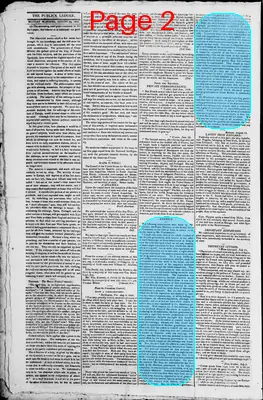
Norfolk Gazette And Publick Ledger
Norfolk, Virginia
What is this article about?
In the British House of Commons on June 24, Prime Minister Canning defended the government's handling of the Chesapeake affair, emphasizing reparation offered without surrendering British rights, and noted no recent communications from America amid possible French negotiations. Whitbread responded on parliamentary debate's influence.
Clipping
OCR Quality
Full Text
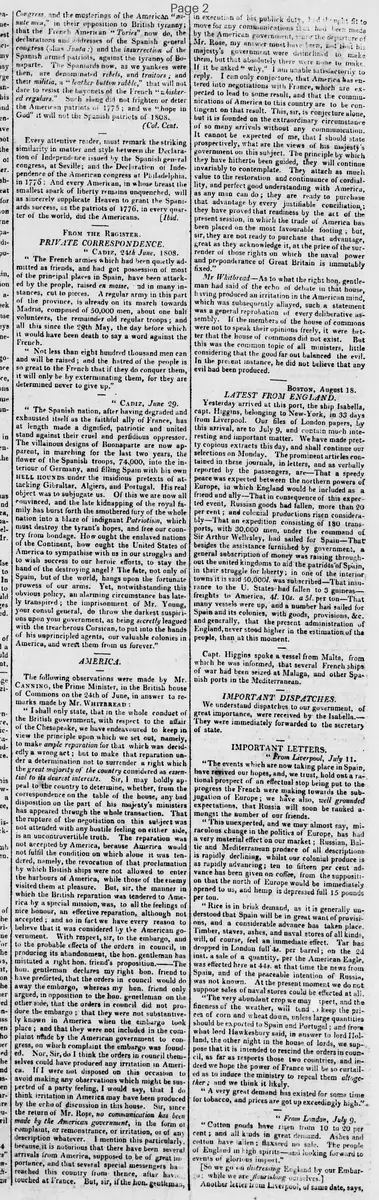
The following observations were made by Mr. Canning, the Prime Minister, in the British house of Commons on the 24th of June, in answer to remarks made by Mr. WHITBREAD:
"I shall only state, that in the whole conduct of the British government, with respect to the affair of the Chesapeake, we have endeavoured to keep in view the principle upon which we set out, namely, to make ample reparation for that which was decidedly a wrong act; but to make that reparation under a determination not to surrender a right which the great majority of the country considered as essential to its dearest interests. Sir, I may boldly appeal to the country to determine, whether, from the correspondence on the table of the house, any bad disposition on the part of his majesty's ministers has appeared through the whole transaction. That the rupture of the negotiation on this subject was not attended with any hostile feeling on either side, is an uncontrovertible truth. The reparation was not accepted by America, because America would not fulfil the condition on which alone it was tendered, namely, the revocation of that proclamation by which British ships were not allowed to enter the harbours of America, while those of the enemy visited them at pleasure. But, sir, the manner in which the British reparation was tendered to America by a special mission, was, to all the feelings of nice honour, an effective reparation, although not accepted; and so in fact we have every reason to believe that it was considered by the American government. With respect, sir, to the embargo, and to the probable effects of the orders in council, in producing its abandonment, the hon. gentleman has mistated a right hon. friend's proposition. The hon. gentleman declares my right hon. friend to have predicted, that the orders in council would do away the embargo, whereas my hon. friend only argued, in opposition to the hon. gentleman on the other side; that the orders in council did not produce the embargo; that they were not substantially known in America when the embargo took place; and that they were not included in the complaint made by the American government to congress, on which complaint the embargo was founded. Nor, Sir, do I think the orders in council themselves could have produced any irritation in America. If I were not disposed on this occasion to avoid making any observations which might be suspected of a party feeling, I would say, that I do think irritation in America may have been produced by the echo of discussion in this house. Sir, since the return of Mr. Rose, no communication has been made by the American government, in the form of complaint, or remonstrance, or irritation, or of any description whatever. I mention this particularly, because it is notorious that there have been several arrivals from America, supposed to be of great importance, and that several special messengers have reached this country from thence, after having touched at France. But, sir, if the hon. gentleman, in execution of his publick duty, had thought fit to move for any communications that had been made by the American government, since the departure of Mr. Rose, my answer must have been, not that his majesty's government were disinclined to make them, but that absolutely there were none to make. If it be asked "why," I am unable satisfactorily to reply. I can only conjecture, that America has entered into negotiations with France, which are expected to lead to some result, and that the communications of America to this country are to be contingent on that result. This, sir, is conjecture alone, but it is founded on the extraordinary circumstance of so many arrivals without any communication. It cannot be expected of me, that I should state prospectively, what are the views of his majesty's government on this subject. The principle by which they have hitherto been guided, they will continue invariably to contemplate. They attach as much value to the restoration and continuance of cordiality, and perfect good understanding with America, as any man can do; they are ready to purchase that advantage by every justifiable conciliation; they have proved that readiness by the act of the present session, in which the trade of America has been placed on the most favourable footing; but, sir, they are not ready to purchase that advantage, great as they acknowledge it, at the price of the surrender of those rights on which the naval power and preponderance of Great Britain is immutably fixed."
Mr. Whitbread—As to what the right hon. gentleman had said of the echo of debate in that house, having produced an irritation in the American mind, which was subsequently allayed, such a statement was a general reprobation of every deliberative assembly. If the members of the house of commons were not to speak their opinions freely, it were better that the house of commons did not exist. But this was the common topic of all ministers, little considering that the good far out balanced the evil. In the present instance, he did not believe that any evil had been produced.
What sub-type of article is it?
What keywords are associated?
What entities or persons were involved?
Where did it happen?
Foreign News Details
Primary Location
America
Event Date
24th Of June
Key Persons
Outcome
reparation for chesapeake affair tendered but not accepted due to conditions; no recent communications from america; ongoing british commitment to naval rights while seeking cordial relations.
Event Details
Mr. Canning addressed the House of Commons defending British government's conduct in the Chesapeake affair, offering reparation via special mission without surrendering rights; discussed embargo origins not caused by orders in council; noted lack of American communications since Mr. Rose's return, conjecturing possible French negotiations; emphasized value of good relations with America but not at cost of naval supremacy. Mr. Whitbread rebutted on parliamentary debate's role in irritation.