Thank you for visiting SNEWPapers!
Sign up free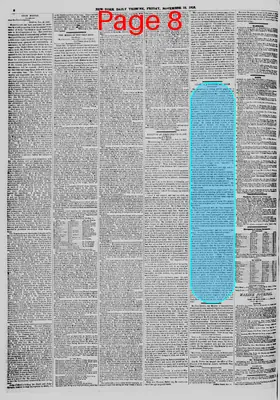
Story
November 19, 1858
New York Daily Tribune
New York, New York County, New York
What is this article about?
An American artist visits a Dutch fortress powder magazine, enduring strict 18th-century safety protocols like removing metals and flammables, only to realize he carries friction matches, narrowly avoiding potential disaster and critiquing outdated rules.
Clipping
OCR Quality
95%
Excellent
Full Text
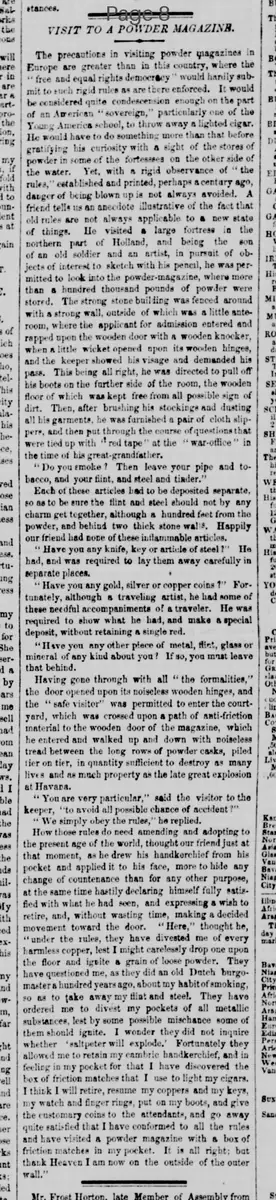
VISIT TO A POWDER MAGAZINE.
The precautions in visiting powder magazines in Europe are greater than in this country, where the "free and equal rights democracy" would hardly submit to such rigid rules as are there enforced. It would be considered quite condescension enough on the part of an American "sovereign," particularly one of the Young America school, to throw away a lighted cigar. He would have to do something more than that before gratifying his curiosity with a sight of the stores of powder in some of the fortresses on the other side of the water. Yet, with a rigid observance of "the rules," established and printed, perhaps a century ago, danger of being blown up is not always avoided. A friend tells us an anecdote illustrative of the fact that old rules are not always applicable to a new state of things. He visited a large fortress in the northern part of Holland, and being the son of an old soldier and an artist, in pursuit of objects of interest to sketch with his pencil, he was permitted to look into the powder-magazine, where more than a hundred thousand pounds of powder were stored. The strong stone building was fenced around with a strong wall, outside of which was a little ante-room, where the applicant for admission entered and rapped upon the wooden door with a wooden knocker, when a little wicket opened upon its wooden hinges, and the keeper showed his visage and demanded his pass. This being all right, he was directed to pull off his boots on the further side of the room, the wooden floor of which was kept free from all possible sign of dirt. Then, after brushing his stockings and dusting all his garments, he was furnished a pair of cloth slippers, and then put through the course of questions that were tied up with "red tape" at the "war-office" in the time of his great-grandfather.
"Do you smoke? Then leave your pipe and tobacco, and your flint, and steel and tinder."
Each of these articles had to be deposited separate, so as to be sure the flint and steel should not by any charm get together, although a hundred feet from the powder, and behind two thick stone walls. Happily our friend had none of these inflammable articles.
"Have you any knife, key or article of steel?" He had, and was required to lay them away carefully in separate places.
"Have you any gold, silver or copper coins?" Fortunately, although a traveling artist, he had some of these needful accompaniments of a traveler. He was required to show what he had, and make a special deposit, without retaining a single red.
"Have you any other piece of metal, flint, glass or mineral of any kind about you? If so, you must leave that behind."
Having gone through with all "the formalities," the door opened upon its noiseless wooden hinges, and the "safe visitor" was permitted to enter the court-yard, which was crossed upon a path of anti-friction material to the wooden door of the magazine, which he entered and walked up and down with noiseless tread between the long rows of powder casks, piled tier on tier, in quantity sufficient to destroy as many lives and as much property as the late great explosion at Havana.
"You are very particular," said the visitor to the keeper, "to avoid all possible chance of accident?"
"We simply obey the rules," he replied.
How those rules do need amending and adopting to the present age of the world, thought our friend just at that moment, as he drew his handkerchief from his pocket and applied it to his face, more to hide any change of countenance than for any other purpose, at the same time hastily declaring himself fully satisfied with what he had seen, and expressing a wish to retire, and, without wasting time, making a decided movement toward the door. "Here," thought he, "under the rules, they have divested me of every harmless copper, lest I might carelessly drop one upon the floor and ignite a grain of loose powder. They have questioned me, as they did an old Dutch burgomaster a hundred years ago, about my habit of smoking so as to take away my flint and steel. They have ordered me to divest my pockets of all metallic substances, lest by some possible mischance some of them should ignite. I wonder they did not inquire whether 'saltpeter will explode.' Fortunately they allowed me to retain my cambric handkerchief, and in feeling in my pocket for that I have discovered the box of friction matches that I use to light my cigars. I think I will retire, resume my coppers and my keys, my watch and finger rings, put on my boots, and give the customary coins to the attendants, and go away quite satisfied that I have conformed to all the rules and have visited a powder magazine with a box of friction matches in my pocket. It is all right: but thank Heaven I am now on the outside of the outer wall."
The precautions in visiting powder magazines in Europe are greater than in this country, where the "free and equal rights democracy" would hardly submit to such rigid rules as are there enforced. It would be considered quite condescension enough on the part of an American "sovereign," particularly one of the Young America school, to throw away a lighted cigar. He would have to do something more than that before gratifying his curiosity with a sight of the stores of powder in some of the fortresses on the other side of the water. Yet, with a rigid observance of "the rules," established and printed, perhaps a century ago, danger of being blown up is not always avoided. A friend tells us an anecdote illustrative of the fact that old rules are not always applicable to a new state of things. He visited a large fortress in the northern part of Holland, and being the son of an old soldier and an artist, in pursuit of objects of interest to sketch with his pencil, he was permitted to look into the powder-magazine, where more than a hundred thousand pounds of powder were stored. The strong stone building was fenced around with a strong wall, outside of which was a little ante-room, where the applicant for admission entered and rapped upon the wooden door with a wooden knocker, when a little wicket opened upon its wooden hinges, and the keeper showed his visage and demanded his pass. This being all right, he was directed to pull off his boots on the further side of the room, the wooden floor of which was kept free from all possible sign of dirt. Then, after brushing his stockings and dusting all his garments, he was furnished a pair of cloth slippers, and then put through the course of questions that were tied up with "red tape" at the "war-office" in the time of his great-grandfather.
"Do you smoke? Then leave your pipe and tobacco, and your flint, and steel and tinder."
Each of these articles had to be deposited separate, so as to be sure the flint and steel should not by any charm get together, although a hundred feet from the powder, and behind two thick stone walls. Happily our friend had none of these inflammable articles.
"Have you any knife, key or article of steel?" He had, and was required to lay them away carefully in separate places.
"Have you any gold, silver or copper coins?" Fortunately, although a traveling artist, he had some of these needful accompaniments of a traveler. He was required to show what he had, and make a special deposit, without retaining a single red.
"Have you any other piece of metal, flint, glass or mineral of any kind about you? If so, you must leave that behind."
Having gone through with all "the formalities," the door opened upon its noiseless wooden hinges, and the "safe visitor" was permitted to enter the court-yard, which was crossed upon a path of anti-friction material to the wooden door of the magazine, which he entered and walked up and down with noiseless tread between the long rows of powder casks, piled tier on tier, in quantity sufficient to destroy as many lives and as much property as the late great explosion at Havana.
"You are very particular," said the visitor to the keeper, "to avoid all possible chance of accident?"
"We simply obey the rules," he replied.
How those rules do need amending and adopting to the present age of the world, thought our friend just at that moment, as he drew his handkerchief from his pocket and applied it to his face, more to hide any change of countenance than for any other purpose, at the same time hastily declaring himself fully satisfied with what he had seen, and expressing a wish to retire, and, without wasting time, making a decided movement toward the door. "Here," thought he, "under the rules, they have divested me of every harmless copper, lest I might carelessly drop one upon the floor and ignite a grain of loose powder. They have questioned me, as they did an old Dutch burgomaster a hundred years ago, about my habit of smoking so as to take away my flint and steel. They have ordered me to divest my pockets of all metallic substances, lest by some possible mischance some of them should ignite. I wonder they did not inquire whether 'saltpeter will explode.' Fortunately they allowed me to retain my cambric handkerchief, and in feeling in my pocket for that I have discovered the box of friction matches that I use to light my cigars. I think I will retire, resume my coppers and my keys, my watch and finger rings, put on my boots, and give the customary coins to the attendants, and go away quite satisfied that I have conformed to all the rules and have visited a powder magazine with a box of friction matches in my pocket. It is all right: but thank Heaven I am now on the outside of the outer wall."
What sub-type of article is it?
Curiosity
Biography
What themes does it cover?
Social Manners
What keywords are associated?
Powder Magazine
Fortress Visit
Outdated Rules
Friction Matches
Holland Precautions
What entities or persons were involved?
Unnamed Artist Visitor
Powder Magazine Keeper
Where did it happen?
Large Fortress In The Northern Part Of Holland
Story Details
Key Persons
Unnamed Artist Visitor
Powder Magazine Keeper
Location
Large Fortress In The Northern Part Of Holland
Story Details
An artist visits a Dutch powder magazine, undergoes strict precautions removing metals and flammables, views the stored powder, but realizes he has friction matches, prompting him to leave quickly to avoid risk.