Thank you for visiting SNEWPapers!
Sign up free
The Portland Gazette
Portland, Cumberland County, Maine
What is this article about?
Reports on ongoing slave trade along Guinea coast, with over 20 vessels transporting thousands of Africans; Sir George Collier's account details involvement of France, Spain, Portugal, and others despite treaties, including 50,000 Africans shipped in past year to Martinique and Cuba.
Clipping
OCR Quality
Full Text
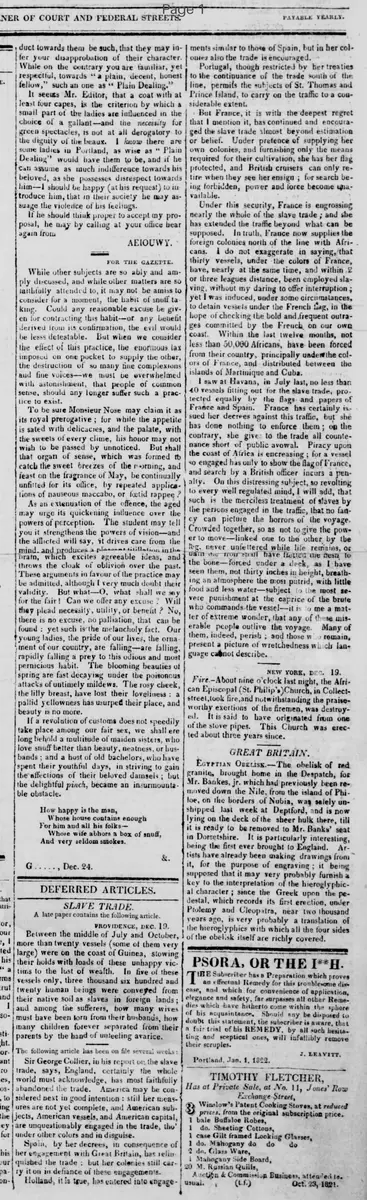
SLAVE TRADE.
A late paper contains the following article.
PROVIDENCE, DEC. 19.
Between the middle of July and October, more than twenty vessels (some of them very large) were on the coast of Guinea, stowing their holds with loads of these unhappy victims to the lust of wealth. In five of these vessels only, three thousand six hundred and twenty human beings were conveyed from their native soil as slaves in foreign lands; and among the sufferers, how many wives must have been torn from their husbands, how many children forever separated from their parents by the hand of unfeeling avarice.
The following article has been on file several weeks:
Sir George Collier, in his report on the slave trade, says, England, certainly the whole world must acknowledge, has most faithfully abandoned the trade. America may be considered next in good intention: still her measures are not yet complete, and American subjects, American vessels, and American capital are unquestionably engaged in the trade, tho under other colors and in disguise.
Spain, by her decrees, in consequence of her engagement with Great Britain, has relinquished the trade: but her colonies still carry it on in defiance of these engagements.
Holland, it is true, has entered into engagements similar to those of Spain. but in her colonies also the trade is encouraged.
Portugal, though restricted by her treaties to the continuance of the trade south of the line, permits the subjects of St. Thomas and Prince Island, to carry on the traffic to a considerable extent.
But France, it is with the deepest regret that I mention it, has continued and encouraged the slave trade almost beyond estimation or belief. Under pretence of supplying her own colonies, and furnishing only the means required for their cultivation, she has her flag protected, and British cruisers can only retire when they see her ensign: for search being forbidden, power and force become unavailable.
Under this security, France is engrossing nearly the whole of the slave trade; and she has extended the traffic beyond what can be supposed. In truth, France now supplies the foreign colonies north of the line with Africans. I do not exaggerate in saying, that thirty vessels, under the colors of France, have, nearly at the same time, and within 2 or three leagues distance, been employed slaving, without my daring to offer interruption; yet I was induced, under some circumstances, to detain vessels under the French flag, in the hope of checking the bold and frequent outrages committed by the French on our own coast. Within the last twelve months, not less than 50,000 Africans, have been forced from their country, principally under the colors of France, and distributed between the islands of Martinique and Cuba.
I saw at Havana, in July last, no less than 40 vessels fitting out for the slave trade, protected equally by the flags and papers of France and Spain. France has certainly issued her decrees against this traffic, but she has done nothing to enforce them; on the contrary, she gives to the trade all countenance short of public avowal. Piracy upon the coast of Africa is increasing; for a vessel so engaged has only to show the flag of France, and search by a British officer incurs a penalty. On this distressing subject, so revolting to every well regulated mind, I will add, that such is the merciless treatment of slaves by the persons engaged in the traffic, that no fancy can picture the horrors of the voyage.
Crowded together, so as not to give the power to move—linked one to the other by the leg, never unfettered while life remains, or until the more strong have filed the chain to the bone—forcing under a deck, as I have seen them, not thirty inches in height, breathing an atmosphere the most putrid, with little food and less water—subject to the most severe punishment at the caprice of the brute who commands the vessel—it is to me a matter of extreme wonder, that any of these miserable people outlive the voyage. Many of them, indeed, perish; and those who remain, present a picture of wretchedness which language cannot describe.
What sub-type of article is it?
What keywords are associated?
What entities or persons were involved?
Where did it happen?
Foreign News Details
Primary Location
Coast Of Guinea
Event Date
Dec. 19
Key Persons
Outcome
in five vessels, three thousand six hundred and twenty human beings conveyed as slaves; within the last twelve months, not less than 50,000 africans forced from their country, principally under the colors of france, and distributed between the islands of martinique and cuba; many perish during the voyage
Event Details
More than twenty vessels on the coast of Guinea between middle of July and October stowing holds with slaves; Sir George Collier reports England has abandoned the trade, America engaged under disguise, Spain and Holland colonies continue despite decrees, Portugal restricted but permits some, France encourages extensively under protected flag, supplying colonies north of the line, thirty French vessels slaving without interruption, 40 vessels fitting out at Havana under French and Spanish flags, increasing piracy, merciless treatment and horrors of the voyage described