Thank you for visiting SNEWPapers!
Sign up free
The National Intelligencer And Washington Advertiser
Washington, District Of Columbia
What is this article about?
U.S. House of Representatives debate on January 9 regarding resolutions to retrocede portions of the District of Columbia to Virginia and Maryland. Speakers including Taggart, Root, and Dawson discuss constitutional implications, suffrage rights, and benefits to the city of Washington, with arguments both for and against the measure.
Merged-components note: This is a continuation of the Congressional Register debate on receding the District of Columbia, spanning pages 1 and 2. The text flows directly from one component to the next mid-sentence. Label changed to domestic_news as it fits national government proceedings better than story.
Clippings
1 of 2
OCR Quality
Full Text
HOUSE OF REPRESENTATIVES.
WEDNESDAY, JANUARY 9.
The debate on receding the District of Columbia.
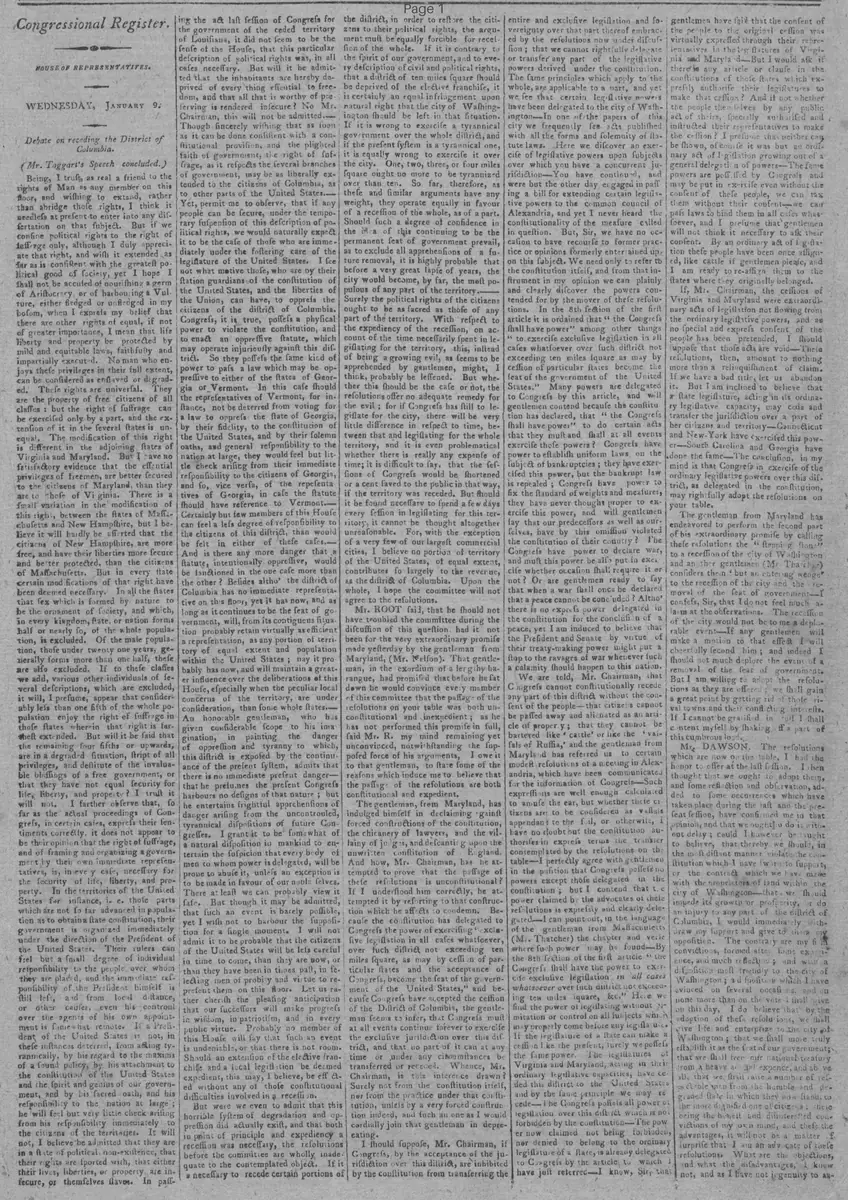
(Mr. Taggart's Speech concluded.)
Being, I trust, as real a friend to the rights of Man as any member on this floor, and wishing to extend, rather than abridge those rights, I think it needless at present to enter into any dissertation on that subject. But if we confine political rights to the right of suffrage only, although I duly appreciate that right, and wish it extended as far as is consistent with the greatest political good of society, yet I hope I shall not be accused of nourishing a germ of Aristocracy, or of harbouring a Vulture, either fledged or unfledged in my bosom, when I express my belief that there are other rights of equal, if not of greater importance, I mean that life, liberty and property be protected by mild and equitable laws, faithfully and impartially executed. No man who enjoys these privileges in their full extent, can be considered as enslaved or degraded. These rights are universal. They are the property of free citizens of all classes: but the right of suffrage can be exercised only by a part, and the extension of it in the several states is unequal. The modification of this right is different in the adjoining states of Virginia and Maryland. But I have no satisfactory evidence that the essential privileges of freemen, are better secured to the citizens of Maryland, than they are to those of Virginia. There is a small variation in the modification of this right, between the states of Massachusetts and New Hampshire, but I believe it will hardly be asserted that the citizens of New Hampshire, are more free, and have their liberties more secure and better protected, than the citizens of Massachusetts. But in every state certain modifications of that right have been deemed necessary. In all the states that sex which is formed by nature to be the ornament of society, and which, in every kingdom, state, or nation forms half or nearly so, of the whole population, is excluded. Of the male population, those under twenty one years, generally forms more than one half, these are also excluded. If to these classes we add, various other individuals of several descriptions, which are excluded, it will, I presume, appear that considerably less than one fifth of the whole population enjoy the right of suffrage in those states wherein that right is farthest extended. But will it be said that the remaining four fifths or upwards, are in a degraded situation, stripped of all privileges, and destitute of the invaluable blessings of a free government, or that they have not equal security for life, liberty, and property? I trust it will not. I farther observe that, so far as the actual proceedings of Congress, in certain cases, express their sentiments correctly, it does not appear to be their opinion that the right of suffrage, and of framing and organizing a government by their own immediate representatives, is, in every case, necessary for the security of life, liberty, and property. In the territories of the United States for instance, i. e. those parts which are not so far advanced in population as to obtain a state constitution, their government is organized immediately under the direction of the President of the United States. Their rulers can feel but a small degree of individual responsibility to the people over whom they are placed, and the immediate responsibility of the President himself is still less. And from local distance, or other causes, even his controul over the agents of his own appointment is somewhat remote. If a President of the United States is not, in these instances deterred, from acting tyrannically, by his regard to the maxims of a sound policy, by his attachment to the constitution of the United States and the spirit and genius of our government, and by his sacred oath, and his responsibility to the nation at large; he will feel but very little check arising from his responsibility immediately to the citizens of the territories. It will not, I believe be admitted that they are in a state of political non-existence, that their rights are sported with, that either their lives, liberties, or property are insecure, or themselves slaves. In passing the act last session of Congress for the government of the ceded territory of Louisiana, it did not seem to be the sense of the House, that this particular description of political rights was, in all cases necessary. But will it be admitted that the inhabitants are hereby deprived of every thing essential to freedom, and that all that is worthy of preserving is rendered insecure? No Mr. Chairman, this will not be admitted. Though sincerely wishing that as soon as it can be done consistent with a constitutional provision, and the plighted faith of government, the right of suffrage, as it respects the several branches of government, may be as liberally extended to the citizens of Columbia, as to other parts of the United States. Yet, permit me to observe, that if any people can be secure, under the temporary suspension of this description of political rights, we would naturally expect it to be the case of those who are immediately under the fostering care of the legislature of the United States. I see not what motive those, who are by their station guardians of the constitution of the United States, and the liberties of the Union, can have, to oppress the citizens of the district of Columbia. Congress, it is true, possesses a physical power to violate the constitution, and to enact an oppressive statute, which may operate injuriously against this district. So they possess the same kind of power to pass a law which may be oppressive to either of the states of Georgia or Vermont. In this case should the representatives of Vermont, for instance, not be deterred from voting for a law to oppress the state of Georgia, by their fidelity, to the constitution of the United States, and by their solemn oaths, and general responsibility to the nation at large, they would feel but little check arising from their immediate responsibility to the citizens of Georgia, and so, vice versa, of the representatives of Georgia, in case the statute should have reference to Vermont. Certainly but few members of this House can feel a less degree of responsibility to the citizens of this district, than would be felt in either of these cases. And is there any more danger that a statute, intentionally oppressive, would be sanctioned in the one case more than the other? Besides altho' the district of Columbia has no immediate representative on this floor, yet it has now, and as long as it continues to be the seat of government, will, from its contiguous situation probably retain virtually as efficient a representation, as any portion of territory of equal extent and population within the United States; nay it probably has now, and will maintain a greater influence over the deliberations of this House, especially when the peculiar local concerns of the territory, are under consideration, than one whole states. An honorable gentleman, who has given considerable scope to his imagination, in painting the danger of oppression and tyranny to which, this district is exposed by the continuance of the present system, admits that there is no immediate present danger- that he presumes the present Congress harbours no designs of that nature; but he entertains frightful apprehensions of danger arising from the uncontrouled, tyrannical dispositions of future Congresses. I grant it to be somewhat of a natural disposition in mankind to entertain the suspicion that every body of men to whom power is delegated, will be prone to abuse it, unless an exception is to be made in favour of our noble selves. There at least we can probably view it safe. But though it may be admitted, that such an event is barely possible, yet I wish not to harbour the supposition for a single moment. I will not admit it to be probable that the citizens of the United States will be less careful in time to come, than they are now, or than they have been in times past, in selecting men of probity and virtue to represent them on this floor. Let us rather cherish the pleasing anticipation that our successors will make progress in wisdom, in patriotism, and in every public virtue. Probably no member of this House will say that such an event is impossible, or that there is not room. Should an extension of the elective franchise and a local legislation be deemed expedient, this may, I believe, be effected without any of those constitutional difficulties involved in a recession. But were we even to admit that this horrible system of degradation and oppression did actually exist, and that both in point of principle and expediency a recession was necessary, the resolutions before the committee are wholly inadequate to the contemplated object. If it is necessary to recede certain portions of the district, in order to restore the citizens to their political rights, the argument must be equally forcible for recession of the whole. If it is contrary to the spirit of our government, and to every description of civil and political rights, that a district of ten miles square should be deprived of the elective franchise, it is certainly an equal infringement upon natural right that the city of Washington should be left in that situation. If it is wrong to exercise a tyrannical government over the whole district, and if the present system is a tyrannical one, it is equally wrong to exercise it over the city. One, two, three, or four miles square ought no more to be tyrannized over than ten. So far, therefore, as these and similar arguments have any weight, they operate equally in favour of a recession of the whole, as of a part. Should such a degree of confidence in the stability of this continuing to be the permanent seat of government prevail, as to exclude all apprehensions of a future removal, it is highly probable that before a very great lapse of years, the city would become, by far, the most populous of any part of the territory. Surely the political rights of the citizens ought to be as sacred as those of any part of the territory. With respect to the expediency of the recession, on account of the time necessarily spent in legislating for the territory, this, instead of being a growing evil, as seems to be apprehended by gentlemen, might, I think, probably be lessened. But whether this should be the case or not, the resolutions offer no adequate remedy for the evil; for if Congress has still to legislate for the city, there will be very little difference in respect to time, between that and legislating for the whole territory, and it is even problematical whether there is really any expense of time; it is difficult to say, that the sessions of Congress would be shortened or a cent saved to the public in that way, if the territory was receded. But should it be found necessary to spend a few days every session in legislating for this territory, it cannot be thought altogether unreasonable. For, with the exception of a very few of our largest commercial cities, I believe no portion of territory of the United States, of equal extent, contributes so largely to the revenue, as the district of Columbia. Upon the whole, I hope the committee will not agree to the resolutions.
Mr. ROOT said, that he should not have troubled the committee during the discussion of this question, had it not been for the very extraordinary promise made yesterday by the gentleman from Maryland, (Mr. Melvin). That gentleman, in the exordium of a lengthy harangue, had promised that before he sat down he would convince every member of this committee that the passage of the resolutions on your table was both unconstitutional and inexpedient; as he has not performed this promise in full, said Mr. R. my mind remaining yet unconvinced, notwithstanding the supposed force of his arguments, I owe it to that gentleman, to state some of the reasons which induce me to believe that the passage of the resolutions are both constitutional and expedient.
The gentleman, from Maryland, has indulged himself in declaiming against forced constructions of the constitution, the chicanery of lawyers, and the villainy of judges, and descanting upon the unwritten constitution of England. And how, Mr. Chairman, has he attempted to prove that the passage of these resolutions is unconstitutional? If I understood him correctly, he attempted it by resorting to that construction which he affects to condemn. Because the constitution has delegated to Congress the power of exercising "exclusive legislation in all cases whatsoever, over such district not exceeding ten miles square, as may by cession of particular states and the acceptance of Congress, become the seat of the government of the United States," and because Congress have accepted the cession of the District of Columbia, the gentleman seems to infer, that Congress must at all events continue forever to exercise the exclusive jurisdiction over this district, and that no part of it can at any time or under any circumstances be transferred or receded. Whence, Mr. Chairman, is this inference drawn? Surely not from the constitution itself, nor from the practice under that constitution, unless by a very forced construction indeed, and such an one as I would cordially join that gentleman in depreciating.
I should suppose, Mr. Chairman, if Congress, by the acceptance of the jurisdiction over this district, are inhibited by the constitution from transferring the entire and exclusive legislation and sovereignty over that part thereof embraced by the resolutions now under discussion; that we cannot rightfully delegate or transfer any part of the legislative powers derived under the constitution. The same principles which apply to the whole, are applicable to a part, and yet we see that certain legislative powers have been delegated to the city of Washington--In one of the papers of this city we frequently see acts published with all the forms and solemnity of statute laws. Here we discover an exercise of legislative powers upon subjects over which you have a concurrent jurisdiction-You have continued, and were but the other day engaged in passing a bill for extending certain legislative powers to the common council of Alexandria, and yet I never heard the constitutionality of the measure called in question. But, Sir, we have no occasion to have recourse to former practice or opinions formerly entertained upon this subject. We need only to refer to the constitution itself, and from that instrument in my opinion we can plainly and clearly discover the powers contemplated for by the mover of these resolutions. In the 8th section of the first article it is ordained that "the Congress shall have power" among other things "to exercise exclusive legislation in all cases whatsoever over such district not exceeding ten miles square as may by cession of particular states become the seat of the government of the United States." Many powers are delegated to Congress by this article, and will gentlemen contend because the constitution has declared, that "the Congress shall have power" to do certain acts that they must and shall at all events exercise those powers? Congress have power to establish uniform laws on the subject of bankruptcies; they have exercised this power, but the bankrupt law is repealed; Congress have power to fix the standard of weights and measures, they have never thought proper to exercise this power, and will gentlemen say that our predecessors as well as ourselves, have by this omission violated the constitution of their country? The Congress have power to declare war, and must this power be also put in execution whether occasion has require it or not? Or are gentlemen ready to say that when a war shall once be declared that a peace cannot be concluded? Altho' there is no express power delegated in the constitution for the conclusion of a peace, yet I am induced to believe that the President and Senate by virtue of their treaty-making power might put a stop to the ravages of war whenever such a calamity should happen to this nation. We are told, Mr. Chairman, that Congress cannot constitutionally recede any part of this district without the consent of the people-that citizens cannot be passed away and alienated as an article of property; that they cannot be bartered like cattle or like the vassals of Russia, and the gentleman from Maryland has referred us to certain modest resolutions of a meeting in Alexandria, which have been communicated for the information of Congress- Such expressions are well enough calculated to amuse the ear, but whether these citizens are to be considered as villains appendant to the soil, or otherwise, I have no doubt but the Constitution authorizes in express terms the transfer contemplated by the resolutions on the table—I perfectly agree with gentlemen in the position that Congress possesses no powers except those delegated in the constitution; but I contend that the power claimed by the advocates of these resolutions is expressly and clearly delegated-I can point out, in the language of the gentleman from Massachusetts (Mr. Thatcher) the chapter and verse where such power may be found—By the 8th section of the first article "the Congress shall have the power to exercise exclusive legislation in all cases whatsoever over such district not exceeding ten miles square, &c." Here we find the power of legislating without limitation or control on all subjects which may properly come before any legislature. If the legislature of a state can make a cession like the present, surely we possess the same power. The legislatures of Virginia and Maryland, acting in their ordinary legislative capacities, have ceded this district to the United States and by the same principle we may recede- The Congress possesses all power of legislation over this district which is not forbidden by the constitution-The power now claimed not being forbidden nor denied to belong to the ordinary legislature of a state, is already delegated to Congress by the article to which I have just referred-I know, Sir, that gentlemen have said that the consent of the people to the original cession was virtually expressed through their representatives in the legislatures of Virginia and Maryland But I would ask if therefore any article or clause in the constitutions of those states which expressly authorizes their legislatures to make that cession? And if not whether the people themselves by any public act of theirs, specially authorized and instructed their representatives to make the cession? I presume that neither can be shown, of course it was but an ordinary act of legislation growing out of a general delegation of powers-The same powers are possessed by Congress and may be put in exercise even without the consent of these people, we Can tax them without their consent-we can pass laws to bind them in all cases whatsoever, and I presume that gentlemen will not think it necessary to ask their consent. By an ordinary act of legislation these people have been once assigned, like cattle if gentlemen please, and I am ready to re-assign them to the states where they originally belonged. If, Mr. Chairman, the cessions of Virginia and Maryland were extraordinary acts of legislation not flowing from the ordinary legislative powers, and as no special and express consent of the people has been pretended, I should suppose that those acts are void--These resolutions, then, amount to nothing more than a relinquishment of claim. If we have a bad title. let us abandon it. But I am inclined to believe that a state legislature, acting in its ordinary legislative capacity, may cede and transfer the jurisdiction over a part of her citizens and territory--Connecticut and New-York have exercised this power--South Carolina and Georgia have done the same The conclusion, in my mind is that Congress in exercise of the ordinary legislative powers over this district, as delegated in the constitution. may rightfully adopt the resolutions on your table. The gentleman from Maryland has endeavored to perform the second part of his extraordinary promise by calling these resolutions the "stepping stone" to a recession of the city of Washington and another gentleman (Mr. Smilie,) considers them 'but an entering wedge" to the recession of the city and the removal of the seat of government-I confess, Sir, that I do not feel much alarm at the observations. The receding of the city would not be to me a deplorable event If any gentlemen will make a motion to that effect I will cheerfully second him : and indeed I should not much deplore the event of a removal of the seat of government. But I am willing to adopt the resolutions as they are offered; we shall gain a great point by getting rid of those rival towns and their conflicting interests. If I cannot be gratified in all I shall content myself by taking a part of this cumbrous load.
Mr. DAWSON. The resolutions which are now on the table, I had the honor to offer at the last session, then I thought that we ought to adopt them, and some reflection and observation, added to some occurrences which have taken place during the last and the present session, have confirmed me in that opinion, and that we ought to do it without delay; could I however be taught to believe, that thereby we should, in the most distant manner violate the constitution which I have sworn to support, or the contract which we have made with the proprietors of land within the city of Washington that. we should impede its growth or prosperity, or do an injury to any part of the district of Columbia, I would immediately withdraw my support and give to them my opposition. The contrary are my sincere convictions, formed after long experience, and much reflection; and with a disposition most friendly to the city of Washington; and political principles which I have evinced on several occasions, and on none more than on the vote I shall give on this day, I do believe that by the adoption of these resolutions, we shall give life and enterprize to the city of Washington; that we shall more truly establish it as the seat of our government; that we shall free our national treasury from a heavy annual expense, and above all, that we shall raise a number of respectable men from the humble and degraded state in which they now stand, to the more dignified one of citizens : these being the honest and disinterested convictions of my own mind, and the advantages, it will not be a matter of surprise that I am an advocate of these resolutions. What are the objections, and what the disadvantages, I know not, and as I have not ingenuity to an-
Anticipate, I must wait until gentlemen will unite us with them, when they shall be acknowledged, or receive such answers as they appear to merit.
Without entering into the merits of this question, I will beg leave to mention one fact, which may meet an argument which I expect will be used here as it has been elsewhere, and which has excited some alarm and some doubt with persons friendly to this city, as to the retrocession. It has been believed that there is connection between the law fixing this as the permanent seat of government, and that assuming the jurisdiction over the District of Columbia, and that a partial repeal of the latter will endanger the other; than this in my judgment no opinion can be more incorrect: the laws then themselves are separate and independent, and the objects of them different and distinct, the one passed in 1790, the other in 1801. And here, sir, permit me to observe that the latter law passed upon the death of that person whose spirit gentleman from Maryland has haughtily introduced, as dim indignation very improperly and unconstitutionally. Son. I will not however believe that that gentleman, if alive, would give his support to a law which seems had-determination of those interests, in the attainment of which his able life had been spent, or that he would have countenanced the doctrines advanced by that gentleman on this day.
Mr. Randolph explained.
Mr. Brown replied, that he had understood the gentleman meant to apply his observations to the Ohio under consideration, which was a repeal to the inhabitants of the district of the right of representation—and this proceeded. By the act this is established as the permanent seat of government, and a solemn contract entered into between the proprietors of lots within the city, whereby they relinquished one half to the general government. This forms the obligation of the contract, from which we cannot depart without a violation of the public faith, and to do which I shall ever be found among the last.
The other was an act left to the discretion of Congress, which they might pass or not, according to their pleasure, and which could not by any possible connection affect the original contract which would have been equally secure without it. & in my judgment more so. It was passed, and I grieve to tell, it was passed to gratify the wishes of a majority of this district, without any consideration on their part—for, be it remembered, that they have not made relinquishments to the government, or contributions to the establishment of the City.
I hope it will not long remain a stain in our code. I voted in its favor, and I have ever felt anxious to make an atonement for that vote by advocating its repeal.
Mr. Chairman, to posterity and to the present age, it must appear a matter of astonishment, that at the seat of our representative government, where it is presumed that its principles are understood, and within a few years after adopting, a number of our most respectable citizens, some of whom had fought, and many of whom had contended or eight years for the rights of representation, on which all other political rights are founded, come forward and pray you to divest them of it,—Sir, when I cast my eyes on the table, and examine its contents, I am almost induced to doubt the reason of my senses—at the same moment, I behold a memorial from the inhabitants of Louisiana, just fresh from the shackles of an arbitrary government, written in the enthusiastic spirit of freedom, imploring you to grant to them the right of representation, as the best gift of God to man, and I spy the petition of the inhabitants of Columbia, the seat of our representative government, begging you to divest them of that right, and to reduce or rather continue them in a state which the Louisianians esteem a degraded one.—Whence Sir, does this arise. Is that spirit, which animated those persons, many of whom I know and highly respect, in 76—when they demand equal representation or death!—Has it expired to a few hot, or is it to be bartered, or as much trash as may be granted them—for a supposed increased value in their property—I hope, Sir, we shall not be instruments to the contract, or as the trustees for its performance.—
A
The observations, Mr. Chairman, may answer to one which has been repeatedly made, 'that a majority of the inhabitants of the district are opposed to the retrocession.'—be that as it may, it has not any weight on my mind. I am not disposed to adopt as my political guardians, or to appoint as the trustees of the rights of others, men who have voluntarily relinquished their own—and that right on which all others depend—the right of representation—however highly I may personally esteem, and I do, many of the characters, politically speaking I view them as non-entities—I wish they were not.
Mr. D. then argued in favor of the constitutional right of Congress to repeal the law, and contended that there was not any connection between the law establishing the city of Washington as the permanent seat of the government, and the one assuming the jurisdiction over the district of Columbia—the first of them formed the obligation of the contract, for a valuable consideration, and for the performance of which the public faith was pledged—the passage of the second was left to the discretion of Congress, might be repealed at their pleasure, to the several precedents which had been adduced to show the constitutional right, he begged leave to add one which had not been mentioned, and which in his judgment was conclusive—the section in the constitution which gave Congress the right to assume the jurisdiction over the territory, gave them the right to 'constitute tribunals inferior to the supreme Court.' (Here Mr. D. turned to the constitution.) the latter right has been exercised—inferior courts have been established, and completely organized—Judges were appointed, and the system went into operation---and yet, Sir, two years ago a large majority of the Congress thought that they had a right to repeal that law, and put down the system.—I now call on gentlemen, and I particularly invite those who favored that repeal, to show me difference in the exercise of the two rights—except indeed, that by that repeal you virtually discontinued officers who had received commissions, and which was relied on by the opponents, to the repeal as their strong ground.
He concluded by saying, as there was not any constitutional bar—nor in his judgment, the interests of the city would be advanced by ridding it of useless incumbrances which impeded its growth—that the parts of the district without the city would be benefitted by returning to their parent states,—That the national treasury would be freed from a heavy annual unnecessary payment, which might go to the redemption of our public debt, or of our fellow citizens in captivity—and above all, as it would raise a number of respectable persons from the unequal situation in which they now stand, to the more dignified one of American citizens. he Should vote in favor of the resolutions, and hoped for their adoption.
(To be continued.)
What sub-type of article is it?
What keywords are associated?
What entities or persons were involved?
Where did it happen?
Domestic News Details
Primary Location
District Of Columbia
Event Date
Wednesday, January 9
Key Persons
Outcome
debate ongoing; resolutions under consideration for adoption to retrocede parts of the district; no final outcome reported.
Event Details
Debate in the House of Representatives on resolutions to recede portions of the District of Columbia to Virginia and Maryland. Mr. Taggart concludes speech opposing the resolutions, arguing that essential rights are protected without suffrage and recession is inadequate. Mr. Root supports, refuting unconstitutionality claims and citing precedents. Mr. Dawson advocates, emphasizing benefits to Washington, constitutional validity, and separation of laws.