Thank you for visiting SNEWPapers!
Sign up free
The Daily Worker
Chicago, Cook County, Illinois
What is this article about?
US farmers in states like Missouri and Oregon face debt and hardship despite Coolidge administration's prosperity claims. Agriculture Secretary Jardine promotes a film showing farm life superior to urban and announces poor 1927 crop yields, predicting higher prices.
Clipping
OCR Quality
Full Text
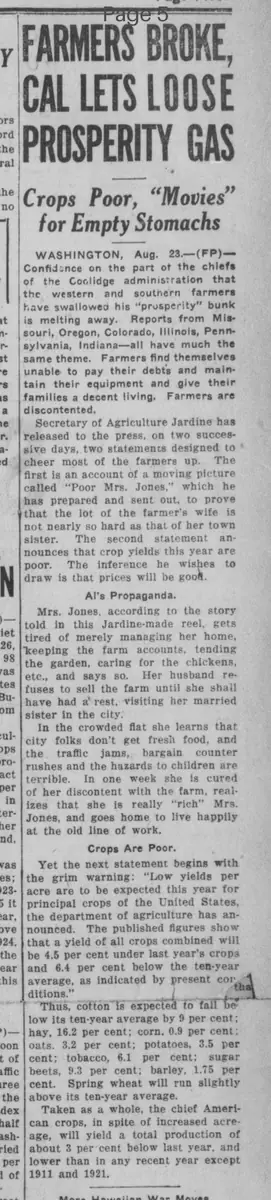
BROKE,
CAL
LETS
LOOSE
PROSPERITY
GAS
Crops
Poor,
"Movies
for Empty Stomachs
WASHINGTON, Aug. 23. - (FP) - Confidence on the part of the chiefs of the Coolidge administration that the western and southern farmers have swallowed his "prosperity" bunk is melting away. Reports from Missouri, Oregon, Colorado, Illinois, Pennsylvania, Indiana - all have much the same theme. Farmers find themselves unable to pay their debts and maintain their equipment and give their families a decent living. Farmers are discontented.
Secretary of Agriculture Jardine has released to the press, on two successive days, two statements designed to cheer most of the farmers up. The first is an account of a moving picture called "Poor Mrs. Jones," which he has prepared and sent out, to prove that the lot of the farmer's wife is not nearly so hard as that of her town sister. The second statement announces that crop yields this year are poor. The inference he wishes to draw is that prices will be good.
Al's Propaganda.
Mrs. Jones, according to the story told in this Jardine-made reel, gets tired of merely managing her home, keeping the farm accounts, tending the garden, caring for the chickens, etc., and says so. Her husband refuses to sell the farm until she shall have had a rest, visiting her married sister in the city.
In the crowded flat she learns that city folks don't get fresh food, and the traffic jams, bargain counter rushes and the hazards to children are terrible. In one week she is cured of her discontent with the farm, realizes that she is really "rich" Mrs. Jones, and goes home to live happily at the old line of work.
Crops Are Poor.
Yet the next statement begins with the grim warning: "Low yields per acre are to be expected this year for principal crops of the United States, the department of agriculture has announced. The published figures show that a yield of all crops combined will be 4.5 per cent under last year's crops and 6.4 per cent below the ten-year average, as indicated by present conditions."
Thus, cotton is expected to fall below its ten-year average by 9 per cent; hay, 16.2 per cent; corn, 0.9 per cent; oats, 3.2 per cent; potatoes, 3.5 per cent; tobacco, 6.1 per cent; sugar beets, 9.3 per cent; barley, 1.75 per cent. Spring wheat will run slightly above its ten-year average.
Taken as a whole, the chief American crops, in spite of increased acreage, will yield a total production of about 3 per cent below last year, and lower than in any recent year except 1911 and 1921.
What sub-type of article is it?
What keywords are associated?
What entities or persons were involved?
Where did it happen?
Domestic News Details
Primary Location
Washington
Event Date
Aug. 23
Key Persons
Outcome
farmers unable to pay debts, maintain equipment, provide decent living; crop yields 4.5 per cent under last year and 6.4 per cent below ten-year average; total production 3 per cent below last year
Event Details
Confidence in Coolidge administration that farmers accepted prosperity message waning; reports from Missouri, Oregon, Colorado, Illinois, Pennsylvania, Indiana show farmer discontent; Secretary Jardine releases statements: moving picture 'Poor Mrs. Jones' to show farm life better than city, and announcement of poor crop yields expecting good prices; details of movie plot where farm wife visits city and prefers farm; crop yield figures for cotton, hay, corn, oats, potatoes, tobacco, sugar beets, barley, spring wheat