Thank you for visiting SNEWPapers!
Sign up free
Portland Gazette, And Maine Advertiser
Portland, Cumberland County, Maine
What is this article about?
Samuel Dexter addresses Massachusetts electors, explaining his non-candidacy despite nominations, critiquing Republican commerce restrictions as unconstitutional and harmful, differing from Federalist war measures while supporting national union during the War of 1812 against Britain. He advocates exposing government errors without sedition to restore balance.
Clipping
OCR Quality
Full Text
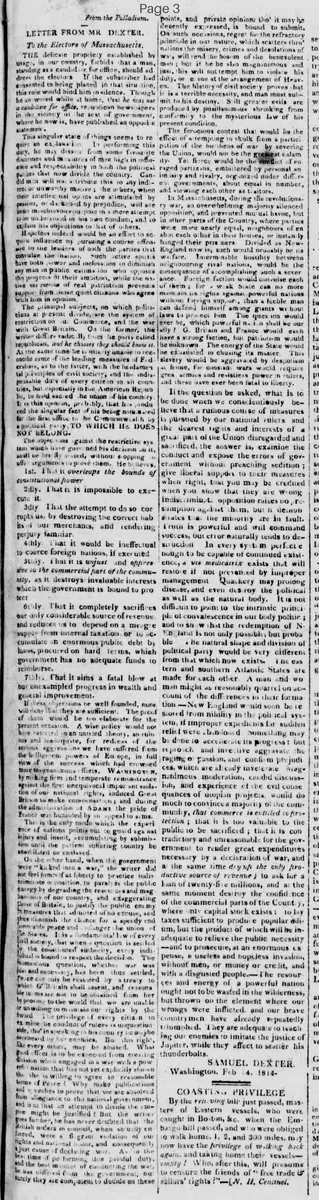
LETTER FROM MR. DEXTER.
To the Electors of Massachusetts.
THE delicate propriety established by usage, in our country, forbids that a man, standing as a candidate for office, should address the electors. If the subscriber had consented to being placed in that situation, this rule would bind him to silence. Though he answered while at home, that he was not a candidate for office, republican newspapers in the vicinity of the seat of government, where he now is, have published an opposite statement.
This singular state of things seems to require an explanation. In performing this duty, he may dissent from some favourite doctrines and measures of men high in influence and respectability in both the political parties that now divide the country. Candid men will not attribute this to any indirect or unworthy motive; he others, when their intellectual optics are stimulated by passion, or darkened by prejudice, will see some mischievous purpose in a mere attempt to be understood in his own conduct, and to explain his objections to that of others.
Hopeless indeed would be an effort to acquire influence by pursuing a course offensive to the leaders of both the parties that convulse the nation. Such active spirits have both power and inclination to diminish any man in public estimation who opposes the projects of their ambition, while the passive inertia of real patriotism prevents support from those quiet citizens who agree with him in opinion.
The principal subjects, on which politicians at present divide, are the system of restriction on our commerce, and the war with Great Britain. On the former, the writer differs radically from the party called republican, and he chooses they should know it. At the same time he is utterly unable to reconcile some of the leading measures of Federalists, as to the latter, with the fundamental principles of civil society, and the indispensable duty of every citizen in all countries, but especially in the American Republic, to hold sacred the union of his country.
It is this opinion, probably, that has produced the singular fact of his being nominated for the first office in the Commonwealth by a political party TO WHICH HE DOES NOT BELONG.
The objections against the restrictive system which have governed his decision on it, shall be briefly stated, without stopping to offer arguments to prove them. He believes, 1st. that it overleaps the bounds of constitutional power. 2dly. That it is impossible to execute it. 3dly. That the attempt to do so corrupts us, by destroying the correct habits of our merchants, and rendering perjury familiar. 4thly. That it would be ineffectual to coerce foreign nations, if executed. 5thly. That it is unjust and oppressive to the commercial part of the community, as it destroys invaluable interests which the government is bound to protect. 6thly. That it completely sacrifices our only considerable source of revenue, and reduces us to depend on a meagre supply from internal taxation, or to accumulate an enormous public debt by loans, procured on hard terms, which government has no adequate funds to reimburse. 7thly. That it aims a fatal blow at our unexampled progress in wealth and general improvement.
If these objections be well founded, none will deny that they are sufficient. The proof of them would be too elaborate for the present occasion. Wise policy would not have resorted to an untried theory, so ruinous and inadequate, for redress of the serious aggressions we have suffered from the belligerent powers of Europe, in full view of the success which had crowned more magnanimous efforts. WASHINGTON, by making firm and temperate remonstrance against the first unequivocal important violation of our national rights, induced Great Britain to make compensation; and during the administration of ADAMS the pride of France was humbled by an appeal to arms.
This is the only mode which the experience of nations points out to guard against injury and insult, accumulating by submission until the patient suffering country be annihilated or enslaved.
On the other hand, when the government were 'kicked into a war,' the writer did not feel himself at liberty to practice indiscriminate opposition, to paralyze the public energy by degrading the resources and magnanimity of our country, and exaggerating those of Britain, to justify the public enemy in measures that admitted of no excuse, and thus diminish the chance for a speedy end to an honorable peace and endanger the union of the States. It is a fundamental law of every civil society, that when a question is settled by the constituted authority, every individual is bound to respect the decision. The momentous question, whether war was just and necessary, has been thus settled.
Peace can only be restored by a treaty to which G. Britain shall assent, and reasonable terms are not to be obtained from her by proving to the world that we are unable or unwilling to maintain our rights by the sword. The privilege of every citizen to examine the conduct of rulers is unquestionable, though in speaking to his country he may be overheard by her enemies. But his right, like every other, may be abused. What good effect is to be expected from creating division when engaged in a war with a power of that nation that has not yet explicitly shown that she is willing to agree to reasonable terms of Peace? Why make publications and speeches to prove that we are absolved from allegiance to the national government, and insist that an attempt to divide the empire might be justified? But the writer goes further, he has never doubted that the British orders in council, when severely enforced, were a flagrant violation of our rights and national honor, and consequently a just cause of declaring war. As to the best time of performing this painful duty, and the best manner of conducting the war, he has differed from the government, but surely they are competent to decide on these points, and private opinion, though it may be decently expressed, is bound to submit.
On such occasions, regret for the refractory principle in our nature, which scatters through nations the misery, crimes and desolations of war, will rend the bosom of the benevolent man: but if he be truly magnanimous and just, this will not tempt him to violate his duty, or repine at the arrangement of Heaven. The history of civil society proves that it is a terrible necessity, and man must submit to his destiny. Still greater evils are produced by pusillanimous shrinking from conformity to the mysterious law of his present condition.
The ferocious contest that would be the effect of attempting to skulk from a participation of the burdens of war by severing the Union, would not be the greatest calamity. Yet fierce would be the conflict of enraged partisans, embittered by personal animosity and rivalry, organized under different governments, about equal in number, and viewing each other as traitors.
In Massachusetts, during the revolutionary war, an overwhelming majority silenced opposition, and prevented mutual havoc, but in other parts of the Country, where parties were more nearly equal, neighbours ofen shot each other in their houses, or instantly hanged their prisoners. Divided as New-England now is, such would probably be its warfare. Interminable hostility between neighbouring rival nations, would be the consequence of accomplishing such a severance. Foreign faction would convulse each of them; for a weak State can no more maintain its rights against powerful nations without foreign support, than a feeble man can defend himself among giants without laws to protect him. The question would ever be, which powerful nation shall be our ally? G. Britain and France would each have a strong faction, but patriotism would be unknown. The energy of the State would be exhausted in choosing its master. This slavery would be aggravated by despotism at home, for constant wars would require great armies and resistless power in rulers, and these have ever been fatal to liberty.
If the question be asked, what is to be done when we conscientiously believe that a ruinous course of measures is pursued by our national rulers and the dearest rights and interests of a great part of the Union disregarded and sacrificed, the answer is, examine the conduct and expose the errors of government without preaching sedition; give liberal support to their measures when right, that you may be credited when you show that they are wrong. Indiscriminate opposition raises no presumption against them, but in demon strates that the minority are in fault. Truth is powerful and will command success, but error naturally tends to destruction. In every system perfect enough to be capable of continued existence a vis medicatrix exists that will restore if not prevented by improper management. Quackery may prolong disease, and even destroy the political as well as the natural body. It is not difficult to point to the intrinsic principle of convalescence in our body politic; and to show that the redemption of N. England is not only possible, but probable. The natural shape and division of political party would be very different from that which now exists. The eastern and southern Atlantic States are made for each other. A man and woman might as reasonably quarrel on account of the differences in their formation. New-England would soon be restored from nihility in the political system, if improper expedients for sudden relief were abandoned. Something may be done to accelerate its progress: but reproach and invective aggravate the raging passion, and confirm prejudices, which are already intolerable. Magnanimous moderation, candid discussion, and experience of the evil consequences of utopian projects, would do much to convince a majority of the community, that commerce is entitled to protection: that it is too valuable to the public to be sacrificed; that it is contradictory and unreasonable for the government to render great expenditures necessary by a declaration of war, and at the same time dry up the only productive source of revenue; to ask for a loan of twenty-five millions, and at the same moment destroy the confidence of the commercial parts of the Country, where only capital stock exists: to lay taxes sufficient to produce popular odium, but the product of which will be inadequate to relieve the public necessity -and to prosecute, at an enormous expense, a useless and hopeless invasion, without men, or money or credit, and with a disgusted people. The resources and energy of a powerful nation ought not to be wasted in the wilderness, but thrown on the element where our wrongs were inflicted, and our brave country men have already repeatedly triumphed. They are adequate to teaching our enemies to imitate the justice of Jupiter, while they affect to scatter his thunderbolts.
SAMUEL DEXTER.
Washington, Feb 4, 1814.
What sub-type of article is it?
What themes does it cover?
What keywords are associated?
What entities or persons were involved?
Letter to Editor Details
Author
Samuel Dexter
Recipient
To The Electors Of Massachusetts
Main Argument
dexter clarifies his non-candidacy, opposes republican commerce restrictions as unconstitutional and ruinous, critiques some federalist war policies, but urges support for the union and war effort against britain while exposing errors without sedition to achieve policy correction.
Notable Details