Thank you for visiting SNEWPapers!
Sign up free
Editorial
March 10, 1959
The Farmville Herald
Farmville, Prince Edward County, Virginia
What is this article about?
In 1959, a budget conflict arises between President Eisenhower and Congress over proposed increases in federal spending for housing ($5.8B vs. $1.65B) and airports ($297M vs. $200M), threatening the $77B balanced budget. Eisenhower opposes the measures, urging economy, with veto likely. Hurdles include Rules Committee and public pressure.
Clipping
OCR Quality
95%
Excellent
Full Text
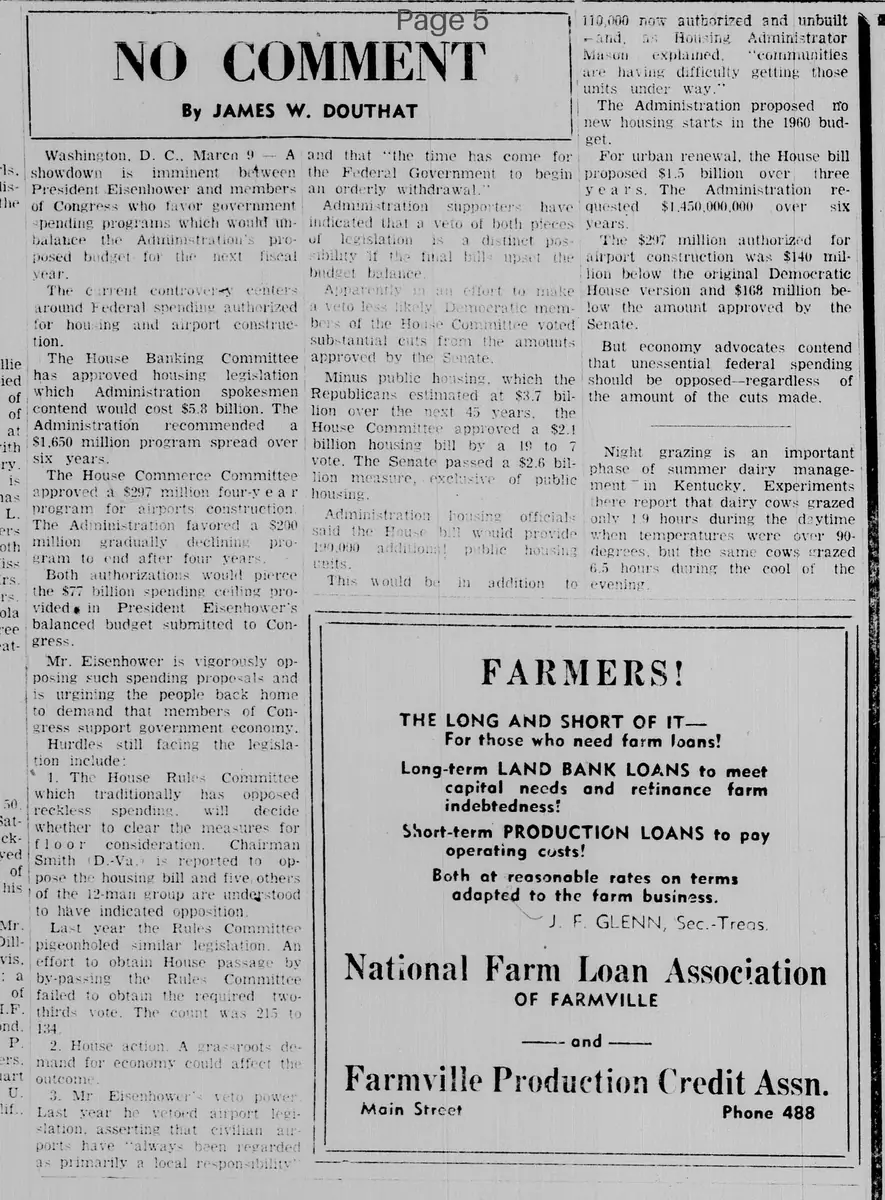
No Comment
By James W. Douthat
Washington, D. C., March 9 - A showdown is imminent between President Eisenhower and members of Congress who favor government spending programs which would unbalance the Administration's proposed budget for the next fiscal year.
The current controversy centers around Federal spending authorized for housing and airport construction.
The House Banking Committee has approved housing legislation which Administration spokesmen contend would cost $5.8 billion. The Administration recommended a $1.650 million program spread over six years.
The House Commerce Committee approved a $297 million four-year program for airports construction. The Administration favored a $200 million gradually declining program to end after four years.
Both authorizations would pierce the $77 billion spending ceiling provided in President Eisenhower's balanced budget submitted to Congress.
Mr. Eisenhower is vigorously opposing such spending proposals and is urging the people back home to demand that members of Congress support government economy.
Hurdles still facing the legislation include:
1. The House Rules Committee which traditionally has opposed reckless spending will decide whether to clear the measures for floor consideration. Chairman Smith (D.-Va.) is reported to oppose the housing bill and five others of the 12-man group are understood to have indicated opposition. Last year the Rules Committee pigeonholed similar legislation. An effort to obtain House passage by by-passing the Rules Committee failed to obtain the required two-thirds vote. The count was 215 to 134.
2. House action. A grass-roots demand for economy could affect the outcome.
3. Mr. Eisenhower's veto power. Last year he vetoed airport legislation, asserting that civilian airports have "always been regarded as primarily a local responsibility and that "the time has come for the Federal Government to begin an orderly withdrawal."
Administration supporters have indicated that a veto of both pieces of legislation is a distinct possibility if the final bill upset the budget balance.
Apparently in an effort to make a veto less likely Democratic members of the House Committee voted substantial cuts from the amounts approved by the Senate.
Minus public housing, which the Republicans estimated at $3.7 billion over the next 45 years, the House Committee approved a $2.1 billion housing bill by a 19 to 7 vote. The Senate passed a $2.6 billion measure, exclusive of public housing.
Administration housing officials said the House bill would provide 70,000 additional public housing units.
This would be in addition to -and, as Housing Administrator Mason explained, "communities are having difficulty getting those units under way."
The Administration proposed no new housing starts in the 1960 budget.
For urban renewal, the House bill proposed $1.5 billion over three years. The Administration requested $1,450,000,000 over six years.
The $297 million authorized for airport construction was $140 million below the original Democratic House version and $165 million below the amount approved by the Senate.
But economy advocates contend that unessential federal spending should be opposed--regardless of the amount of the cuts made.
By James W. Douthat
Washington, D. C., March 9 - A showdown is imminent between President Eisenhower and members of Congress who favor government spending programs which would unbalance the Administration's proposed budget for the next fiscal year.
The current controversy centers around Federal spending authorized for housing and airport construction.
The House Banking Committee has approved housing legislation which Administration spokesmen contend would cost $5.8 billion. The Administration recommended a $1.650 million program spread over six years.
The House Commerce Committee approved a $297 million four-year program for airports construction. The Administration favored a $200 million gradually declining program to end after four years.
Both authorizations would pierce the $77 billion spending ceiling provided in President Eisenhower's balanced budget submitted to Congress.
Mr. Eisenhower is vigorously opposing such spending proposals and is urging the people back home to demand that members of Congress support government economy.
Hurdles still facing the legislation include:
1. The House Rules Committee which traditionally has opposed reckless spending will decide whether to clear the measures for floor consideration. Chairman Smith (D.-Va.) is reported to oppose the housing bill and five others of the 12-man group are understood to have indicated opposition. Last year the Rules Committee pigeonholed similar legislation. An effort to obtain House passage by by-passing the Rules Committee failed to obtain the required two-thirds vote. The count was 215 to 134.
2. House action. A grass-roots demand for economy could affect the outcome.
3. Mr. Eisenhower's veto power. Last year he vetoed airport legislation, asserting that civilian airports have "always been regarded as primarily a local responsibility and that "the time has come for the Federal Government to begin an orderly withdrawal."
Administration supporters have indicated that a veto of both pieces of legislation is a distinct possibility if the final bill upset the budget balance.
Apparently in an effort to make a veto less likely Democratic members of the House Committee voted substantial cuts from the amounts approved by the Senate.
Minus public housing, which the Republicans estimated at $3.7 billion over the next 45 years, the House Committee approved a $2.1 billion housing bill by a 19 to 7 vote. The Senate passed a $2.6 billion measure, exclusive of public housing.
Administration housing officials said the House bill would provide 70,000 additional public housing units.
This would be in addition to -and, as Housing Administrator Mason explained, "communities are having difficulty getting those units under way."
The Administration proposed no new housing starts in the 1960 budget.
For urban renewal, the House bill proposed $1.5 billion over three years. The Administration requested $1,450,000,000 over six years.
The $297 million authorized for airport construction was $140 million below the original Democratic House version and $165 million below the amount approved by the Senate.
But economy advocates contend that unessential federal spending should be opposed--regardless of the amount of the cuts made.
What sub-type of article is it?
Economic Policy
Partisan Politics
What keywords are associated?
Budget Balance
Housing Legislation
Airport Construction
Government Spending
Eisenhower Veto
Fiscal Economy
What entities or persons were involved?
President Eisenhower
House Banking Committee
House Commerce Committee
Chairman Smith (D. Va.)
Housing Administrator Mason
Editorial Details
Primary Topic
Budget Showdown Over Housing And Airport Spending
Stance / Tone
Supportive Of Administration's Fiscal Restraint
Key Figures
President Eisenhower
House Banking Committee
House Commerce Committee
Chairman Smith (D. Va.)
Housing Administrator Mason
Key Arguments
Housing Legislation Costs $5.8b Vs. Administration's $1.65m Over Six Years
Airport Program $297m Vs. $200m Declining Over Four Years
Both Exceed $77b Budget Ceiling
Eisenhower Urges Public Support For Economy
Rules Committee Likely To Block
Veto Possible, As Last Year For Airports Citing Local Responsibility
House Bill Cuts Made To Avoid Veto But Still Opposed