Thank you for visiting SNEWPapers!
Sign up free
New Hampshire Statesman And State Journal
Concord, Merrimack County, New Hampshire
What is this article about?
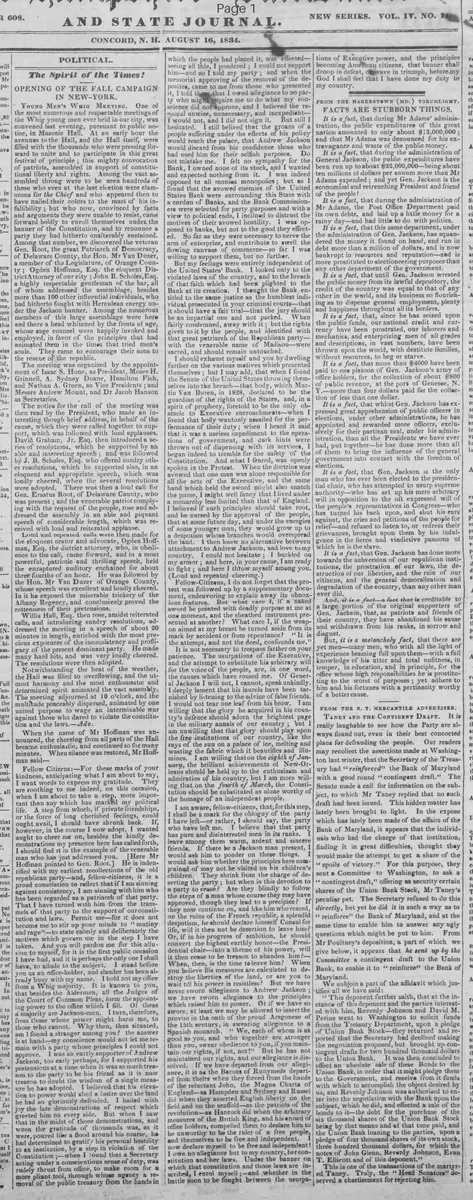
A massive Young Men's Whig meeting in New York City's Masonic Hall featured former Jackson Democrats, including Gen. Erastus Root and Ogden Hoffman, publicly switching to the Whig cause. Speakers criticized Andrew Jackson's removal of bank deposits as unconstitutional executive overreach, adopting resolutions in support of constitutional liberty.
Clipping
OCR Quality
Full Text
The Spirit of the Times!
OPENING OF THE FALL CAMPAIGN IN NEW-YORK.
Young Men's Whig Meeting. One of the most numerous and respectable meetings of the Whig young men ever held in our city, was convened last evening, pursuant to public notice, in Masonic Hall. At an early hour the avenues to the Hall, and the Hall itself, were filled with the thousands who were pressing forward to unite and to participate in this great festival of principle; this mighty convocation of patriots, assembled in support of constitutional liberty and rights. Among the vast assembled throng were to be seen hundreds of those who even at the last election were clamorous for the Chief and who appeared then to have nailed their colors to the mast of his infallibility; but who now, convinced by facts and arguments they were unable to resist, came forward boldly to enroll themselves under the banner of the Constitution, and to renounce a party they had hitherto unalterably sustained. Among that number, we discovered the veteran Gen. Root, the great Patriarch of Democracy, of Delaware County, the Hon. Mr. Van Duzer, a member of the Legislature, of Orange County; Ogden Hoffman, Esq. the eloquent District Attorney of our city; John B. Scholes, Esq. a highly respectable gentleman of the bar, all of whom addressed the assemblage, besides more than 100 other influential individuals, who had hitherto fought with Herculean energy under the Jackson banner. Among the numerous members of this large assemblage were here and there a head whitened by the frosts of age, whose sage counsel were happily invoked and employed, in favor of the principles that had animated them in the times that tried men's souls. They came to encourage their sons to the rescue of the republic.
The meeting was organized by the appointment of Isaac S. Hone, as President, Moses H. Grinnell, A. Sydney Doane, Hamilton Fish, and Nathan A. Green, as Vice Presidents; and Messrs. Andrew Mount, and Dr. Jacob Hanson as Secretaries.
The notice for the call of the meeting was then read by the President, who made an interesting though brief address, in behalf of the cause, which they were called together to support, which was followed with loud applauses.
David Graham, Jr. Esq. then introduced a series of resolutions, which he supported by an able and interesting speech: and was followed by J. B. Scholes, Esq. who offered sundry other resolutions, which he supported also, in an eloquent and appropriate speech, which was loudly cheered, when the several resolutions were adopted. There was then a loud call for Gen. Erastus Root, of Delaware County, who was present; and the venerable patriot complying with the request of the people, rose and addressed the assembly in an able and piquant speech of considerable length, which was received with loud and reiterated applause.
Loud and repeated calls were then made for the eloquent orator and advocate, Ogden Hoffman, Esq. the district attorney, who, in obedience to the call, came forward, and in a most powerful, patriotic and thrilling speech, held the enraptured auditory enchained for about three fourths of an hour. He was followed by the Hon. Mr. Van Duzer of Orange County, whose speech was excellent and loudly cheered. In it he exposed the miserable trickery of the Albany Regency, and conclusively proved the rottenness of their pretensions.
Willis Hall, Esq. then rose, amidst reiterated calls, and introducing sundry resolutions, addressed the meeting in a speech of about 20 minutes in length, enriched with the most precious exposures of the inconsistency and profligacy of the present dominant party. He made many hard hits, and was very loudly cheered.
The resolutions were then adopted.
Notwithstanding the heat of the weather, the Hall was filled to overflowing, and the utmost harmony and the most enthusiastic and determined spirit animated the vast assembly.
The meeting adjourned at 10 o'clock, and the multitude peaceably dispersed, animated by one united purpose to wage an interminable war against those who dared to violate the constitution and the laws.—Adv.
When the name of Mr. Hoffman was announced, the cheering from all parts of the Hall became enthusiastic, and continued so for many minutes. When silence was restored, Mr. Hoffman said—
Fellow Citizens:—For these marks of your kindness, anticipating what I am about to say, I want words to express my gratitude. They are soothing to me indeed, on this occasion, when I am about to take a step, more important than any which has marked my political life. A step from which, if private friendships, or the force of long cherished feelings, could ought avail, I should have shrunk back. If, however, in the course I now adopt, I wanted aught to cheer me on, besides the kindly demonstrations my presence here has called forth, I should find it in the example of the venerable man who has just addressed you. [Here Mr. Hoffman pointed to Gen. Root.] He is identified with my earliest recollections of the old republican party—and, fellow-citizens, it is a proud consolation to reflect that if I am sinning against consistency, I am sinning with him who has been regarded as a patriarch of that party. That I have turned with him from the trammels of that party to the support of our constitution and laws. Permit me—for it does not become me to stir up your minds to "mutiny and rage"—to state calmly and deliberately the motives which govern me in the step I have taken. And you will pardon me for this allusion to myself, for it is the first public occasion I have had, and it is perhaps the only one I shall have, to allude to the subject. I stand before you as an office-holder, and slander has been already busy with my name. I hold not my office from a Whig majority. It is known to you, that besides the Aldermen, all the Judges of the Court of Common Pleas, form the appointing power to the office which I fill. Of these a majority are Jackson-men. I turn, therefore, from those whose power might harm me, to those who cannot. Why then, thus situated, am I found a stranger among you? the answer is at hand—my conscience would not let me remain with a party whose principles I could not approve. I was an early supporter of Andrew Jackson, too early perhaps, for I supported his pretensions at a time when it was as much treason to the party to be his friend as it is now treason to doubt the wisdom of a single measure he has adopted. I believed that his elevation to power would shed a lustre over the land he had so gloriously defended. I hailed with joy the late demonstrations of respect which greeted him on every side. But when I saw that in the midst of those demonstrations, and when the gratitude of thousands was, as it were, poured like a flood around his course, he had determined to gratify his personal hostility to an institution, by a step in violation of the Constitution;—when I found that a Secretary acting under a conscientious sense of duty, was rudely thrust from office, to make room for a more pliant tool, through whose agency a removal of the public treasury from the hands in which the people had placed it, was effected—seeing all this, I pondered; I could not support him—and so I told my party; and when the memorial approving of the removal of the deposites, came to me from those who presented it, I told them that I owed allegiance to no party who might require me to do what my conscience did not approve, and I believed the removal unwise, unnecessary, and inexpedient—I would not, and I did not sign it. But still I hesitated. I still believed that the groans of a people suffering under the effects of his policy would reach the palace, that Andrew Jackson would discard from his confidence those who had used him for their selfish purposes. Do not mistake me. I felt no sympathy for the Bank, I owned none of its stock, and I wanted and expected nothing from it. I was indeed opposed to all monied monopolies; but as I found that the avowed enemies of the United States Bank were surrounding this State with a cordon of Banks, and the Bank Commissioners were selected for party purposes and with a view to political ends, I inclined to distrust the motives of their avowed hostility. I was opposed to banks, but not to the good they effected. So far as they were necessary to nerve the arm of enterprize, and contribute to swell the flowing canvass of commerce—so far I was willing to support them, but no further.
But my feelings were entirely independent of the United States' Bank. I looked only to the violated laws of the country, and to the breach of that faith which had been plighted to the Bank at its creation. I thought the Bank entitled to the same justice as the humblest individual prosecuted in your criminal courts—that it should have a fair trial—that the jury should be an impartial one and not packed. When fairly condemned, away with it; but the rights given to it by the people, and identified with that great patriarch of the Republican party—with the venerable name of Madison—were sacred, and should remain untouched.
I should exhaust myself and you by dwelling further on the various motives which presented themselves; but I may add, that when I found the Senate of the United States throwing themselves into the breach—that body, which Martin Van Buren, in 1828, declared to be the guardian of the rights of the States, and, in a spirit of prophecy, foretold to be the only obstacle to Executive encroachments—when I found that body wantonly assailed for the performance of their duty: when I heard it said that it was a useless impediment to the operations of government, and dark hints were thrown out of dispensing with its services, I began indeed to tremble for the safety of the Constitution. And what I feared, was openly spoken in the Protest. When the doctrine was avowed that one man was alone responsible for all the acts of the Executive, and the same hand which held the sword might also snatch the purse, I might well fancy that I lived under a monarchy less limited than that of England.
I believed if such principles should take root, and be nursed by the approval of the people, that at some future day, and under the energies of some younger man, they would grow up to a despotism whose branches would overspread the land. I then knew no alternative between attachment to Andrew Jackson, and love to my country. I could not hesitate; I buckled on my armor; and here, in your cause, I am ready to fight; and here I throw myself among you.
(Loud and repeated cheering.)
Fellow-Citizens, I do not forget that the protest was followed up by a supplementary document, endeavoring to explain away its obnoxious features. But what care I, if a naked sword be pointed with deadly purpose at me at one moment, and the sheathed instrument presented at another? What care I, if the weapon aimed at my breast be turned aside from its mark by accident or from repentance? "It is the attempt, and not the deed, confounds me."
It is not necessary to trespass farther on your patience. The usurpations of the Executive, and the attempt to substitute his arbitrary will for the voice of the people, are, in one word, the causes which have roused me. Of General Jackson I will not, I cannot, speak unkindly. I deeply lament that his laurels have been tarnished by listening to the advice of false friends. I would not tear one leaf from his brow. I am willing that the glory he acquired in his country's defence should adorn the brightest page in the military annals of our country; but I am unwilling that that glory should play upon the free institutions of our country, like the rays of the sun on a palace of ice, melting and wasting the fabric which it beautifies and illuminates. I am willing that on the eighth of January, the brilliant achievements of New-Orleans should be held up to the enthusiasm and admiration of his country, but I am more willing that on the fourth of March, the Constitution should be substituted as alone worthy of the homage of an independent people.
I am aware, fellow-citizens, that, for this step, I shall be a mark for the obloquy of the party I have left—or rather, I should say, the party who have left me. I believe that that party has pure and disinterested men in its ranks. I leave among them warm, ardent and sincere friends. If there be a Jackson man present, I would ask him to ponder on these things. I would ask him whether the principles here complained of may not be visited on his children's children. They shrink from the charge of deserting the party; but when is this devotion to a party to cease? Are they blindly to follow the steps of a man whose course they may have approved, though they lead to a precipice? If they now continue on, and like him who reared, on the ruins of the French republic, a splendid despotism, he should declare himself Consul for life, will it then not be desertion to leave him? Or, if in his progress of ambition, he should convert the highest earthly honor—the Presidential chair—into a throne of his power, will it then cease to be treason to abandon him?—When, then, is the time to leave him? When you believe his measures are calculated to destroy the liberties of the land, or are you to wait till his power is resistless? But we have never sworn allegiance to Andrew Jackson; we have sworn allegiance to the principles which raised him to power. Or if we have so sworn, at least we may be allowed to insert the proviso in the oath of the proud Aragonese of the 15th century, in swearing allegiance to a Spanish monarch. "We, each of whom is as good as you, and who together are stronger than you, swear obedience to you, if you maintain our rights, if not, not!" But he has not maintained our rights, and our allegiance is dissolved. If we have departed from our allegiance, it is as the Barons of Runnymede departed from theirs when they forced from the hands of the reluctant John, the Magna Charta of England—as Hampden and Sydney and Russell did when they asserted English liberty on the field and on the scaffold—as the patriots of the revolution—as Hancock did when the arbitrary measures of the British King, and his crowd of office holders, compelled them to declare him to be unworthy to be the ruler of a free people, and themselves to be free and independent.
I now declare myself to be free and independent! I owe no allegiance but to my country, her constitution and her laws. Under the banner on which that constitution and those laws are inscribed, I enrol myself;—and whether in the battle soon to be fought between the usurpations of Executive power, and the principles becoming American citizens, that banner shall droop in defeat, or wave in triumph, before my God I shall feel that I have done my duty to my country.
What sub-type of article is it?
What themes does it cover?
What keywords are associated?
What entities or persons were involved?
Where did it happen?
Story Details
Key Persons
Location
Masonic Hall, New York
Event Date
Last Evening
Story Details
A large Young Men's Whig meeting in New York convenes with former Jackson supporters switching sides, led by speeches from Gen. Root and Ogden Hoffman denouncing Jackson's unconstitutional removal of bank deposits and executive overreach; resolutions adopted amid enthusiastic support for constitutional principles.