Thank you for visiting SNEWPapers!
Sign up free
The Enquirer
Richmond, Henrico County, Virginia
What is this article about?
In a Senate speech, Gen. S. Smith concludes his argument for a resolution prohibiting imports of certain British goods like woollens, linens, rum, hardware, and salt to counter British trade aggressions, asserting minimal harm to U.S. revenue and economy while pressuring Britain for justice.
Merged-components note: Relabeled from foreign_news to domestic_news as content is a US Senate speech on foreign policy matters, fitting national non-story news. Merged table listing duties, which is integral to the speech content; bbox overlap.
Clipping
OCR Quality
Full Text
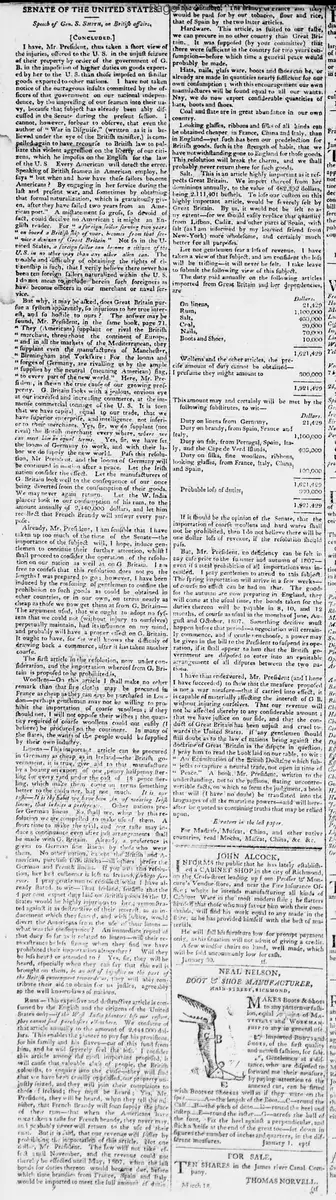
Speech of Gen. S. Smith, on British affairs
[CONCLUDED.]
I have, Mr. President, thus taken a short view of the injuries offered to the U. S. in the unjust seizure of their property by order of the government of G. B. in the imposition of higher duties on goods exported by her to the U. S. than those imposed on similar goods exported to other nations. I have not taken notice of the outrageous insults committed by the officers of that government on our national independence, by the impressing of our seamen into their navy, because that subject has already been ably discussed in the Senate during the present session. I cannot, however, forbear to observe, that even the author of "War in Disguise," (written as it is believed under the eye of the British minister) is compelled again to have recourse to British law to palliate this violent aggression on the liberty of our citizens, which he imposes on the English for the law of the U. S. Every American will detect the error. Speaking of British seamen in American employ, he says "but when and how have these sailors become Americans? By engaging in her service during the last and present war, and sometimes by obtaining that formal naturalization, which is gratuitously given, after they have sailed two years from an American port." A misstatement so gross, so devoid of fact, could deceive no American; it might an English reader. For "a foreign sailor serving two years on board a British ship of war, becomes from that service a denizen of Great Britain." Not so in the U. States, a foreign sailor can become a citizen of the U. S. in no other way than any other alien can. The trouble and difficulty of obtaining the rights of citizenship is such, that I verily believe there never has been ten foreign sailors naturalized within the U. S. I do not mean to include herein such foreigners as have become officers in our merchant or naval service.
But why, it may be asked, does Great Britain pursue a system apparently so injurious to her true interest, and so hostile to ours? The answer may be found, Mr. President, in the same book, page 71. "They (Americans) supplant or rival the British merchant, throughout the continent of Europe and in all the markets of the Mediterranean, they supplant even the manufactures of Manchester, Birmingham and Yorkshire: For the looms and forges of Germany, are rivalling us by the ample supplies by the neutral (meaning American) flag, to every part of the new world." Here, Mr. President, is shown the true cause of our growing prosperity. G. Britain looks with a jealous, envious eye at our increased and increasing commerce, at the immense commercial tonnage of the U. S. It is seen that we have capital equal to our trade, that we have superior enterprise, and intelligence not inferior to their merchants. Yes, sir, we do supplant (not rival) the British merchant everywhere, where we can meet him on equal terms. Yes, sir, we have set the looms of Germany to work, and with their labor we do supply the new world. Pass this resolution, Mr. President, and the looms of Germany will be continued in motion after a peace. Let the Irish nation consider the effect. Let the manufacturers of G. Britain look well to the consequence of our once being diverted from the consumption of their goods. We may never again return. Let the W. India planter look to our consumption of his rum, to the amount annually of 2,140,000 dollars, and let him recollect that French Brandy will answer every purpose.
Already, Mr. President, I am sensible that I have taken up too much of the time of the Senate—the importance of the subject will, I hope, induce gentlemen to continue their further attention, whilst I shall proceed to consider the operation of the resolution on our nation as well as on G. Britain. I am free to confess that this resolution does not go the length I was prepared to go; however, I have been induced by the reasoning of gentlemen to confine the prohibition to such goods as could be obtained in other countries, or in our own, on terms nearly as cheap as those we now get them at from G. Britain. The argument used, that we ought to adopt no system that we could not (without injury to ourselves) perpetually maintain, had its influence on my mind, and probably will have a proper effect on G. Britain. It ought to have, for she well knows the difficulty of drawing back a commerce, after it has taken another course.
The articles in the resolution, now under consideration, and the importation whereof from G. Britain is proposed to be prohibited is,
Woollens—On this article I shall make no other remark than that fine cloths may be procured in France as cheap as they can now be purchased in London—perhaps gentlemen may not be willing to prohibit the importation of coarse woollens; if they should not, I will not oppose their wishes; the quantity required of coarse woollens could not easily (I believe) be procured on the continent. In many of the states, the wants of the people would be supplied by their own industry.
Linens—This important article can be procured in Germany as cheap as in Ireland—the British government give by a bounty on export of one penny halfpenny sterling for every yard under the cost of 18 pence sterling, which makes them come on terms something better to the consumer, but not much. It is our taste—it is the habit we have been in of wearing Irish linens, that induces a preference. Other nations prefer German linens—So shall we, when by this resolution we are compelled to make use of them. A short time to make the trial, and our taste may induce a continuance even after just arrangements shall be made with G. Britain. Already a preference is given to German fine linens by those who wear them. No other nation, except the British and American, purchase Irish linens—all others prefer the German and French linens. If you pass this resolution, her best customer is lost to Ireland, perhaps forever. I pray gentlemen to recollect what I have already stated, to wit—That Ireland, sensible that the 4 per cent export duty laid on British goods to the U. States would be highly injurious to her; remonstrated against it as destructive of their interest, as an inducement which they feared, and with justice, would divert the Americans from the use of their linens—what was the consequence? An immediate repeal of that duty so far as it related to linens—will their remonstrance be less strong when they find we have prohibited their importation altogether? Will they be less heard or attended to? Yes, sir, they will be heard, especially when they can say that this evil is brought on them, by an act of injustice on the part of the British government towards us, they will ably contribute their aid to obtain for us justice, agreeably to the well known laws of nations.
Rum—This expensive and destructive article is consumed by the English and the citizens of the United States only—if the West India planters lose our custom, they cannot find purchasers elsewhere. We consume of that article annually to the amount of 2,444,000 dollars. This enables the planter to pay for his provisions, for his family and his slaves—cut of this fund from him, and he will severely feel the loss. I consider this article among the most important proposed, it will cause that valuable class of people, the British colonists, to enquire into the cause—they will find that we have been cruelly oppressed, our property unjustly seized, and they will join their complaints to those of Ireland; they must be heard; Yes, Mr. President, they will be heard, when they tell the minister, that French Brandy will soon supply the place of their rum—that when the Americans have once taken a taste for French brandy, they never may, and probably never will return to the use of their rum. But it is said, that our revenue will suffer by prohibiting the importation of this article. Not one dollar, Mr. President. The Law will not take effect until November, and the revenue could not thereby be affected until May, I say then, when the last bonds for duties thereon would become due, before which time brandies from France, Spain and Italy would be imported to meet the full amount of duties on hand continued. The brandy of France at least would be paid for by our tobacco, flour and rice, that of Spain by the two latter articles.
Hardware. This article, as suited to our taste, we can procure in no other country than Great Britain. It was supposed (by your committee) that there were sufficient in the country for two years consumption—before which time a general peace would probably be made.
Hats, nails, glass ware, boots and shoes can be, or already are made in quantities nearly sufficient for our own consumption; with this encouragement our own manufactures will be found equal to all our wants. Nay, we do now export considerable quantities of hats, boots and shoes.
Coal and slate are in great abundance in our own country.
Looking glasses, ribbons and silks of all kinds can be obtained cheaper in France, China and Italy, than in England—yet such has been our predilection for British goods, such is the strength of habit, that we have notwithstanding gone to England for those goods. This resolution will break the charm, and we shall probably never return there for such goods.
Salt. This is an article highly important as it respects Great Britain. We import thereof from her dominions annually, to the value of 468,592 dollars, being 2,111,401 bushels. To lose our custom on this highly important article, would be severely felt by Great Britain. By us, it would not be felt to any extent—for we should easily replace that quantity from Lisbon, Cadiz, and other parts of Spain, with salt (as I am informed by my learned friend from New-York) more wholesome, and certainly much better for all purposes.
Let not gentlemen fear a loss of revenue. I have taken a view of that subject, and am confident the loss will be trifling—it will never be felt. I take leave to submit the following view of this subject.
The duty paid annually on the following articles imported from Great Britain and her dependencies are
1,621,429
Woollens and the other articles, the precise amount of duty cannot be obtained—I presume they might amount to
$300,000
1,921,429
This amount may and certainly will be met by the following substitutes, to wit—
Dollars.
Duty on linens from Germany,
21,429
Duty on brandy, from Spain, France and Italy,
1,100,000
Duty on salt, from Portugal, Spain, Italy, and the Cape de Verd Islands,
400,000
Duty on silks, fine woollens, ribbons, looking glasses, from France, Italy, China, and Spain,
100,000
1,621,429
Probable loss of duties,
300,000
1,921,429
If it should be the opinion of the Senate, that the importation of coarse woollens and hard wares shall not be prohibited, then I do not believe there will be one dollar loss of revenue, if the resolution should pass.
But, Mr. President, no deficiency can be felt in any case prior to the summer and autumn of 1807—even if a total prohibition of all importations was intended. I pray gentlemen to attend to this subject. The spring importation will arrive in a few weeks—of course no effect can be had on that. The goods for the autumn are now preparing in England, they will come at the usual time, the bonds taken for the duties thereon will be payable in 8, 10, and 12 months, of course as usual in the months of June, August and October, 1807. Something decisive must happen before that period—a negotiation will certainly commence, and if gentlemen choose, a power may be given in the bill to the President to suspend its operation, if it shall appear to him that the British government are disposed to enter into an equitable arrangement of all disputes between the two nations.
I have thus endeavored, Mr. President (and I hope I have succeeded) to show that the measure proposed is not a war measure—that if carried into effect, it is capable of materially affecting the interest of G. B. without injuring ourselves. That our revenue will not be affected thereby to any considerable amount: that we have justice on our side, and that the conduct of Great Britain has been unjust and cruel towards the United States. If any gentlemen should still doubt as to the law of nations being against the doctrine of Great Britain in the dispute in question, I pray him to read the book laid on our table, to wit: "An Examination of the British Doctrine which subjects to capture a neutral trade, not open in time of Peace." A book, Mr. President, written to the understanding, not to the passions, stating incontrovertible facts, on which to form the judgment, a book that will (I have no doubt) be translated into the languages of all the maritime powers and will hereafter be quoted as containing truths that may be relied upon.
| On linens, | 21,429 |
| Rum, | 1,100,000 |
| Salt, | 400,000 |
| Coal, | 20,000 |
| Nails, | 70,000 |
| Boots and Shoes, | 10,000 |
What sub-type of article is it?
What keywords are associated?
What entities or persons were involved?
Where did it happen?
Domestic News Details
Primary Location
United States Senate
Key Persons
Outcome
proposal of resolution to prohibit imports of woollens, linens, rum, hardware, hats, nails, glass ware, boots, shoes, coal, slate, looking glasses, ribbons, silks, and salt from great britain; expected minimal revenue loss offset by substitutes from other countries.
Event Details
Gen. S. Smith delivers a speech in the Senate advocating for a resolution to prohibit importation of specific British goods to retaliate against British trade injuries, impressment of seamen, and seizures, arguing it will pressure Britain without harming U.S. interests, citing alternatives from France, Germany, Spain, Italy, and domestic production.