Thank you for visiting SNEWPapers!
Sign up free
The Webster Echo
Addison, Webster Springs, Webster County, West Virginia
What is this article about?
U.S. Food Administration relaxes meat restrictions to cut bread consumption amid Allied demands and Argentine shortages, citing enlarged meat supplies from heavier hogs and better transport; retains beefless/porkless Tuesdays but drops other meatless days; urges continued economy.
Clipping
OCR Quality
Full Text
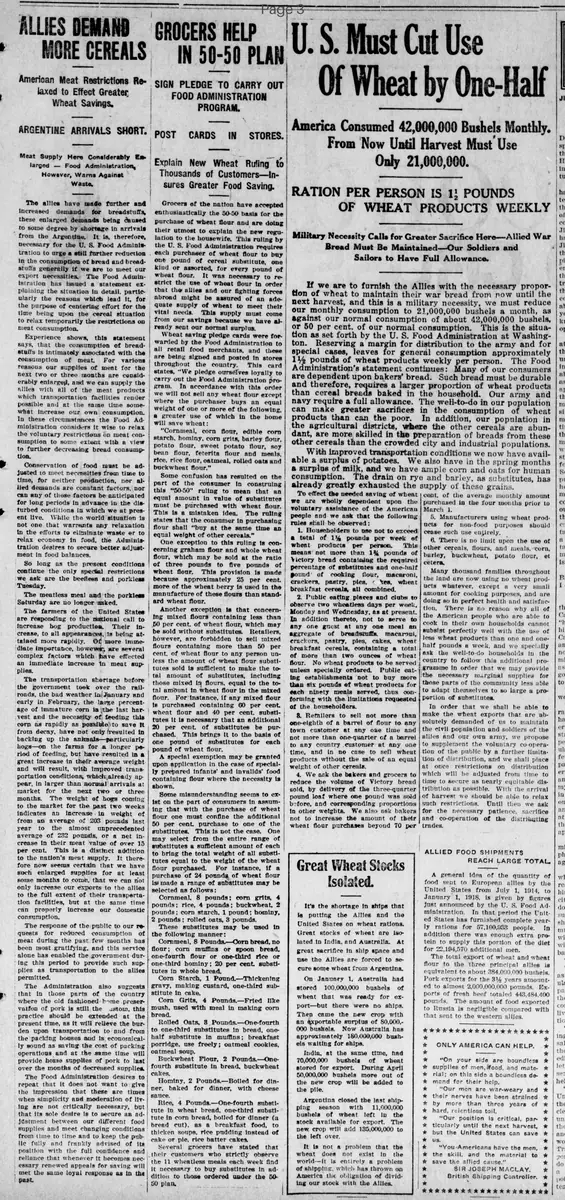
MORE CEREALS
American Meat Restrictions Relaxed to Effect Greater Wheat Savings.
ARGENTINE ARRIVALS SHORT
Meat Supply Here Considerably Enlarged - Food Administration However, Warns Against Waste.
The allies have made further and increased demands for breadstuffs, these enlarged demands being caused to some degree by shortage in arrivals from the Argentine. It is therefore necessary for the U. S. Food Administration to urge a still further reduction in the consumption of bread and breadstuffs generally if we are to meet our export necessities. The Food Administration has issued a statement explaining the situation in detail, particularly the reasons which lead it, for the purpose of centering effort for the time being upon the cereal situation to relax temporarily the restrictions on meat consumption.
Experience shows, this statement says, that the consumption of breadstuffs is intimately associated with the consumption of meat. For various reasons our supplies of meat for the next two or three months are considerably enlarged, and we can supply the allies with all of the meat products which transportation facilities render possible and at the same time somewhat increase our own consumption.
In these circumstances the Food Administration considers it wise to relax the voluntary restrictions on meat consumption to some extent with a view to further decreasing bread consumption.
Conservation of food must be adjusted to meet necessities from time to time, for neither production, nor allied demands are constant factors, nor can any of those factors be anticipated for long periods in advance in the disturbed conditions in which we at present live. While the world situation is not one that warrants any relaxation in the efforts to eliminate waste or to relax economy in food, the Administration desires to secure better adjustment in food balances.
So long as the present conditions continue the only special restrictions we ask are the beefless and porkless Tuesday.
The meatless meal and the porkless Saturday are no longer asked.
The farmers of the United States are responding to the national call to increase hog production. Their increase, to all appearances, is being attained more rapidly. Of more immediate importance, however, are several complex factors which have effected an immediate increase in meat supplies.
The transportation shortage before the government took over the railroads, the bad weather in January and early in February, the large percentage of immature corn in the last harvest and the necessity of feeding this corn as rapidly as possible to save it from decay, have not only resulted in backing up the animals--particularly hogs--on the farms for a longer period of feeding, but have resulted in a great increase in their average weight and will result, with improved transportation conditions, which already appear, in larger than normal arrivals at market for the next two or three months. The weight of hogs coming to the market for the past two weeks indicates an increase in weight of from an average of 203 pounds last year to the almost unprecedented average of 232 pounds, or a net increase in their meat value of over 15 per cent. This is a distinct addition to the nation's meat supply. It therefore now seems certain that we have such enlarged supplies for at least some months to come, that we can not only increase our exports to the allies to the full extent of their transportation facilities, but at the same time can properly increase our domestic consumption.
The response of the public to our requests for reduced consumption of meat during the past few months has been most gratifying, and this service alone has enabled the government during this period to provide such supplies as transportation to the allies permitted.
The Administration also suggests that in those parts of the country where the old fashioned home preservation of pork is still the custom, this practice should be extended at the present time, as it will relieve the burden upon transportation to and from the packing houses and is economically sound as saving the cost of packing operations and at the same time will provide home supplies of pork to last over the months of decreased supplies.
The Food Administration desires to repeat that it does not want to give the impression that these are times when simplicity and moderation of living are not critically necessary, but that its sole desire is to secure an adjustment between our different food supplies and meet changing conditions from time to time and to keep the public fully and frankly advised of its position with the full confidence and reliance that whenever it becomes necessary renewed appeals for saving will met the same loyal response as in the past.
What sub-type of article is it?
What keywords are associated?
Where did it happen?
Domestic News Details
Primary Location
United States
Outcome
relaxation of voluntary restrictions on meat consumption, elimination of meatless meals and porkless saturdays, retention of beefless and porkless tuesdays; increased meat supplies from heavier hogs and improved transportation, enabling higher exports to allies and domestic consumption.
Event Details
The U.S. Food Administration urges further reduction in bread and breadstuffs consumption due to increased Allied demands caused by Argentine shortages. To focus on cereal situation, it temporarily relaxes meat consumption restrictions, as meat supplies are enlarged for the next two or three months from factors like transportation improvements, weather delays, and heavier hog weights (from 203 to 232 pounds average). Public response to prior reductions has been gratifying. Suggests extending home pork preservation. Emphasizes ongoing need for simplicity and moderation, with adjustments to meet changing conditions.