Thank you for visiting SNEWPapers!
Sign up free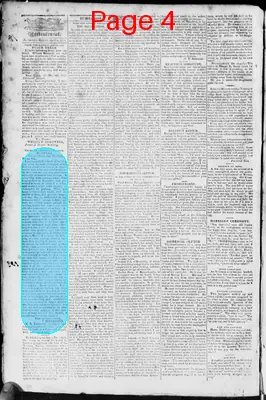
Story
April 8, 1824
Martinsburgh Gazette
Martinsburg, Berkeley County, West Virginia
What is this article about?
In a 1824 letter from Salem, Indiana, farmer C. Harrison shares his innovative method of budding apple and pear trees using winter-preserved cuttings, achieving high success rates and preferring it to grafting for its neatness and ease.
Clipping
OCR Quality
98%
Excellent
Full Text
FROM THE AMERICAN FARMER.
BUDDING.
Salem, (Ind.) Jan 14, 1824.
Dear Sir,
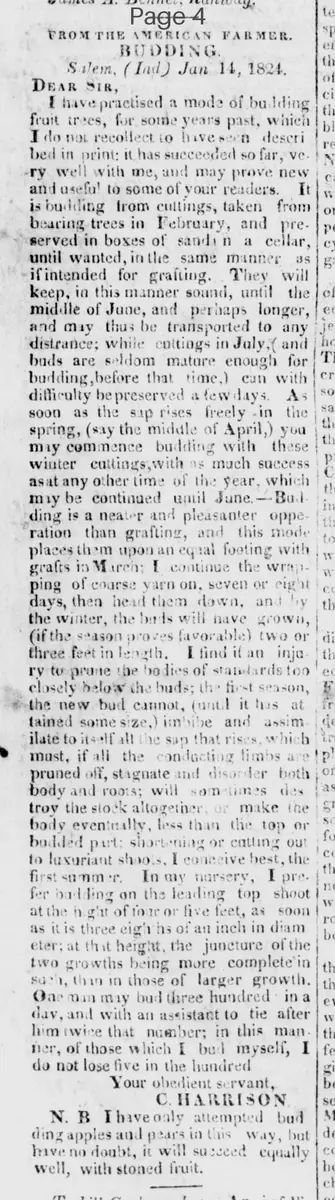
I have practised a mode of budding fruit trees, for some years past, which I do not recollect to have seen described in print: it has succeeded so far, very well with me, and may prove new and useful to some of your readers. It is budding from cuttings, taken from bearing trees in February, and preserved in boxes of sand in a cellar, until wanted, in the same manner as if intended for grafting. They will keep, in this manner sound, until the middle of June, and perhaps longer, and may thus be transported to any distance; while cuttings in July, (and buds are seldom mature enough for budding, before that time,) can with difficulty be preserved a few days. As soon as the sap rises freely in the spring, (say the middle of April,) you may commence budding with these winter cuttings, with as much success as at any other time of the year, which may be continued until June. Budding is a neater and pleasanter operation than grafting, and this mode places them upon an equal footing with grafts in March; I continue the wrapping of coarse yarn on, seven or eight days, then head them down, and by the winter, the buds will have grown, (if the season proves favorable) two or three feet in length. I find it injurious to prune the bodies of standards too closely below the buds: the first season, the new bud cannot, (until it has attained some size,) imbibe and assimilate to itself all the sap that rises, which must, if all the conducting limbs are pruned off, stagnate and disorder both body and roots: will sometimes destroy the stock altogether, or make the body eventually, less than the top or budded part: shortening or cutting out to luxuriant shoots, I conceive best, the first summer. In my nursery, I prefer budding on the leading top shoot at the height of two or five feet, as soon as it is three eights of an inch in diameter; at that height, the juncture of the two growths being more complete in substance, than in those of larger growth. One man may bud three hundred in a day, and with an assistant to tie after him twice that number; in this manner, of those which I bud myself, I do not lose five in the hundred.
Your obedient servant,
C. HARRISON.
N. B. I have only attempted budding apples and pears in this way, but have no doubt, it will succeed equally well, with stone fruit.
BUDDING.
Salem, (Ind.) Jan 14, 1824.
Dear Sir,
I have practised a mode of budding fruit trees, for some years past, which I do not recollect to have seen described in print: it has succeeded so far, very well with me, and may prove new and useful to some of your readers. It is budding from cuttings, taken from bearing trees in February, and preserved in boxes of sand in a cellar, until wanted, in the same manner as if intended for grafting. They will keep, in this manner sound, until the middle of June, and perhaps longer, and may thus be transported to any distance; while cuttings in July, (and buds are seldom mature enough for budding, before that time,) can with difficulty be preserved a few days. As soon as the sap rises freely in the spring, (say the middle of April,) you may commence budding with these winter cuttings, with as much success as at any other time of the year, which may be continued until June. Budding is a neater and pleasanter operation than grafting, and this mode places them upon an equal footing with grafts in March; I continue the wrapping of coarse yarn on, seven or eight days, then head them down, and by the winter, the buds will have grown, (if the season proves favorable) two or three feet in length. I find it injurious to prune the bodies of standards too closely below the buds: the first season, the new bud cannot, (until it has attained some size,) imbibe and assimilate to itself all the sap that rises, which must, if all the conducting limbs are pruned off, stagnate and disorder both body and roots: will sometimes destroy the stock altogether, or make the body eventually, less than the top or budded part: shortening or cutting out to luxuriant shoots, I conceive best, the first summer. In my nursery, I prefer budding on the leading top shoot at the height of two or five feet, as soon as it is three eights of an inch in diameter; at that height, the juncture of the two growths being more complete in substance, than in those of larger growth. One man may bud three hundred in a day, and with an assistant to tie after him twice that number; in this manner, of those which I bud myself, I do not lose five in the hundred.
Your obedient servant,
C. HARRISON.
N. B. I have only attempted budding apples and pears in this way, but have no doubt, it will succeed equally well, with stone fruit.
What sub-type of article is it?
Biography
Curiosity
What themes does it cover?
Triumph
Moral Virtue
What keywords are associated?
Budding Fruit Trees
Winter Cuttings
Apple Pear Budding
Horticultural Method
Nursery Practice
What entities or persons were involved?
C. Harrison
Where did it happen?
Salem, (Ind.)
Story Details
Key Persons
C. Harrison
Location
Salem, (Ind.)
Event Date
Jan 14, 1824
Story Details
C. Harrison describes a successful method of budding fruit trees using cuttings from bearing trees taken in February, preserved in sand until June, allowing budding from mid-April to June with high success rate, preferring it over grafting for neatness.