Thank you for visiting SNEWPapers!
Sign up free
Letter to Editor
May 2, 1803
The National Intelligencer And Washington Advertiser
Washington, District Of Columbia
What is this article about?
A letter from the Baltimore American critiques Mr. Bayard's speech on the US sale of bank stock, correcting his erroneous exchange rate calculations between London and Holland, and demonstrating that the transaction yielded a net annual gain of $6,216 to the United States by reducing higher-interest debt.
Clipping
OCR Quality
88%
Good
Full Text
From the Baltimore American.
THE Federal Gazette, of Monday, has republished from the E. Post, the 15th number, on the President's Message, which they head Bank Stock—It has been so fully and satisfactorily discussed by Mr. Bayard, that little else remains but to adapt his remarks to a newspaper copy.
The Post then gives Mr. Bayard's speech on the sale of the bank stock; and has also adopted his errors. Mr. Bayard quotes the exchange on London, in March April and May, 1802, from 96 to 99, for the London from thence? He infers, that bills on London ought to have been purchased, in order to make payment for the debt due in Holland: and that therewith bills on Holland might have been purchased at the rate of 10 guilders 16 stivers, to 10 gs. to 17s. the pound sterling—and thus Mr. B. says a gain would have been to the United States. 2 per cent. by the remittance to London, and of more than half per cent. from London to Holland.
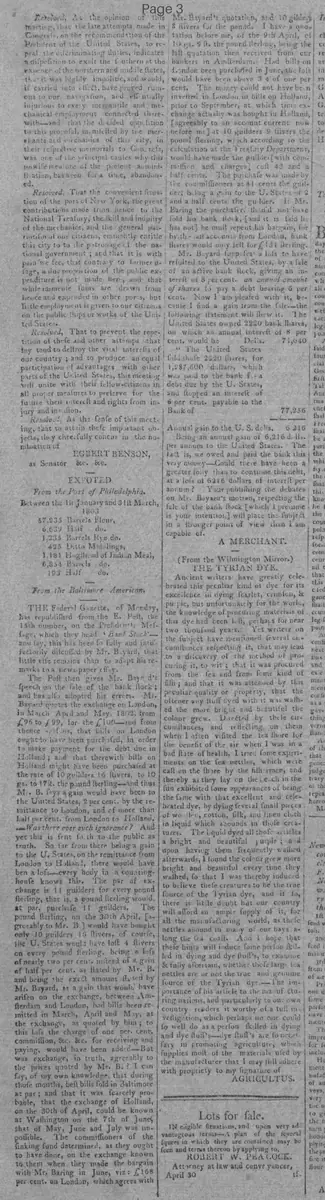
Was there ever such ignorance? And yet this is sent to the public as truth. So far from there being a gain to the U. States, on the remittance from London to Holland, there would have been a loss—every body in a counting-house knows this. The par of exchange is 11 guilders for every pound sterling, that is, a pound sterling would, at par, purchase 11 guilders. The pound sterling, on the 30th April, [agreeably to Mr. B.] would have bought only 10 guilders 16 Stivers. of course, the U. States would have lost 4 stivers on every pound sterling, being a loss of nearly two per cent. instead of a gain of half per cent. as stated by Mr. B. and being the exact amount stated by Mr. Bayard, as a gain that would have arisen on the exchange, between Amsterdam and London, had bills been remitted in March, April and May, at the exchange, as quoted by him; to this loss the charge of one per cent. commission, &c. &c. or receiving and paying, would have been added—But was exchange, in truth, agreeably to the prices quoted by Mr. B.? I can say, of my own knowledge, that during those months, best bills sold in Baltimore at par; and that it was scarcely probable, that the exchange of Holland, on the 30th of April, could be known at Washington on the 7th of June, that of May, June and July was impossible. The commissioners of the Sinking fund determined, as they ought to have done, on the exchange known to them when they made the bargain with Mr. Baring in June, viz: 168 per cent. on London, which agrees with Mr. Bayard's quotation, and 10 guilders 8 stivers for the pound. I have a quotation before me of the 9th April, of 10 gs. 9 st. the pound sterling, being the last quotation then received from our bankers in Amsterdam. Had bills on London been purchased in June, the loss would have been above 3/4 of one per cent. The money could not have been invested in London in bills on Holland, prior to September, at which time exchange actually was bought in Holland, agreeably to an account current now before me] at 10 guilders 9 stivers the pound sterling. which according to the calculation at the Treasury Department, would have made the guilder [with commission and charges] cost 43 and a half cents. The purchase was made by the commissioners at 41 cents the guilder; being a gain to the U. States of 2 and a half cents the guilder. If Mr. Baring the purchaser, should not have sold his bank stock, and it is said he has not] he must repent his bargain, for by the last accounts from London, bank shares would only sell for 131 Sterling.
Mr. Bayard supposes a loss to have resulted to the United States, by a Sale of an active bank stock, giving an interest of 8 per cent. an annual amount of shares to pay a debt bearing 6 per cent. Now I am pleased with it, because I find a gain from the sale—the following statement will shew it. The United States owned 2220 bank shares, on which an annual interest of 8 per cent. would be
Dollars. 71,040
The United States sold those 2220 shares, for 1,287,600 dollars, which was paid to the bank as a debt due by the U. States, and stopped an interest of 6 per cent. payable to the Bank of
77,256
Annual gain to the U. S. dolls. 6,316
Being an annual gain of 6,216 dolls. per annum to the United States. The fact is, we owed and paid the bank this very money—Could there have been a greater folly than to continue this debt, at a loss of 6216 dollars of interest per annum? Your publishing the debates on Mr. Bayard's motion, respecting the sale of the bank stock [which I presume is your intention.] will place the subject in a stronger point of view than I am capable of.
THE Federal Gazette, of Monday, has republished from the E. Post, the 15th number, on the President's Message, which they head Bank Stock—It has been so fully and satisfactorily discussed by Mr. Bayard, that little else remains but to adapt his remarks to a newspaper copy.
The Post then gives Mr. Bayard's speech on the sale of the bank stock; and has also adopted his errors. Mr. Bayard quotes the exchange on London, in March April and May, 1802, from 96 to 99, for the London from thence? He infers, that bills on London ought to have been purchased, in order to make payment for the debt due in Holland: and that therewith bills on Holland might have been purchased at the rate of 10 guilders 16 stivers, to 10 gs. to 17s. the pound sterling—and thus Mr. B. says a gain would have been to the United States. 2 per cent. by the remittance to London, and of more than half per cent. from London to Holland.
Was there ever such ignorance? And yet this is sent to the public as truth. So far from there being a gain to the U. States, on the remittance from London to Holland, there would have been a loss—every body in a counting-house knows this. The par of exchange is 11 guilders for every pound sterling, that is, a pound sterling would, at par, purchase 11 guilders. The pound sterling, on the 30th April, [agreeably to Mr. B.] would have bought only 10 guilders 16 Stivers. of course, the U. States would have lost 4 stivers on every pound sterling, being a loss of nearly two per cent. instead of a gain of half per cent. as stated by Mr. B. and being the exact amount stated by Mr. Bayard, as a gain that would have arisen on the exchange, between Amsterdam and London, had bills been remitted in March, April and May, at the exchange, as quoted by him; to this loss the charge of one per cent. commission, &c. &c. or receiving and paying, would have been added—But was exchange, in truth, agreeably to the prices quoted by Mr. B.? I can say, of my own knowledge, that during those months, best bills sold in Baltimore at par; and that it was scarcely probable, that the exchange of Holland, on the 30th of April, could be known at Washington on the 7th of June, that of May, June and July was impossible. The commissioners of the Sinking fund determined, as they ought to have done, on the exchange known to them when they made the bargain with Mr. Baring in June, viz: 168 per cent. on London, which agrees with Mr. Bayard's quotation, and 10 guilders 8 stivers for the pound. I have a quotation before me of the 9th April, of 10 gs. 9 st. the pound sterling, being the last quotation then received from our bankers in Amsterdam. Had bills on London been purchased in June, the loss would have been above 3/4 of one per cent. The money could not have been invested in London in bills on Holland, prior to September, at which time exchange actually was bought in Holland, agreeably to an account current now before me] at 10 guilders 9 stivers the pound sterling. which according to the calculation at the Treasury Department, would have made the guilder [with commission and charges] cost 43 and a half cents. The purchase was made by the commissioners at 41 cents the guilder; being a gain to the U. States of 2 and a half cents the guilder. If Mr. Baring the purchaser, should not have sold his bank stock, and it is said he has not] he must repent his bargain, for by the last accounts from London, bank shares would only sell for 131 Sterling.
Mr. Bayard supposes a loss to have resulted to the United States, by a Sale of an active bank stock, giving an interest of 8 per cent. an annual amount of shares to pay a debt bearing 6 per cent. Now I am pleased with it, because I find a gain from the sale—the following statement will shew it. The United States owned 2220 bank shares, on which an annual interest of 8 per cent. would be
Dollars. 71,040
The United States sold those 2220 shares, for 1,287,600 dollars, which was paid to the bank as a debt due by the U. States, and stopped an interest of 6 per cent. payable to the Bank of
77,256
Annual gain to the U. S. dolls. 6,316
Being an annual gain of 6,216 dolls. per annum to the United States. The fact is, we owed and paid the bank this very money—Could there have been a greater folly than to continue this debt, at a loss of 6216 dollars of interest per annum? Your publishing the debates on Mr. Bayard's motion, respecting the sale of the bank stock [which I presume is your intention.] will place the subject in a stronger point of view than I am capable of.
What sub-type of article is it?
Informative
Persuasive
Political
What themes does it cover?
Economic Policy
Politics
What keywords are associated?
Bank Stock Sale
Exchange Rates
Mr Bayard
Us Debt
Holland Bills
London Exchange
Sinking Fund
Financial Gain
What entities or persons were involved?
The Printer
Letter to Editor Details
Recipient
The Printer
Main Argument
the us sale of bank stock to pay debt resulted in an annual gain of $6,216 by replacing 8% interest payments with 6%, and mr. bayard's claims of loss due to exchange rates are incorrect, as alternative remittances would have incurred losses.
Notable Details
Corrects Bayard's Exchange Rate Errors From March May 1802
References Par Exchange Of 11 Guilders Per Pound Sterling
Cites Personal Knowledge Of Baltimore Bill Sales At Par
Details Sinking Fund Commissioners' Decision In June 1802
Calculates Gain Of 2.5 Cents Per Guilder In Purchase
Notes Potential Regret For Mr. Baring If Unsold At 131 Sterling