Thank you for visiting SNEWPapers!
Sign up free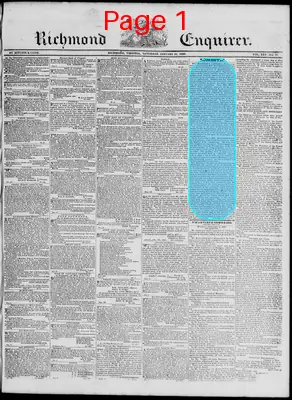
Richmond Enquirer
Richmond, Richmond County, Virginia
What is this article about?
Editorial in the Charleston Patriot critiques James Madison's letter arguing for Congress's constitutional power to impose protective tariffs on manufactures, emphasizing interpretation based on the Constitution's spirit of equality and compromise among states, particularly between Southern exporters and Northern manufacturers.
Clipping
OCR Quality
Full Text
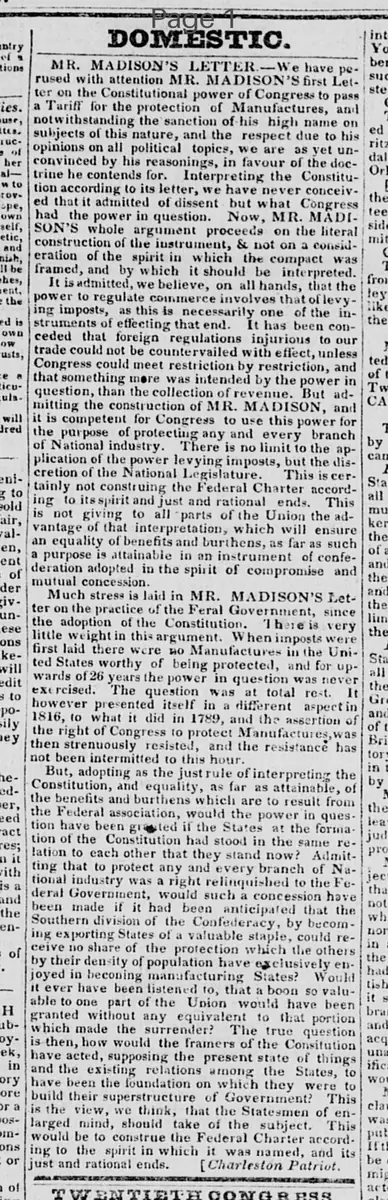
MR. MADISON'S LETTER.—We have perused with attention MR. MADISON'S first Letter on the Constitutional power of Congress to pass a Tariff for the protection of Manufactures, and notwithstanding the sanction of his high name on subjects of this nature, and the respect due to his opinions on all political topics, we are as yet unconvinced by his reasonings, in favour of the doctrine he contends for. Interpreting the Constitution according to its letter, we have never conceived that it admitted of dissent but what Congress had the power in question. Now, MR. MADISON'S whole argument proceeds on the literal construction of the instrument, & not on a consideration of the spirit in which the compact was framed, and by which it should be interpreted.
It is admitted, we believe, on all hands, that the power to regulate commerce involves that of levying imposts, as this is necessarily one of the instruments of effecting that end. It has been conceded that foreign regulations injurious to our trade could not be countervailed with effect, unless Congress could meet restriction by restriction, and that something more was intended by the power in question, than the collection of revenue. But admitting the construction of MR. MADISON, and it is competent for Congress to use this power for the purpose of protecting any and every branch of National industry. There is no limit to the application of the power levying imposts, but the discretion of the National Legislature. This is certainly not construing the Federal Charter according to its spirit and just and rational ends. This is not giving to all parts of the Union the advantage of that interpretation, which will ensure an equality of benefits and burthens, as far as such a purpose is attainable in an instrument of confederation adopted in the spirit of compromise and mutual concession.
Much stress is laid in MR. MADISON'S Letter on the practice of the Federal Government, since the adoption of the Constitution. There is very little weight in this argument. When imposts were first laid there were no Manufactures in the United States worthy of being protected, and for upwards of 26 years the power in question was never exercised. The question was at total rest. It however presented itself in a different aspect in 1816, to what it did in 1789, and the assertion of the right of Congress to protect Manufactures, was then strenuously resisted, and the resistance has not been intermitted to this hour.
But, adopting as the just rule of interpreting the Constitution, and equality, as far as attainable, of the benefits and burthens which are to result from the Federal association, would the power in question have been granted if the States at the formation of the Constitution had stood in the same relation to each other that they stand now? Admitting that to protect any and every branch of National industry was a right relinquished to the Federal Government, would such a concession have been made if it had been anticipated that the Southern division of the Confederacy, by becoming exporting States of a valuable staple, could receive no share of the protection which the others by their density of population have exclusively enjoyed in becoming manufacturing States? Would it ever have been listened to, that a boon so valuable to one part of the Union would have been granted without any equivalent to that portion which made the surrender? The true question is then, how would the framers of the Constitution have acted, supposing the present state of things and the existing relations among the States, to have been the foundation on which they were to build their superstructure of Government? This is the view, we think, that the Statesmen of enlarged mind, should take of the subject. This would be to construe the Federal Charter according to the spirit in which it was framed, and its just and rational ends.
[Charleston Patriot.]
What sub-type of article is it?
What themes does it cover?
What keywords are associated?
What entities or persons were involved?
Where did it happen?
Story Details
Key Persons
Location
United States
Event Date
1816
Story Details
Critique of MR. MADISON's letter supporting Congress's power to impose protective tariffs, arguing for constitutional interpretation based on spirit of equality between Southern exporting states and Northern manufacturing states, referencing historical context from 1789 to 1816.