Thank you for visiting SNEWPapers!
Sign up free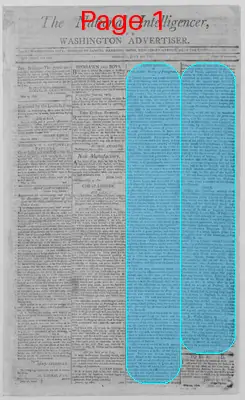
Literary
July 6, 1801
The National Intelligencer And Washington Advertiser
Washington, District Of Columbia
What is this article about?
Biographical extract from Proud's History of Pennsylvania detailing James Logan's life: born in Ireland to Quaker family, emigrated to Pennsylvania with William Penn in 1699, served as Provincial Secretary, Chief Justice, and President of Council; scholar in languages, math, philosophy; authored scientific works; translated Cicero; died 1751, bequeathed valuable Loganian Library to Philadelphia.
Clipping
OCR Quality
95%
Excellent
Full Text
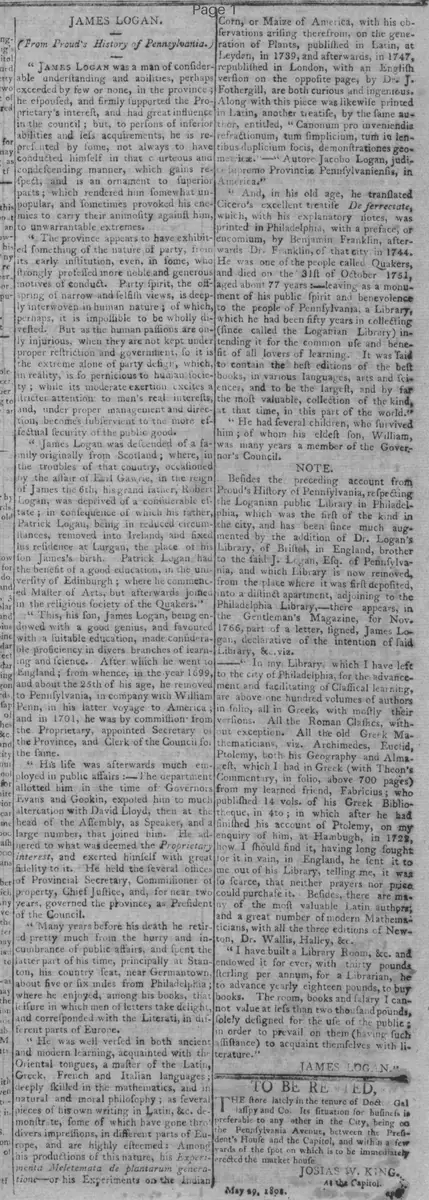
JAMES LOGAN.
(From Proud's History of Pennsylvania.)
"James Logan was a man of considerable understanding and abilities, perhaps exceeded by few or none, in the province; he espoused, and firmly supported the Proprietary's interest, and had great influence in the council; but, to persons of inferior abilities and less acquirements, he is represented by some, not always to have conducted himself in that courteous and condescending manner, which gains respect, and is an ornament to superior parts; which rendered him somewhat unpopular, and sometimes provoked his enemies to carry their animosity against him, to unwarrantable extremes.
"The province appears to have exhibited something of the nature of party, from its early institution, even, in some, who strongly professed more noble and generous motives of conduct. Party spirit, the offspring of narrow and selfish views, is deeply interwoven in human nature; of which, perhaps, it is impossible to be wholly divested. But as the human passions are only injurious, when they are not kept under proper restriction and government, so it is the extreme alone of party design, which, in reality, is so pernicious to human society; while its moderate exertion excites a stricter attention to men's real interests, and, under proper management and direction, becomes subservient to the more effectual security of the public good.
"James Logan was descended of a family originally from Scotland; where, in the troubles of that country, occasioned by the affair of Earl Gowrie, in the reign of James the 6th, his grandfather, Robert Logan, was deprived of a considerable estate; in consequence of which his father, Patrick Logan, being in reduced circumstances, removed into Ireland, and fixed his residence at Lurgan, the place of his son James's birth. Patrick Logan had the benefit of a good education, in the university of Edinburgh; where he commenced Master of Arts, but afterwards joined in the religious society of the Quakers."
"This, his son, James Logan, being endowed with a good genius, and favoured with a suitable education, made considerable proficiency in divers branches of learning and science. After which he went to England; from whence, in the year 1699, and about the 25th of his age, he removed to Pennsylvania, in company with William Penn, in his latter voyage to America; and in 1701, he was by commission from the Proprietary, appointed Secretary of the Province, and Clerk of the Council for the same.
"His life was afterwards much employed in public affairs:—The department allotted him in the time of Governors Evans and Gookin, exposed him to much altercation with David Lloyd, then at the head of the Assembly, as Speaker, and a large number, that joined him. He adhered to what was deemed the Proprietary interest, and exerted himself with great fidelity to it. He held the several offices of Provincial Secretary, Commissioner of property, Chief Justice, and, for near two years, governed the province, as President of the Council.
"Many years before his death he retired pretty much from the hurry and incumbrance of public affairs, and spent the latter part of his time, principally at Stenton, his country seat, near Germantown, about five or six miles from Philadelphia; where he enjoyed, among his books, that leisure in which men of letters take delight, and corresponded with the Literati, in different parts of Europe.
"He was well versed in both ancient and modern learning, acquainted with the Oriental tongues, a master of the Latin, Greek, French and Italian languages; deeply skilled in the mathematics, and in natural and moral philosophy; as several pieces of his own writing in Latin, &c. demonstrate, some of which have gone thro' divers impressions, in different parts of Europe, and are highly esteemed: Among his productions of this nature, his Experimenta Meletemata de plantarum generatione—or his Experiments on the Indian Corn, or Maize of America, with his observations arising therefrom, on the generation of Plants, published in Latin, at Leyden, in 1739, and afterwards, in 1747, republished in London, with an English version on the opposite page, by Dr. J. Fothergill, are both curious and ingenious. Along with this piece was likewise printed in Latin, another treatise, by the same author, entitled, "Canonum pro inveniendis refractionum, tum simplicium, tum in lentibus duplicium focis, demonstrationes geometricæ.'—'Autore Jacobo Logan, judice supremo Provinciæ Pennsylvanienis, in America.'
"And, in his old age, he translated Cicero's excellent treatise De Senectute, which, with his explanatory notes, was printed in Philadelphia, with a preface, or encomium, by Benjamin Franklin, afterwards Dr. Franklin, of that city in 1744. He was one of the people called Quakers, and died on the 31st of October 1751, aged about 77 years: leaving as a monument of his public spirit and benevolence to the people of Pennsylvania, a Library, which he had been fifty years in collecting (since called the Loganian Library) intending it for the common use and benefit of all lovers of learning. It was said to contain the best editions of the best books, in various languages, arts and sciences, and to be the largest, and by far the most valuable, collection of the kind, at that time, in this part of the world.
"He had several children, who survived him; of whom his eldest son, William, was many years a member of the Governor's Council.
NOTE.
Besides the preceding account from Proud's History of Pennsylvania, respecting the Loganian public Library in Philadelphia, which was the first of the kind in the city, and has been since much augmented by the addition of Dr. Logan's Library, of Bristol, in England, brother to the said J. Logan, Esq. of Pennsylvania, and which Library is now removed from the place where it was first deposited, into a distinct apartment, adjoining to the Philadelphia Library,—there appears, in the Gentleman's Magazine, for Nov. 1766, part of a letter, signed, James Logan, declarative of the intention of said Library, &c. viz.
"In my Library, which I have left to the city of Philadelphia, for the advancement and facilitating of Classical learning, are above one hundred volumes of authors in folio, all in Greek, with mostly their versions. All the Roman Classics, without exception. All the old Greek Mathematicians, viz. Archimedes, Euclid, Ptolemy, both his Geography and Almagest, which I had in Greek (with Theon's Commentary, in folio, above 700 pages) from my learned friend, Fabricius; who published 14 vols. of his Greek Bibliotheque, in 4to; in which after he had finished his account of Ptolemy, on my enquiry of him, at Hamburg, in 1728, how I should find it, having long sought for it in vain, in England, he sent it to me out of his Library, telling me, it was so scarce, that neither prayers nor price could purchase it. Besides, there are many of the most valuable Latin authors; and a great number of modern Mathematicians, with all the three editions of Newton, Dr. Wallis, Halley, &c.
"I have built a Library Room, &c. and endowed it for ever, with thirty pounds sterling per annum, for a Librarian, he to advance yearly eighteen pounds, to buy books. The room, books and salary I cannot value at less than two thousand pounds, solely designed for the use of the public: in order to prevail on them (having such assistance) to acquaint themselves with literature."
JAMES LOGAN.
(From Proud's History of Pennsylvania.)
"James Logan was a man of considerable understanding and abilities, perhaps exceeded by few or none, in the province; he espoused, and firmly supported the Proprietary's interest, and had great influence in the council; but, to persons of inferior abilities and less acquirements, he is represented by some, not always to have conducted himself in that courteous and condescending manner, which gains respect, and is an ornament to superior parts; which rendered him somewhat unpopular, and sometimes provoked his enemies to carry their animosity against him, to unwarrantable extremes.
"The province appears to have exhibited something of the nature of party, from its early institution, even, in some, who strongly professed more noble and generous motives of conduct. Party spirit, the offspring of narrow and selfish views, is deeply interwoven in human nature; of which, perhaps, it is impossible to be wholly divested. But as the human passions are only injurious, when they are not kept under proper restriction and government, so it is the extreme alone of party design, which, in reality, is so pernicious to human society; while its moderate exertion excites a stricter attention to men's real interests, and, under proper management and direction, becomes subservient to the more effectual security of the public good.
"James Logan was descended of a family originally from Scotland; where, in the troubles of that country, occasioned by the affair of Earl Gowrie, in the reign of James the 6th, his grandfather, Robert Logan, was deprived of a considerable estate; in consequence of which his father, Patrick Logan, being in reduced circumstances, removed into Ireland, and fixed his residence at Lurgan, the place of his son James's birth. Patrick Logan had the benefit of a good education, in the university of Edinburgh; where he commenced Master of Arts, but afterwards joined in the religious society of the Quakers."
"This, his son, James Logan, being endowed with a good genius, and favoured with a suitable education, made considerable proficiency in divers branches of learning and science. After which he went to England; from whence, in the year 1699, and about the 25th of his age, he removed to Pennsylvania, in company with William Penn, in his latter voyage to America; and in 1701, he was by commission from the Proprietary, appointed Secretary of the Province, and Clerk of the Council for the same.
"His life was afterwards much employed in public affairs:—The department allotted him in the time of Governors Evans and Gookin, exposed him to much altercation with David Lloyd, then at the head of the Assembly, as Speaker, and a large number, that joined him. He adhered to what was deemed the Proprietary interest, and exerted himself with great fidelity to it. He held the several offices of Provincial Secretary, Commissioner of property, Chief Justice, and, for near two years, governed the province, as President of the Council.
"Many years before his death he retired pretty much from the hurry and incumbrance of public affairs, and spent the latter part of his time, principally at Stenton, his country seat, near Germantown, about five or six miles from Philadelphia; where he enjoyed, among his books, that leisure in which men of letters take delight, and corresponded with the Literati, in different parts of Europe.
"He was well versed in both ancient and modern learning, acquainted with the Oriental tongues, a master of the Latin, Greek, French and Italian languages; deeply skilled in the mathematics, and in natural and moral philosophy; as several pieces of his own writing in Latin, &c. demonstrate, some of which have gone thro' divers impressions, in different parts of Europe, and are highly esteemed: Among his productions of this nature, his Experimenta Meletemata de plantarum generatione—or his Experiments on the Indian Corn, or Maize of America, with his observations arising therefrom, on the generation of Plants, published in Latin, at Leyden, in 1739, and afterwards, in 1747, republished in London, with an English version on the opposite page, by Dr. J. Fothergill, are both curious and ingenious. Along with this piece was likewise printed in Latin, another treatise, by the same author, entitled, "Canonum pro inveniendis refractionum, tum simplicium, tum in lentibus duplicium focis, demonstrationes geometricæ.'—'Autore Jacobo Logan, judice supremo Provinciæ Pennsylvanienis, in America.'
"And, in his old age, he translated Cicero's excellent treatise De Senectute, which, with his explanatory notes, was printed in Philadelphia, with a preface, or encomium, by Benjamin Franklin, afterwards Dr. Franklin, of that city in 1744. He was one of the people called Quakers, and died on the 31st of October 1751, aged about 77 years: leaving as a monument of his public spirit and benevolence to the people of Pennsylvania, a Library, which he had been fifty years in collecting (since called the Loganian Library) intending it for the common use and benefit of all lovers of learning. It was said to contain the best editions of the best books, in various languages, arts and sciences, and to be the largest, and by far the most valuable, collection of the kind, at that time, in this part of the world.
"He had several children, who survived him; of whom his eldest son, William, was many years a member of the Governor's Council.
NOTE.
Besides the preceding account from Proud's History of Pennsylvania, respecting the Loganian public Library in Philadelphia, which was the first of the kind in the city, and has been since much augmented by the addition of Dr. Logan's Library, of Bristol, in England, brother to the said J. Logan, Esq. of Pennsylvania, and which Library is now removed from the place where it was first deposited, into a distinct apartment, adjoining to the Philadelphia Library,—there appears, in the Gentleman's Magazine, for Nov. 1766, part of a letter, signed, James Logan, declarative of the intention of said Library, &c. viz.
"In my Library, which I have left to the city of Philadelphia, for the advancement and facilitating of Classical learning, are above one hundred volumes of authors in folio, all in Greek, with mostly their versions. All the Roman Classics, without exception. All the old Greek Mathematicians, viz. Archimedes, Euclid, Ptolemy, both his Geography and Almagest, which I had in Greek (with Theon's Commentary, in folio, above 700 pages) from my learned friend, Fabricius; who published 14 vols. of his Greek Bibliotheque, in 4to; in which after he had finished his account of Ptolemy, on my enquiry of him, at Hamburg, in 1728, how I should find it, having long sought for it in vain, in England, he sent it to me out of his Library, telling me, it was so scarce, that neither prayers nor price could purchase it. Besides, there are many of the most valuable Latin authors; and a great number of modern Mathematicians, with all the three editions of Newton, Dr. Wallis, Halley, &c.
"I have built a Library Room, &c. and endowed it for ever, with thirty pounds sterling per annum, for a Librarian, he to advance yearly eighteen pounds, to buy books. The room, books and salary I cannot value at less than two thousand pounds, solely designed for the use of the public: in order to prevail on them (having such assistance) to acquaint themselves with literature."
JAMES LOGAN.
What sub-type of article is it?
Essay
What themes does it cover?
Political
Religious
Moral Virtue
What keywords are associated?
James Logan
Pennsylvania History
Quaker
Loganian Library
Biography
William Penn
Benjamin Franklin
Public Service
What entities or persons were involved?
From Proud's History Of Pennsylvania
Literary Details
Title
James Logan.
Author
From Proud's History Of Pennsylvania
Subject
Biography Of James Logan
Form / Style
Biographical Prose Essay
Key Lines
James Logan Was A Man Of Considerable Understanding And Abilities, Perhaps Exceeded By Few Or None, In The Province;
He Was One Of The People Called Quakers, And Died On The 31st Of October 1751, Aged About 77 Years:
Leaving As A Monument Of His Public Spirit And Benevolence To The People Of Pennsylvania, A Library, Which He Had Been Fifty Years In Collecting (Since Called The Loganian Library)