Thank you for visiting SNEWPapers!
Sign up free
Dollar Weekly Mirror
Manchester, Hillsboro County, Hillsborough County, New Hampshire
What is this article about?
Near Bonn, Germany, maid Hanchen outwits her treacherous suitor Heinrich and an accomplice attempting to rob her master's mill. She locks Heinrich in a room, sends the child for help, and traps the accomplice in the mill's machinery by starting it, leading to their capture. She later marries the miller's son.
Clipping
OCR Quality
Full Text
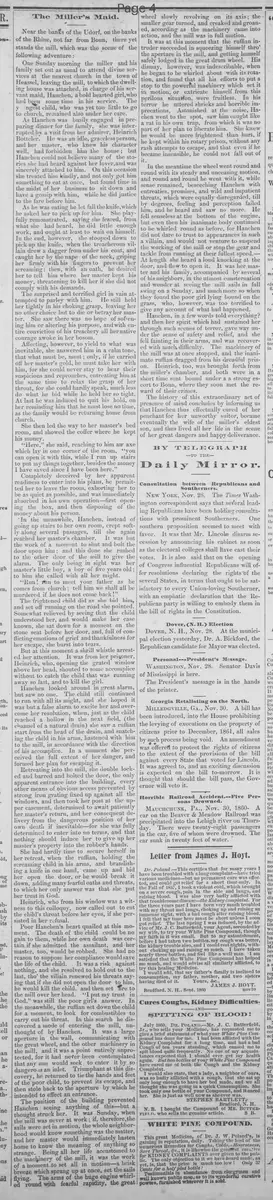
Near the banks of the Udorf, on the banks of the Rhine, not far from Bonn, there yet stands the mill, which was the scene of the following adventure:
One Sunday morning the miller and his family set out as usual to attend divine services at the nearest church in the town of Heassel, leaving the mill, to which the dwelling house was attached, in charge of his servant maid, Hanchen, a bold hearted girl, who had been some time in his service. The youngest child, who was yet too little to go to church, remained also under her care.
As Hanchen was busily engaged in preparing dinner for the family, she was interrupted by a visit from her admirer, Heinrich Botteler. He was an idle, graceless person, and her master, who knew his character well, had forbidden him the house; but Hanchen could not believe many of the stories she had heard against her lover, and was sincerely attached to him. On this occasion she treated him kindly, and not only got him something to eat at once, but found time in the midst of her business to sit down and have a gossip with him, while he did justice to the fare before him.
As he was eating he let fall the knife, which he asked her to pick up for him. She playfully remonstrated, saying she feared, from what she had heard, he did little enough work, and ought at least to wait on himself. In the end, however, she stooped down to pick up the knife, when the treacherous villain drew a dagger from under his coat, and caught her by the nape of the neck, griping her firmly with his fingers to prevent her screaming: then, with an oath, he desired her to tell him where her master kept his money, threatening to kill her if she did not comply with his demands.
The surprised and terrified girl in vain attempted to parley with him. He still held her tightly in his choking grasp, leaving her no other choice but to die or betray her master. She saw there was no hope of softening him or altering his purpose, and with entire conviction of his treachery all her native courage awoke in her bosom.
Affecting, however, to yield to what was inevitable, she answered him in a calm tone, that what must be, must; only, if he carried off her master's gold, he must take her with him, for she could never stay to hear their suspicions and reproaches, entreating him at the same time to relax the grasp of her throat, for she could hardly speak, much less do what he bid while he held her so tight.
At last he was induced to quit his hold, on her reminding him that he must lose no time, as the family would be returning home from church.
She then led the way to her master's bed room, and showed the coffer where he kept his money.
"Here," she said, reaching to him an axe which lay in one corner of the room, "you can open it with this, while I run up stairs to put my things together, besides the money I have saved since I have been here."
Completely deceived by her apparent readiness to enter into his plans, he permitted her to leave the room, exhorting her to be as quiet as possible, and was immediately absorbed in his own operation—first opening the box, and then disposing of the money about his person.
In the meanwhile, Hanchen, instead of going up stairs to her own room, crept softly along several passages, till she again reached her master's chamber. It was but the work of a moment to shut and bolt the door upon him; and this done she rushed to the other door of the mill to give the alarm. The only being in sight was her master's little boy, a boy of five years old: to him she called with all her might.
"Run! run to meet your father as he comes from church; tell him we shall all be murdered if he does not come back!"
The frightened child did as she bid him, and set off running on the road she pointed. Somewhat relieved by seeing that the child understood her, and would make her case known, she sat down for a moment on the stone seat before her door, and, full of conflicting emotions of grief and thankfulness for her escape, she burst into tears.
But at this moment a shrill whistle arrested her attention. It was from her prisoner, Heinrich, who, opening the grated window above her head, shouted to some accomplice without to catch the child that was running away so fast, and to kill the girl.
Hanchen looked around in great alarm, but saw no one. The child still continued to run with all its might, and she hoped it was but a false alarm to excite her and overcome her resolution, when, just as the child reached a hollow in the next field, (the channel of a natural drain) she saw a ruffian start from the head of the drain, and snatching the child in his arms, hastened with him to the mill, in accordance with the direction of his accomplice. In a moment she perceived the full extent of her danger, and formed her plan for escaping it.
Retreating into the mill, she double locked and barred and bolted the door, the only apparent entrance into the building, every other means of obvious access prevented by strong iron grating fixed up against all the windows, and then took her post at the upper casement, determined to await patiently her master's return, and her consequent delivery from the dangerous position of her own death if inevitable—for she was fully determined to enter into no terms, and that nothing should induce her to give up her master's property into the robber's hands.
She had hardly time to secure herself in her retreat, when the ruffian, holding the screaming child in his arms, and brandishing a knife in one hand, came up and bid her open the door, or he would break it down, adding many fearful oaths and threats, to which her only answer was that she put her trust in God.
Heinrich, who from his window was a witness to this colloquy, now called out to cut the child's throat before her eyes, if she persisted in her refusal.
Poor Hanchen's heart quailed at this moment. The death of the child could be no gain to them, while her own death was certain if she admitted the assailant, and her master, too, would be robbed. She had no reason to suppose her compliance would save the life of the child. It was a risk against nothing, and she resolved to hold out to the last, tho' the villain renewed his threats saying that if she did not open the door to him, he would kill the child, and then set fire to the mill over her head. "I put my trust in God." was still the poor girl's answer. In the meanwhile, the ruffian set down the child for a moment, to look for combustibles to carry out his threat. In this search he discovered a mode of entering the mill, unthought of by Hanchen. It was a large aperture in the wall, communicating with the great wheel, and the other machinery in the mill, and it was a point entirely unprotected, for it had never been contemplated that any one would seek to enter it by so dangerous an inlet. Triumphant at this discovery, he returned to tie the hands and feet of the poor child, to prevent its escape, and then stole back to the aperture by which he intended to effect an entrance.
The position of the building prevented Hanchen seeing anything of this—but a thought struck her. It was Sunday, when the mill was never at work; if, therefore, the sails were set in motion, the whole neighborhood would know something was the matter, and her master would immediately hasten home to know the meaning of anything so strange. Being all her life accustomed to the machinery of the mill, it was the work of a moment to set all in motion—a brisk breeze which sprang up at once, set the sails flying. The arms of the huge engine whirled round with fearful rapidity, the great wheel slowly revolving on its axis: the smaller gear turned, and creaked and groaned, according as the machinery came into action, and the mill was in full motion.
It was at this moment that the ruffian intruder succeeded in squeezing himself thro' the aperture in the mill, and getting himself safely lodged in the great drum wheel. His dismay, however, was indescribable, when he began to be whirled about with its rotation, and found that all his efforts to put a stop to the powerful machinery which set it in motion, or extricate himself from this perilous situation, were fruitless. In his terror he uttered shrieks and horrible imprecations. Astonished at the noise, Hanchen went to the spot, saw him caught like a rat in his own trap, from which it was no part of her plan to liberate him. She knew he would be more frightened than hurt, if he kept within his rotary prison, without any rash attempts to escape, and that even if he became insensible, he could not fall out of it.
In the meantime the wheel went round and round with its steady and unceasing motion, and round and round he went with it, while sense remained, beseeching Hanchen with entreaties, promises, and wild and impatient threats, which were equally disregarded, till by degrees, feeling and perception failed him, and he heard and saw no more. He fell senseless at the bottom of the engine, but even then his inanimate body continued to be whirled round as before, for Hanchen did not dare to trust to appearances in such a villain, and would not venture to suspend the working of the mill or stop the gear and tackle from running at their fullest speed.
At length she heard a loud knocking at the door, and flew to open it. It was her master and his family, accompanied by several of his neighbors, in the utmost consternation and wonder at seeing the mill sails in full swing on a Sunday, and much more so when they found the poor girl lying bound on the grass, who, however, was too terrified to give any account of what had happened.
Hanchen, in a few words told everything, and then her spirit which had sustained her through such scenes of terror, gave way under the sense of safety and relief, and she fell fainting in their arms, and was recovered with much difficulty. The machinery of the mill was at once stopped, and the inanimate ruffian dragged from his dreadful prison. Heinrich, too, was brought forth from the miller's chamber, and both were in a short time sent bound under a strong escort to Bonn, where they soon met the reward of their crimes.
The history of this extraordinary act of presence of mind concludes by informing us that Hanchen thus effectually cured of her penchant for her unworthy suitor, became eventually the wife of the miller's eldest son, and thus lived all her life in the scene of her great dangers and happy deliverance.
What sub-type of article is it?
What themes does it cover?
What keywords are associated?
What entities or persons were involved?
Where did it happen?
Story Details
Key Persons
Location
Mill Near Bonn On The Rhine
Story Details
Servant maid Hanchen feigns compliance with robber Heinrich's demand for her master's money, locks him in the bedroom, sends the child to alert the family, barricades the mill against the accomplice who captures the child, starts the mill machinery to trap the intruder in the wheel, and awaits rescue, resulting in the robbers' capture and her marriage to the miller's son.