Thank you for visiting SNEWPapers!
Sign up free
Gazette Of The United States, & Philadelphia Daily Advertiser
Philadelphia, Philadelphia County, Pennsylvania
What is this article about?
Colonne's 1796 analysis of Europe's political state urges a constitutional monarchy for France to restore order, critiques the revolution, and recalls allied powers' declarations from 1791-1793 aiming to reestablish monarchy without conquests, emphasizing just peace and liberty.
Merged-components note: Continuation of the political extract on Europe, including reference to Calonne and French emigrants; sequential reading order and thematic coherence.
Clipping
OCR Quality
Full Text
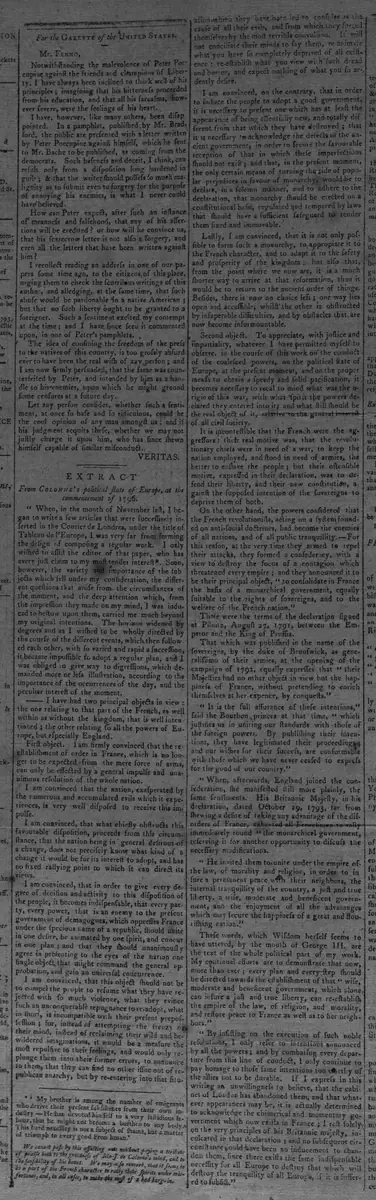
From Colonne's political state of Europe, at the commencement of 1796.
"When, in the month of November last, I began to write a few articles that were successively inserted in the Courier de Londres, under the title of Tableau de l'Europe, I was very far from forming the design of composing a regular work. I only wished to assist the editor of that paper, who has every just claim to my most tender interest. Soon, however, the variety and importance of the subject which fell under my consideration, the different questions that arose from the circumstances of the moment, and the deep attention which, from the impression they made on my mind, I was induced to bestow upon them, carried me much beyond my original intentions. The horizon widened by degrees and as I wished to be wholly directed by the course of the different events, which then followed each other, with so varied and rapid a succession, it became impossible to adopt a regular plan, and I was obliged to give way to digressions, which demanded more or less illustration, according to the importance of the occurrences of the day, and the peculiar interest of the moment.
I have had two principal objects in view: the one relating to that part of the French, as well as within as without the kingdom, that is well intentioned; the other relating to all the powers of Europe, but especially England.
First object. - I am firmly convinced that the re-establishment of order in France, which is no longer to be expected from the mere force of arms, can only be effected by a general impulse and unanimous resolution of the whole nation. I am convinced that the nation, exasperated by the numerous and accumulated evils which it experiences, is very well disposed to receive this impulse. I am convinced, that what chiefly obstructs this favourable disposition, proceeds from this circumstance, that the nation being in general desirous of a change, does not precisely know what kind of a change it would be for its interest to adopt, and has no fixed rallying point to which it can direct its views. I am convinced, that in order to give every degree of decision and activity to this disposition of the people, it becomes indispensable, that every party, every power, that is an enemy to the present government of demagogues, which oppresses France under the specious name of a republic, should unite in one desire, be animated by one spirit, and concur in one plan; and that they should unanimously agree in presenting to the eyes of the nation one single object that might command the general approbation, and gain an universal concurrence. I am convinced, that this object should not be to compel the people to resume what they have rejected with so much violence, what they evince such an unconquerable repugnance to re-adopt, what in short, is incompatible with their present disposition; for, instead of attempting to frenzy their mind, instead of reclaiming their wild and bewildered imaginations, it would be a measure the most repulsive to their feelings, and would only re-plunge them into their former errors, to announce to them, that they can find no other issue out of republican anarchy, but by re-entering into that situation which they have been led to consider as the cause of all their evils, and from which they forced themselves by the most terrible convulsion. It will not conciliate their minds to say they re-animate what you have so completely deprived of all existence: re-establish what you view with such dread and horror, and expect nothing of what you so ardently desire.
I am convinced, on the contrary, that in order to induce the people to adopt a good government, it is necessary to present one which has at least the appearance of being essentially new, and totally different from that which they have destroyed; that it is necessary to acknowledge the defects of the ancient government, in order to ensure the favourable reception of that in which these imperfections should not exist; and that, in the present moment, the only certain means of turning the tide of popular prejudices in favour of monarchy, would be to declare, in a solemn manner, and to adhere to the declaration, that monarchy should be erected on a constitutional basis, regulated and tempered by laws that should have a sufficient safeguard to render them fixed and immovable.
Lastly, I am convinced, that it is not only possible to form such a monarchy, to appropriate it to the French character, and to adapt it to the safety and prosperity of the kingdom; but also that, from the point where we now are, it is a much shorter way to arrive at that reformation, than it would be to return to the ancient order of things. Besides, there is now no choice left; one way lies open and accessible, whilst the other is obstructed by insuperable difficulties, and by obstacles that are now become insurmountable.
Second object. To appreciate, with justice and impartiality, whatever I have permitted myself to observe, in the course of this work on the conduct of the coalesced powers, on the political state of Europe, at the present moment, and on the proper means to obtain a speedy and solid pacification, it becomes necessary to recall to mind what was the origin of this war, with what spirit the powers declared they entered into it, and what still should be the real object of it, relative to the general interest of all civil society.
It is incontestable that the French were the aggressors: their real motive was, that the revolutionary chiefs were in need of a war, to keep the nation employed, and stood in need of armies, the better to enslave the people; but their ostensible motive, expressed in their declaration, was to defend their liberty, and their new constitution, against the supposed intention of the sovereigns to deprive them of both.
On the other hand, the powers considered that the French revolutionists, acting on a system founded on anti-social doctrines, had become the enemies of all nations, and of all public tranquillity.—For this reason, at the very time they armed to repel their attacks, they formed a confederacy, with a view to destroy the focus of a contagion which threatened every empire; and they announced it to be their principal object, "to consolidate in France the basis of a monarchical government, equally suitable to the rights of sovereigns, and to the welfare of the French nation."
These were the terms of the declaration signed at Pilnitz, August 27, 1791, between the Emperor and the King of Prussia.
That which was published in the name of the sovereigns, by the duke of Brunswick, as generalissimo of their armies, at the opening of the campaign of 1792, equally expresses that "their Majesties had no other object in view but the happiness of France, without pretending to enrich themselves at her expense, by conquests."
"It is the full assurance of these intentions," said the Bourbon princes at that time, "which justifies us in uniting our standards with those of the foreign powers. By publishing their intentions, they have legitimated their proceedings; and our wishes for their success, are conformable with those which we have never ceased to express for the good of our country."
"When, afterwards, England joined the confederation, she manifested still more plainly, the same sentiments. His Britannic Majesty, in his declaration, dated October 29, 1793, far from shewing a desire of taking any advantage of the disorders of France, exhorted all Frenchmen to rally immediately round "the monarchical government, reserving it for another opportunity to discuss the necessary modifications."
"He invited them to unite under the empire of the law, of morality and religion, in order to insure a permanent peace with their neighbors, the internal tranquillity of the country, a just and true liberty, a wise, moderate and beneficent government, and the enjoyment of all the advantages which may secure the happiness of a great and flourishing nation."
These words, which Wisdom herself seems to have uttered, by the mouth of George III. are the text of the whole political part of my work. My continual efforts are to demonstrate that now more than ever; every plan and every step should be directed towards the establishment of that "wise, moderate and beneficent government, which alone can insure a just and true liberty, can re-establish the empire of the law, of religion, and morality, and restore peace to France as well as to her neighbors."
"By insisting on the execution of such noble resolutions, I only refer to intentions announced by all the powers; and by combating every departure from this line of conduct, I only continue to pay homage to those same intentions too worthy of the allies not to be durable. If I express in this writing an unwillingness to believe, that the cabinet of London has abandoned them, and that whatever appearances may be, it is actually determined to acknowledge the chimerical and momentary government which now exists in France; I rest solely on the very principles of his Britannic majesty, inculcated in that declaration; and no subsequent circumstance could have been an inducement to abandon them, since there exists the same indispensable necessity for all Europe to destroy that which will destroy the tranquility of all Europe, if it is suffered to subsist."
My brother is among the number of emigrants who derive their present subsistence from their own industry - He has devoted himself to a very fastidious labour, that he might not become a burthen to any body. This hard necessity is not a subject of shame, but a matter of triumph to every good Frenchman.
We cannot pass by this affecting state without paying a tribute of praise both to the greatness of Mon. de Calonne's mind, and to the sensibility of his heart. We may also remark, that it seems to be a part of the French character to rally their spirits under misfortunes, and, in all cases, to make the most of a bad bargain.
What sub-type of article is it?
What keywords are associated?
What entities or persons were involved?
Where did it happen?
Foreign News Details
Primary Location
France
Event Date
Commencement Of 1796
Key Persons
Outcome
advocacy for constitutional monarchy in france to achieve pacification and restore order, recalling allied intentions for monarchical restoration without conquests.
Event Details
Colonne's analysis argues for re-establishing order in France through a new constitutional monarchy rather than restoring the old regime, addressing the French nation's desire for change. It reviews the war's origins, French aggression under revolutionary pretexts, and European powers' confederacy to counter revolutionary threats, citing declarations from Pilnitz (1791), Brunswick (1792), and England (1793) emphasizing monarchical restoration for France's welfare and general peace.