Thank you for visiting SNEWPapers!
Sign up free
The Daily Bulletin
Honolulu, Honolulu County, Hawaii
What is this article about?
US Consul reports on leprosy in Cape Town, introduced by Malay slaves over a century ago, prevalent among 15,000 Malays, hereditary and infectious, transmissible to animals like pigeons and mice, bill for leper segregation introduced in Cape Colony Parliament.
Clipping
OCR Quality
Full Text
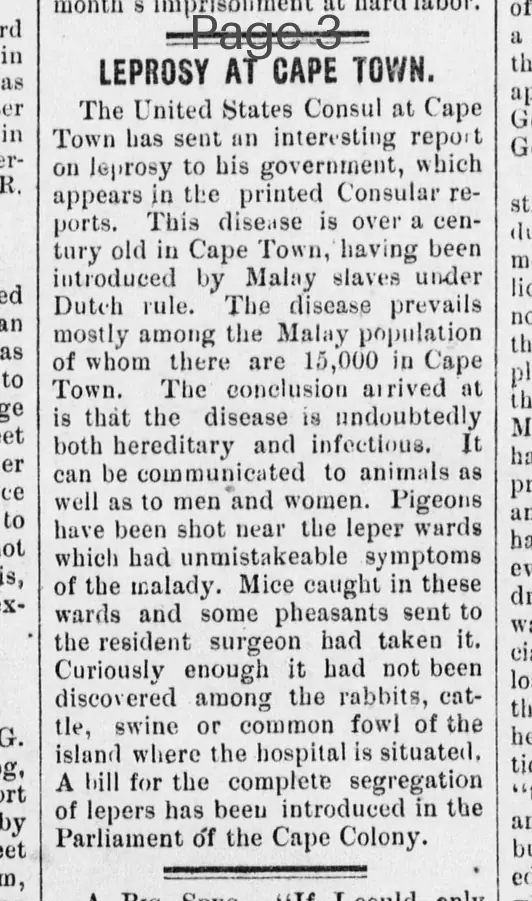
The United States Consul at Cape Town has sent an interesting report on leprosy to his government, which appears in the printed Consular reports. This disease is over a century old in Cape Town, having been introduced by Malay slaves under Dutch rule. The disease prevails mostly among the Malay population of whom there are 15,000 in Cape Town. The conclusion arrived at is that the disease is undoubtedly both hereditary and infectious. It can be communicated to animals as well as to men and women. Pigeons have been shot near the leper wards which had unmistakable symptoms of the malady. Mice caught in these wards and some pheasants sent to the resident surgeon had taken it. Curiously enough it had not been discovered among the rabbits, cattle, swine or common fowl of the island where the hospital is situated. A bill for the complete segregation of lepers has been introduced in the Parliament of the Cape Colony.
What sub-type of article is it?
What keywords are associated?
Where did it happen?
Foreign News Details
Primary Location
Cape Town
Outcome
disease concluded hereditary and infectious; transmissible to animals; bill for complete segregation of lepers introduced in parliament.
Event Details
Leprosy over a century old in Cape Town, introduced by Malay slaves under Dutch rule, prevails mostly among 15,000 Malay population. Report by US Consul notes it communicates to animals like pigeons, mice, pheasants, but not rabbits, cattle, swine, or common fowl near hospital.