Thank you for visiting SNEWPapers!
Sign up free
Letter to Editor
November 9, 1824
The National Republican And Ohio Political Register
Cincinnati, Hamilton County, Ohio
What is this article about?
In a satirical letter, unmarried woman Barbara Catnip complains about intrusive 'good neighbors' in Portsmouth, NH, who damage her home, borrow incessantly, and invade her privacy, prompting her to sell her house and flee.
Clipping
OCR Quality
95%
Excellent
Full Text
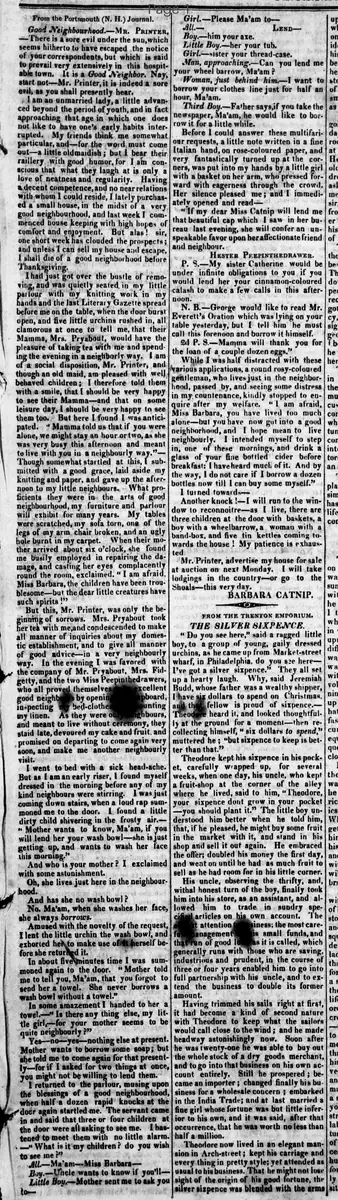
From the Portsmouth (N. H.) Journal.
Good Neighbourhood.—MR. PRINTER,
There is a sore evil under the sun, which seems hitherto to have escaped the notice of your correspondents, but which is said to prevail very extensively in this hospitable town. It is a Good Neighbor. Nay, start not—Mr. Printer, it is indeed a sore evil, as you shall presently hear.
I am an unmarried lady, a little advanced beyond the period of youth, and in fact approaching that age in which one does not like to have one's early habits interrupted. My friends think me somewhat particular, and—for the word must come out—a little old maidish; but I bear their raillery with good humor, for I am conscious that what they laugh at is only a love of neatness and regularity. Having a decent competence, and no near relations with whom I could reside, I lately purchased a small house, in the midst of a very good neighbourhood, and last week I commenced house keeping with high hopes of comfort and enjoyment. But alas! sir, one short week has clouded the prospects; and unless I can sell my house and escape, I shall die of a good neighborhood before Thanksgiving.
I had just got over the bustle of removing and was quietly seated in my little parlour with my knitting work in my hands and the last Literary Gazette spread before me on the table, when the door burst open, and five little urchins rushed in, all clamorous at once to tell me, that their Mamma, Mrs. Pryabout, would have the pleasure of taking tea with me and spending the evening in a neighbourly way. I am of a social disposition, Mr. Printer, and though an old maid, am pleased with well behaved children; I therefore told them with a smile, that I should be very happy to see their Mamma—and that on some leisure day, I should be very happy to see them too. But here I found I was anticipated. "Mamma told us that if you were alone, we might stay an hour or two, as she was very busy this afternoon and meant to live with you in a neighbourly way."
Though somewhat startled at this, I submitted with a good grace, laid aside my knitting and paper, and gave up the afternoon to my little neighbours. What proficients they were in the arts of good neighbourhood, my furniture and parlour will exhibit for many years. My tables were scratched, my sofa torn, one of the legs of my arm chair broken, and an ugly hole burnt in my carpet. When their mother arrived about six o'clock, she found me busily employed in repairing the damage, and casting her eyes complacently round the room, exclaimed. "I am afraid, Miss Barbara, the children have been troublesome—but the dear little creatures have such spirits!"
But this, Mr. Printer, was only the beginning of sorrows. Mrs. Pryabout took her tea with me, and condescended to make all manner of inquiries about my domestic establishment, and to give all manner of good advice—in a very neighbourly way. In the evening I was favored with the company of Mr. Pryabout, Mrs. Fidgetty, and the two Miss Peepinthedrawers, who all proved themselves excellent good neighbours by opening my cupboards, inspecting my bed-clothes, bedding, my linen. As they were neighbours, and meant to live without ceremony, they stayed late, devoured my cake and fruit, and promised on departing to come again very soon, and make me another neighbourly visit.
I went to bed with a sick head-ache. But as I am an early riser, I found myself dressed in the morning before any of my kind neighbours were stirring. I was just coming down stairs, when a loud rap summoned me to the door. I found a little dirty child shivering in the frosty air. "Mother wants to know, Ma'am, if you will lend her your wash bowl—she is just getting up, and wants to wash her face this morning." And who is your mother? I exclaimed with some astonishment. "Oh, she lives just here in the neighbourhood." And has she no wash bowl? "No. Ma'am, when she washes her face, she always borrows."
Amused with the novelty of the request I lent the little urchin the wash bowl, and exhorted her to make use of it herself before she returned it. In about five minutes time I was summoned again to the door. "Mother told me to tell you, Ma'am, that you forgot to send her a towel. She never borrows a wash bowl without a towel." In some amazement I handed to her a towel. "Is there any thing else, my little girl, —for your mother seems to be quite neighbourly?" "Yes no—yes—nothing else at present. Mother wants to borrow some soap; but she told me to come again for that presently—for if I asked for two things at once, you might not be willing to lend them."
I returned to the parlour, musing upon the blessings of a good neighbourhood, when half a dozen rapid knocks at the door again startled me. The servant came in and said that three or four children at the door were all asking to see me. I hastened to meet them with no little alarm. "What is it my children? do you wish to see me?" All. Ma'am—Miss Barbara Boy.—Uncle wants to know if you'll— Little Boy.—Mother sent me to ask you Girl.—Please Ma'am to— All. Lend Boy.—him your axe. Little Boy.—her your tub Girl.—sister your thread-case. Man, approaching.—Can you lend me your wheel barrow, Ma'am? Woman, just behind him.—I want to borrow your clothes line just for half an hour, Ma'am. Third Boy.—Father says, if you take the newspaper, Ma'am, he would like to borrow it for a little while.
Before I could answer these multifarious requests, a little note written in a fine Italian hand, on rose-coloured paper, and very fantastically turned up at the corners, was put into my hands by a little girl with a basket on her arm, who pressed forward with eagerness through the crowd. Her silence pleased me; and I immediately opened and read— "If my dear Miss Catnip will lend me that beautiful cap which I saw in her bureau last evening, she will confer an unspeakable favor upon her affectionate friend and neighbour. Hester Peepinthedrawer. P. S. My sister Catherine would be under infinite obligations to you if you would lend her your cinnamon-coloured calash to make a few calls in this afternoon. N. B. George would like to read Mr. Everett's Oration which was lying on your table yesterday, but I tell him he must call this forenoon and borrow it himself. 2d P. S.—Mamma will thank you for the loan of a couple dozen eggs."
While I was half distracted with these various applications, a round rosy-coloured gentleman, who lives just in the neighbourhood, passed by, and seeing some distress in my countenance, kindly stopped to enquire after my welfare. "I am afraid, Miss Barbara, you have lived too much alone—but you have now got into a good neighbourhood, and I hope mean to live neighbourly. I intended myself to step in, one of these mornings, and drink a glass of your fine bottled cider before breakfast: I have heard much of it. And by the way, I do not care if I borrow a dozen bottles now till I can buy some myself." I turned towards Another knock!—I will run to the window to reconnoitre—as I live, there are three children at the door with baskets, a boy with a wheelbarrow, a woman with a band-box, and five tin kettles coming towards the house! My patience is exhausted.
Mr. Printer, advertise my house for sale at auction on next Monday. I will take lodgings in the country—or go to the Shoals—this very day.
BARBARA CATNIP.
Good Neighbourhood.—MR. PRINTER,
There is a sore evil under the sun, which seems hitherto to have escaped the notice of your correspondents, but which is said to prevail very extensively in this hospitable town. It is a Good Neighbor. Nay, start not—Mr. Printer, it is indeed a sore evil, as you shall presently hear.
I am an unmarried lady, a little advanced beyond the period of youth, and in fact approaching that age in which one does not like to have one's early habits interrupted. My friends think me somewhat particular, and—for the word must come out—a little old maidish; but I bear their raillery with good humor, for I am conscious that what they laugh at is only a love of neatness and regularity. Having a decent competence, and no near relations with whom I could reside, I lately purchased a small house, in the midst of a very good neighbourhood, and last week I commenced house keeping with high hopes of comfort and enjoyment. But alas! sir, one short week has clouded the prospects; and unless I can sell my house and escape, I shall die of a good neighborhood before Thanksgiving.
I had just got over the bustle of removing and was quietly seated in my little parlour with my knitting work in my hands and the last Literary Gazette spread before me on the table, when the door burst open, and five little urchins rushed in, all clamorous at once to tell me, that their Mamma, Mrs. Pryabout, would have the pleasure of taking tea with me and spending the evening in a neighbourly way. I am of a social disposition, Mr. Printer, and though an old maid, am pleased with well behaved children; I therefore told them with a smile, that I should be very happy to see their Mamma—and that on some leisure day, I should be very happy to see them too. But here I found I was anticipated. "Mamma told us that if you were alone, we might stay an hour or two, as she was very busy this afternoon and meant to live with you in a neighbourly way."
Though somewhat startled at this, I submitted with a good grace, laid aside my knitting and paper, and gave up the afternoon to my little neighbours. What proficients they were in the arts of good neighbourhood, my furniture and parlour will exhibit for many years. My tables were scratched, my sofa torn, one of the legs of my arm chair broken, and an ugly hole burnt in my carpet. When their mother arrived about six o'clock, she found me busily employed in repairing the damage, and casting her eyes complacently round the room, exclaimed. "I am afraid, Miss Barbara, the children have been troublesome—but the dear little creatures have such spirits!"
But this, Mr. Printer, was only the beginning of sorrows. Mrs. Pryabout took her tea with me, and condescended to make all manner of inquiries about my domestic establishment, and to give all manner of good advice—in a very neighbourly way. In the evening I was favored with the company of Mr. Pryabout, Mrs. Fidgetty, and the two Miss Peepinthedrawers, who all proved themselves excellent good neighbours by opening my cupboards, inspecting my bed-clothes, bedding, my linen. As they were neighbours, and meant to live without ceremony, they stayed late, devoured my cake and fruit, and promised on departing to come again very soon, and make me another neighbourly visit.
I went to bed with a sick head-ache. But as I am an early riser, I found myself dressed in the morning before any of my kind neighbours were stirring. I was just coming down stairs, when a loud rap summoned me to the door. I found a little dirty child shivering in the frosty air. "Mother wants to know, Ma'am, if you will lend her your wash bowl—she is just getting up, and wants to wash her face this morning." And who is your mother? I exclaimed with some astonishment. "Oh, she lives just here in the neighbourhood." And has she no wash bowl? "No. Ma'am, when she washes her face, she always borrows."
Amused with the novelty of the request I lent the little urchin the wash bowl, and exhorted her to make use of it herself before she returned it. In about five minutes time I was summoned again to the door. "Mother told me to tell you, Ma'am, that you forgot to send her a towel. She never borrows a wash bowl without a towel." In some amazement I handed to her a towel. "Is there any thing else, my little girl, —for your mother seems to be quite neighbourly?" "Yes no—yes—nothing else at present. Mother wants to borrow some soap; but she told me to come again for that presently—for if I asked for two things at once, you might not be willing to lend them."
I returned to the parlour, musing upon the blessings of a good neighbourhood, when half a dozen rapid knocks at the door again startled me. The servant came in and said that three or four children at the door were all asking to see me. I hastened to meet them with no little alarm. "What is it my children? do you wish to see me?" All. Ma'am—Miss Barbara Boy.—Uncle wants to know if you'll— Little Boy.—Mother sent me to ask you Girl.—Please Ma'am to— All. Lend Boy.—him your axe. Little Boy.—her your tub Girl.—sister your thread-case. Man, approaching.—Can you lend me your wheel barrow, Ma'am? Woman, just behind him.—I want to borrow your clothes line just for half an hour, Ma'am. Third Boy.—Father says, if you take the newspaper, Ma'am, he would like to borrow it for a little while.
Before I could answer these multifarious requests, a little note written in a fine Italian hand, on rose-coloured paper, and very fantastically turned up at the corners, was put into my hands by a little girl with a basket on her arm, who pressed forward with eagerness through the crowd. Her silence pleased me; and I immediately opened and read— "If my dear Miss Catnip will lend me that beautiful cap which I saw in her bureau last evening, she will confer an unspeakable favor upon her affectionate friend and neighbour. Hester Peepinthedrawer. P. S. My sister Catherine would be under infinite obligations to you if you would lend her your cinnamon-coloured calash to make a few calls in this afternoon. N. B. George would like to read Mr. Everett's Oration which was lying on your table yesterday, but I tell him he must call this forenoon and borrow it himself. 2d P. S.—Mamma will thank you for the loan of a couple dozen eggs."
While I was half distracted with these various applications, a round rosy-coloured gentleman, who lives just in the neighbourhood, passed by, and seeing some distress in my countenance, kindly stopped to enquire after my welfare. "I am afraid, Miss Barbara, you have lived too much alone—but you have now got into a good neighbourhood, and I hope mean to live neighbourly. I intended myself to step in, one of these mornings, and drink a glass of your fine bottled cider before breakfast: I have heard much of it. And by the way, I do not care if I borrow a dozen bottles now till I can buy some myself." I turned towards Another knock!—I will run to the window to reconnoitre—as I live, there are three children at the door with baskets, a boy with a wheelbarrow, a woman with a band-box, and five tin kettles coming towards the house! My patience is exhausted.
Mr. Printer, advertise my house for sale at auction on next Monday. I will take lodgings in the country—or go to the Shoals—this very day.
BARBARA CATNIP.
What sub-type of article is it?
Satirical
Comedic
Social Critique
What themes does it cover?
Social Issues
What keywords are associated?
Good Neighborhood
Intrusive Neighbors
Borrowing Habits
Social Etiquette
Old Maid
Portsmouth Nh
What entities or persons were involved?
Barbara Catnip
Mr. Printer
Letter to Editor Details
Author
Barbara Catnip
Recipient
Mr. Printer
Main Argument
overly intrusive neighbors who constantly borrow items, damage property, and invade privacy make 'good neighborhood' a sore evil, leading the author to seek escape by selling her house.
Notable Details
Children Damage Furniture And Carpet
Mrs. Pryabout's Family Inspects Personal Items
Multiple Borrowing Requests For Wash Bowl, Towel, Soap, Axe, Tub, Thread Case, Wheelbarrow, Clothes Line, Newspaper
Note From Hester Peepinthedrawer Requesting Cap, Calash, Oration, Eggs
Gentleman Borrows Bottled Cider