Thank you for visiting SNEWPapers!
Sign up free
Editorial
May 3, 1836
State Journal
Montpelier, Washington County, Vermont
What is this article about?
A minority report argues against Congress's constitutional power to restrict mail circulation of publications deemed to incite slave insurrections in slaveholding states, asserting it would abridge freedom of the press under the First Amendment. It critiques proposed legislation, distinguishes from the Sedition Act, and emphasizes absolute protection of press liberty.
Clipping
OCR Quality
95%
Excellent
Full Text
LIBERTY OF THE PRESS.
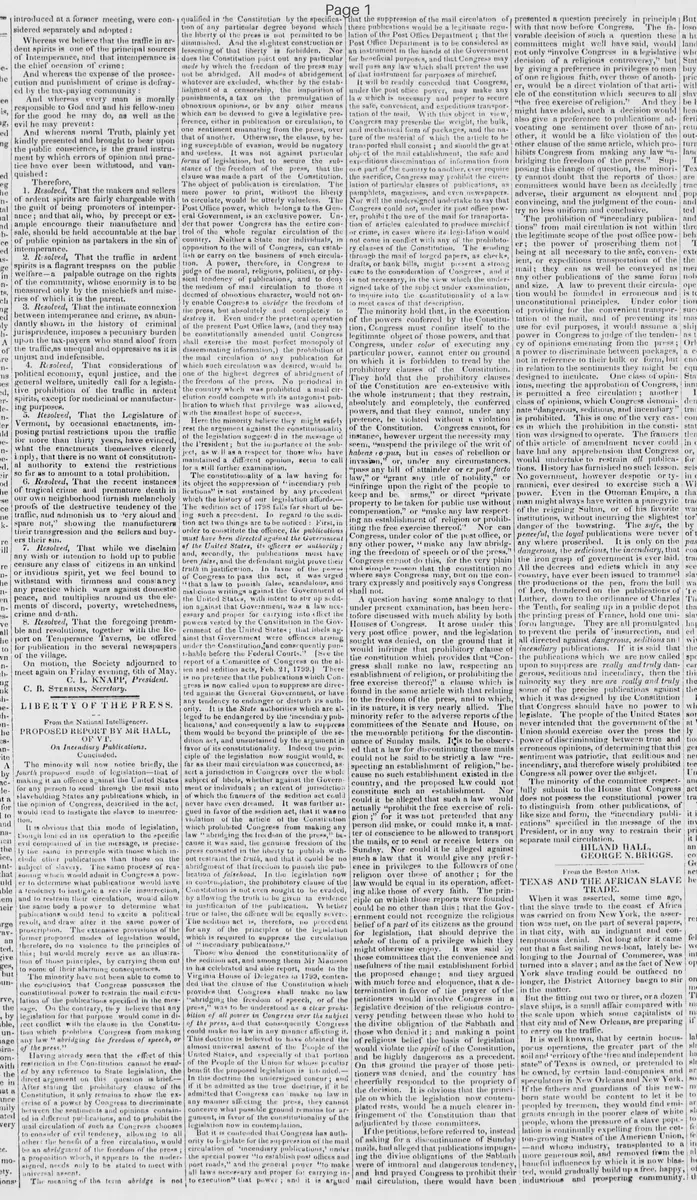
The minority will now notice briefly, the fourth proposed mode of legislation—that of making it an offence against the United States for any person to send through the mail into slaveholding States any publications which, in the opinion of Congress, described in the act, would tend to instigate the slaves to insurrection.
It is obvious that this mode of legislation, though limited in its operation to the specific evil complained of in the message, is precisely the same in principle with those which include other publications than those on the subject of slavery. The same process of reasoning which would admit in Congress a power to determine what publications would have a tendency to instigate a servile insurrection, and to restrain their circulation, would allow the same body a power to determine what publications would tend to excite a political revolt, and draw after it the same power of proscription. The extensive provisions of the former proposed modes of legislation would, therefore, do no violence to the principles of this; but would merely serve as an illustration of those principles, by carrying them out to some of their alarming consequences.
The minority have not been able to come to the conclusion that Congress possesses the constitutional power to restrain the mail circulation of the publications specified in the message.
On the contrary, they believe that any legislation for that purpose would come in direct conflict with the clause in the Constitution which prohibits Congress from making any law "abridging the freedom of speech, or of the press."
Having already seen that the effect of this restriction in the Constitution cannot be evaded by any reference to State legislation, the direct argument on this question is brief. After stating the prohibitory clause of the Constitution, it only remains to show the exercise of a power by Congress to discriminate between the sentiments and opinions contained in different publications, and to prohibit the mail circulation of such as Congress chooses to consider of evil tendency, allowing to all others the benefit of a free circulation, would be an abridgment of the freedom of the press; a proposition which, it appears to the undersigned, needs only to be stated to meet with universal assent.
The meaning of the term abridge is not qualified in the Constitution by the specification of any particular degree beyond which the liberty of the press is not permitted to be diminished. And the slightest construction or lessening of that liberty is forbidden. Nor does the Constitution point out any particular mode by which the freedom of the press may not be abridged. All modes of abridgement whatever are excluded, whether by the establishment of a censorship, the imposition of punishments, a tax on the promulgation of obnoxious opinions, or by any other means which can be devised to give a legislative preference, either in publication or circulation, to one sentiment emanating from the press, over that of another. Otherwise, the clause, by being susceptible of evasion, would be nugatory and useless. It was not against particular forms of legislation, but to secure the substance of the freedom of the press, that the clause was made a part of the Constitution.
The object of publication is circulation. The mere power to print, without the liberty to circulate, would be utterly valueless. The Post Office power, which belongs to the General Government, is an exclusive power. Under that power Congress has the entire control of the whole regular circulation of the country. Neither a State nor individuals, in opposition to the will of Congress, can establish or carry on the business of such circulation. A power, therefore, in Congress to judge of the moral, religious, political, or physical tendency of publications, and to deny the medium of mail circulation to those it deemed of obnoxious character, would not only enable Congress to abridge the freedom of the press, but absolutely and completely to destroy it. Even under the practical operation of the present Post Office laws, (and they may be constitutionally amended until Congress shall exercise the most perfect monopoly of disseminating information,) the prohibition of the mail circulation of any publication for which such circulation was desired, would be one of the highest degrees of abridgment of the freedom of the press. No periodical in the country which was prohibited a mail circulation could compete with its antagonist publication to which that privilege was allowed, with the smallest hope of success.
Here the minority believe they might safely rest the argument against the constitutionality of the legislation suggested in the message of the President; but the importance of the subject, as well as a respect for those who have maintained a different opinion, seem to call for a still further examination.
The constitutionality of a law having for its object the suppression of "incendiary publications" is not sustained by any precedent which the history of our legislation affords. The sedition act of 1798 falls far short of being such a precedent. In regard to the sedition act two things are to be noticed: First, in order to constitute the offence, the publications must have been directed against the Government of the United States, its officers or authority; and, secondly, the publications must have been false, and the defendant might prove their truth in justification. In favor of the power of Congress to pass this act, it was urged "that a law to punish false, scandalous, and malicious writings against the Government of the United States, with intent to stir up sedition against that Government, was a law necessary and proper for carrying into effect the powers vested by the Constitution in the Government of the United States; that libels against that Government were offences arising under the Constitution, and consequently punishable before the Federal Courts." [See the report of a Committee of Congress on the alien and sedition acts, Feb. 21, 1799.] There is no pretence that the publications which Congress is now called upon to suppress are directed against the General Government, or have any tendency to endanger or disturb its authority. It is the State authorities which are alleged to be endangered by the incendiary publications,' and consequently a law to suppress them would be beyond the principle of the sedition act, and unsustained by the argument in favor of its constitutionality. "Indeed the principle of the legislation now sought would, so far as the mail circulation was concerned, assert a jurisdiction in Congress over the whole subject of libels, whether against the Government or individuals; an extent of jurisdiction of which the framers of the sedition act could never have even dreamed. It was further urged in favor of the sedition act, that it was no violation of the article of the Constitution which prohibited Congress from making any law "abridging the freedom of the press," because it was said, the genuine freedom of the press consisted in the liberty to publish without restraint the truth, and that it could be no abridgment of that freedom to punish the publication of falsehood. In the legislation now in contemplation, the prohibitory clause of the Constitution is not even sought to be evaded, by allowing the truth to be given in evidence in justification of the publication. Whether true or false, the offence will be equally severe. The sedition act is, therefore, no precedent for any of the principles of the legislation which is required to suppress the circulation of "incendiary publications."
Those who denied the constitutionality of the sedition act, and among them Mr Madison in his celebrated and able report, made to the Virginia House of Delegates in 1799, contended that the clause of the Constitution which provides that Congress shall make no law "abridging the freedom of speech, or of the press," was to be understood as a clear prohibition of all power in Congress over the subject of the press, and that consequently Congress could make no law in any manner affecting it. This doctrine is believed to have obtained the almost universal assent of the People of the United States, and especially of that portion of the People of the Union for whose peculiar benefit the proposed legislation is intended.— In this doctrine the undersigned concur; and if it be admitted as the true doctrine, if it be admitted that Congress can make no law in any manner affecting the press, they cannot conceive what possible ground remains for argument, in favor of the constitutionality of the legislation now in contemplation.
But it is contended that Congress has authority to legislate for the suppression of the mail circulation of incendiary publications,' under the special power "to establish post offices and post roads," and the general power "to make all laws necessary and proper for carrying into execution" that power; and it is argued that the suppression of the mail circulation of these publications would be a legitimate regulation of the Post Office Department; that the Post Office Department is to be considered as an instrument in the hands of the Government for beneficial purposes, and that Congress may well pass any law which shall prevent the use of that instrument for purposes of mischief.
It will be readily conceded that Congress, under the post office power, may make any law which is necessary and proper to secure the safe, convenient, and expeditious transportation of the mail. With this object in view, Congress may prescribe the weight, the bulk, and mechanical form of packages. and the nature of the material of which the article to be transported shall consist: and should the great object of the mail establishment, the safe and expeditious dissemination of information from one part of the country to another, ever require the sacrifice, Congress may prohibit the circulation of particular classes of publications, as pamphlets, magazines, and even newspapers. Nor will the undersigned undertake to say that Congress could not, under its post office power, prohibit the use of the mail for transportation of articles calculated to produce mischief or crime, in cases where its legislation would not come in conflict with any of the prohibitory clauses of the Constitution. The sending through the mail of forged papers, as checks, drafts, or bank bills, might present a strong case to the consideration of Congress, and it is not necessary. in the view which the undersigned take of the subject under examination, to inquire into the constitutionality of a law to meet cases of that description.
The minority hold that, in the execution of the powers conferred by the Constitution, Congress must confine itself to the legitimate object of those powers, and that Congress. under color of executing any particular power, cannot enter on ground on which it is forbidden to tread by the prohibitory clauses of the Constitution. They hold that the prohibitory clauses of the Constitution are co-extensive with the whole instrument: that they restrain, absolutely and completely, the conferred powers, and that they cannot, under any pretence, be violated without a violation of the Constitution. Congress cannot, for instance, however urgent the necessity may seem, "suspend the privilege of the writ of habeas corpus, but in cases of rebellion or invasion," or, under any circumstances, "pass any bill of attainder or ex post facto law," or "grant any title of nobility," or "infringe upon the right of the people to keep and bear arms," or direct "private property to be taken for public use without compensation," or "make any law respecting an establishment of religion or prohibiting the free exercise thereof." Nor can Congress, under color of the post office, or any other power, "make any law abridging the freedom of speech or of the press."
Congress cannot do this, for the very plain and simple reason that the constitution nowhere says Congress may, but on the contrary expressly and positively says Congress shall not.
A question having some analogy to that under present examination, has been heretofore discussed with much ability by both Houses of Congress. It arose under this very post office power, and the legislation sought was denied, on the ground that it would infringe that prohibitory clause of the constitution which provides that "Congress shall make no law, respecting an establishment of religion, or prohibiting the free exercise thereof;" a clause which is found in the same article with that relating to the freedom of the press, and to which, in its nature, it is very nearly allied. The minority refer to the adverse reports of the committees of the Senate and House, on the memorable petitions for the discontinuance of Sunday mails. It is to be observed that a law for discontinuing those mails could not be said to be strictly a law "respecting an establishment of religion," because no such establishment existed in the country, and the proposed law could not constitute such an establishment. Nor could it be alleged that such a law would actually "prohibit the free exercise of religion;" for it was not pretended that any person did make, or could make it, a matter of conscience to be allowed to transport the mails, or to send or receive letters on Sunday. 'Nor could it be alleged against such a law that it would give any preference in privileges to the followers of one religion over those of another; for the law would be equal in its operation, affecting alike those of every faith. The principle on which those reports were founded could be no other than this : that the Government could not recognize the religious belief of a part of its citizens as the ground for legislation, that should deprive the whole of them of a privilege which they might otherwise enjoy. It was said by those committees that the convenience and usefulness of the mail establishment forbid the proposed change; and they argued with much force and eloquence, that a determination in favor of the prayer of the petitioners would involve Congress in a legislative decision of the religious controversy pending between those who hold to the divine obligation of the Sabbath and those who denied it : and making a point of religious belief the basis of legislation would violate the spirit of the Constitution, and be highly dangerous as a precedent. On this ground the prayer of those petitioners was denied, and the country has cheerfully responded to the propriety of the decision. It is obvious that the principle on which the legislation now contemplated rests, would be a much clearer infringement of the Constitution than that adjudicated by those committees.
If the petitions, before referred to, instead of asking for a discontinuance of Sunday mails, had alleged that publications impugning the divine obligations of the Sabbath were of immoral and dangerous tendency, and had prayed Congress to prohibit their mail circulation, there would have been presented a question precisely in principle with that now before Congress. The favorable decision of such a question these committees might well have said, would not only "involve Congress in a legislative decision of a religious controversy," but by giving a preference in privileges to men of one religious faith, over those of another, would be a direct violation of that article of the constitution which secures to all "the free exercise of religion." And they might have added, such a decision would also give a preference to publications advocating one sentiment over those of another, it would be a like violation of the other clause of the same article, which prohibits Congress from making any law "abridging the freedom of the press." Supposing this change of question, the minority cannot doubt that the reports of those committees would have been as decidedly adverse, their argument as eloquent and convincing, and the judgment of the country no less uniform and conclusive.
The prohibition of "incendiary publications" from mail circulation is not within the legitimate scope of the post office power; the power of proscribing them not being at all necessary to the safe, convenient, or expeditious transportation of the mail: they can as well be conveyed as any other publications of the same form and size. A law to prevent their circulation would be founded in erroneous and unconstitutional principles. Under color of providing for the convenient transportation of the mail, and of preventing its use for evil purposes, it would assume a power in Congress to judge of the tendency of opinions emanating from the press; a power to discriminate between packages, not in reference to their bulk or form, but in relation to the sentiments they might be designed to inculcate. One class of opinions, meeting the approbation of Congress, is permitted a free circulation; another class of opinions, which Congress denominate "dangerous, seditious, and incendiary" is prohibited. This is one of the very cases in which the prohibition in the constitution was designed to operate. The framers of this article of amendment never could have had any apprehension that Congress would undertake to restrain all publications. History has furnished no such lesson. No government, however despotic or tyrannical, ever desired to exercise such a power. Even in the Ottoman Empire, a man might always have written a panegyric of the reigning Sultan, or of his favorite institutions, without incurring the slightest danger of the bowstring. The safe, the peaceful, the loyal publications were never anywhere proscribed. It is only on the dangerous, the seditious, the incendiary, that the iron grasp of government is ever laid. All the decrees and edicts which in any country, have ever been issued to trammel the productions of the pen, from the bull of Leo, thundered on the publications of Luther, down to the ordinance of Charles the Tenth, for sealing up in a public depot the printing press of France, hold one uniform language. They are all promulgated to prevent the perils of "insurrection, and all directed against dangerous, seditious and incendiary publications. If it is said that the publications which we are now called upon to suppress are really and truly dangerous, seditious and incendiary, then the minority say they are really and truly some of the precise publications against which it was designed by the Constitution that Congress should have no power to legislate. The people of the United States never intended that the government of the Union should exercise over the press the power of discriminating between true and erroneous opinions, of determining that this sentiment was patriotic, that seditious and incendiary, and therefore wisely prohibited Congress all power over the subject.
The minority of the committee respectfully submit to the House that Congress does not possess the constitutional power to distinguish from other publications. of like size and form, the "incendiary publications" specified in the message of the President, or in any way to restrain their separate mail circulation.
The minority will now notice briefly, the fourth proposed mode of legislation—that of making it an offence against the United States for any person to send through the mail into slaveholding States any publications which, in the opinion of Congress, described in the act, would tend to instigate the slaves to insurrection.
It is obvious that this mode of legislation, though limited in its operation to the specific evil complained of in the message, is precisely the same in principle with those which include other publications than those on the subject of slavery. The same process of reasoning which would admit in Congress a power to determine what publications would have a tendency to instigate a servile insurrection, and to restrain their circulation, would allow the same body a power to determine what publications would tend to excite a political revolt, and draw after it the same power of proscription. The extensive provisions of the former proposed modes of legislation would, therefore, do no violence to the principles of this; but would merely serve as an illustration of those principles, by carrying them out to some of their alarming consequences.
The minority have not been able to come to the conclusion that Congress possesses the constitutional power to restrain the mail circulation of the publications specified in the message.
On the contrary, they believe that any legislation for that purpose would come in direct conflict with the clause in the Constitution which prohibits Congress from making any law "abridging the freedom of speech, or of the press."
Having already seen that the effect of this restriction in the Constitution cannot be evaded by any reference to State legislation, the direct argument on this question is brief. After stating the prohibitory clause of the Constitution, it only remains to show the exercise of a power by Congress to discriminate between the sentiments and opinions contained in different publications, and to prohibit the mail circulation of such as Congress chooses to consider of evil tendency, allowing to all others the benefit of a free circulation, would be an abridgment of the freedom of the press; a proposition which, it appears to the undersigned, needs only to be stated to meet with universal assent.
The meaning of the term abridge is not qualified in the Constitution by the specification of any particular degree beyond which the liberty of the press is not permitted to be diminished. And the slightest construction or lessening of that liberty is forbidden. Nor does the Constitution point out any particular mode by which the freedom of the press may not be abridged. All modes of abridgement whatever are excluded, whether by the establishment of a censorship, the imposition of punishments, a tax on the promulgation of obnoxious opinions, or by any other means which can be devised to give a legislative preference, either in publication or circulation, to one sentiment emanating from the press, over that of another. Otherwise, the clause, by being susceptible of evasion, would be nugatory and useless. It was not against particular forms of legislation, but to secure the substance of the freedom of the press, that the clause was made a part of the Constitution.
The object of publication is circulation. The mere power to print, without the liberty to circulate, would be utterly valueless. The Post Office power, which belongs to the General Government, is an exclusive power. Under that power Congress has the entire control of the whole regular circulation of the country. Neither a State nor individuals, in opposition to the will of Congress, can establish or carry on the business of such circulation. A power, therefore, in Congress to judge of the moral, religious, political, or physical tendency of publications, and to deny the medium of mail circulation to those it deemed of obnoxious character, would not only enable Congress to abridge the freedom of the press, but absolutely and completely to destroy it. Even under the practical operation of the present Post Office laws, (and they may be constitutionally amended until Congress shall exercise the most perfect monopoly of disseminating information,) the prohibition of the mail circulation of any publication for which such circulation was desired, would be one of the highest degrees of abridgment of the freedom of the press. No periodical in the country which was prohibited a mail circulation could compete with its antagonist publication to which that privilege was allowed, with the smallest hope of success.
Here the minority believe they might safely rest the argument against the constitutionality of the legislation suggested in the message of the President; but the importance of the subject, as well as a respect for those who have maintained a different opinion, seem to call for a still further examination.
The constitutionality of a law having for its object the suppression of "incendiary publications" is not sustained by any precedent which the history of our legislation affords. The sedition act of 1798 falls far short of being such a precedent. In regard to the sedition act two things are to be noticed: First, in order to constitute the offence, the publications must have been directed against the Government of the United States, its officers or authority; and, secondly, the publications must have been false, and the defendant might prove their truth in justification. In favor of the power of Congress to pass this act, it was urged "that a law to punish false, scandalous, and malicious writings against the Government of the United States, with intent to stir up sedition against that Government, was a law necessary and proper for carrying into effect the powers vested by the Constitution in the Government of the United States; that libels against that Government were offences arising under the Constitution, and consequently punishable before the Federal Courts." [See the report of a Committee of Congress on the alien and sedition acts, Feb. 21, 1799.] There is no pretence that the publications which Congress is now called upon to suppress are directed against the General Government, or have any tendency to endanger or disturb its authority. It is the State authorities which are alleged to be endangered by the incendiary publications,' and consequently a law to suppress them would be beyond the principle of the sedition act, and unsustained by the argument in favor of its constitutionality. "Indeed the principle of the legislation now sought would, so far as the mail circulation was concerned, assert a jurisdiction in Congress over the whole subject of libels, whether against the Government or individuals; an extent of jurisdiction of which the framers of the sedition act could never have even dreamed. It was further urged in favor of the sedition act, that it was no violation of the article of the Constitution which prohibited Congress from making any law "abridging the freedom of the press," because it was said, the genuine freedom of the press consisted in the liberty to publish without restraint the truth, and that it could be no abridgment of that freedom to punish the publication of falsehood. In the legislation now in contemplation, the prohibitory clause of the Constitution is not even sought to be evaded, by allowing the truth to be given in evidence in justification of the publication. Whether true or false, the offence will be equally severe. The sedition act is, therefore, no precedent for any of the principles of the legislation which is required to suppress the circulation of "incendiary publications."
Those who denied the constitutionality of the sedition act, and among them Mr Madison in his celebrated and able report, made to the Virginia House of Delegates in 1799, contended that the clause of the Constitution which provides that Congress shall make no law "abridging the freedom of speech, or of the press," was to be understood as a clear prohibition of all power in Congress over the subject of the press, and that consequently Congress could make no law in any manner affecting it. This doctrine is believed to have obtained the almost universal assent of the People of the United States, and especially of that portion of the People of the Union for whose peculiar benefit the proposed legislation is intended.— In this doctrine the undersigned concur; and if it be admitted as the true doctrine, if it be admitted that Congress can make no law in any manner affecting the press, they cannot conceive what possible ground remains for argument, in favor of the constitutionality of the legislation now in contemplation.
But it is contended that Congress has authority to legislate for the suppression of the mail circulation of incendiary publications,' under the special power "to establish post offices and post roads," and the general power "to make all laws necessary and proper for carrying into execution" that power; and it is argued that the suppression of the mail circulation of these publications would be a legitimate regulation of the Post Office Department; that the Post Office Department is to be considered as an instrument in the hands of the Government for beneficial purposes, and that Congress may well pass any law which shall prevent the use of that instrument for purposes of mischief.
It will be readily conceded that Congress, under the post office power, may make any law which is necessary and proper to secure the safe, convenient, and expeditious transportation of the mail. With this object in view, Congress may prescribe the weight, the bulk, and mechanical form of packages. and the nature of the material of which the article to be transported shall consist: and should the great object of the mail establishment, the safe and expeditious dissemination of information from one part of the country to another, ever require the sacrifice, Congress may prohibit the circulation of particular classes of publications, as pamphlets, magazines, and even newspapers. Nor will the undersigned undertake to say that Congress could not, under its post office power, prohibit the use of the mail for transportation of articles calculated to produce mischief or crime, in cases where its legislation would not come in conflict with any of the prohibitory clauses of the Constitution. The sending through the mail of forged papers, as checks, drafts, or bank bills, might present a strong case to the consideration of Congress, and it is not necessary. in the view which the undersigned take of the subject under examination, to inquire into the constitutionality of a law to meet cases of that description.
The minority hold that, in the execution of the powers conferred by the Constitution, Congress must confine itself to the legitimate object of those powers, and that Congress. under color of executing any particular power, cannot enter on ground on which it is forbidden to tread by the prohibitory clauses of the Constitution. They hold that the prohibitory clauses of the Constitution are co-extensive with the whole instrument: that they restrain, absolutely and completely, the conferred powers, and that they cannot, under any pretence, be violated without a violation of the Constitution. Congress cannot, for instance, however urgent the necessity may seem, "suspend the privilege of the writ of habeas corpus, but in cases of rebellion or invasion," or, under any circumstances, "pass any bill of attainder or ex post facto law," or "grant any title of nobility," or "infringe upon the right of the people to keep and bear arms," or direct "private property to be taken for public use without compensation," or "make any law respecting an establishment of religion or prohibiting the free exercise thereof." Nor can Congress, under color of the post office, or any other power, "make any law abridging the freedom of speech or of the press."
Congress cannot do this, for the very plain and simple reason that the constitution nowhere says Congress may, but on the contrary expressly and positively says Congress shall not.
A question having some analogy to that under present examination, has been heretofore discussed with much ability by both Houses of Congress. It arose under this very post office power, and the legislation sought was denied, on the ground that it would infringe that prohibitory clause of the constitution which provides that "Congress shall make no law, respecting an establishment of religion, or prohibiting the free exercise thereof;" a clause which is found in the same article with that relating to the freedom of the press, and to which, in its nature, it is very nearly allied. The minority refer to the adverse reports of the committees of the Senate and House, on the memorable petitions for the discontinuance of Sunday mails. It is to be observed that a law for discontinuing those mails could not be said to be strictly a law "respecting an establishment of religion," because no such establishment existed in the country, and the proposed law could not constitute such an establishment. Nor could it be alleged that such a law would actually "prohibit the free exercise of religion;" for it was not pretended that any person did make, or could make it, a matter of conscience to be allowed to transport the mails, or to send or receive letters on Sunday. 'Nor could it be alleged against such a law that it would give any preference in privileges to the followers of one religion over those of another; for the law would be equal in its operation, affecting alike those of every faith. The principle on which those reports were founded could be no other than this : that the Government could not recognize the religious belief of a part of its citizens as the ground for legislation, that should deprive the whole of them of a privilege which they might otherwise enjoy. It was said by those committees that the convenience and usefulness of the mail establishment forbid the proposed change; and they argued with much force and eloquence, that a determination in favor of the prayer of the petitioners would involve Congress in a legislative decision of the religious controversy pending between those who hold to the divine obligation of the Sabbath and those who denied it : and making a point of religious belief the basis of legislation would violate the spirit of the Constitution, and be highly dangerous as a precedent. On this ground the prayer of those petitioners was denied, and the country has cheerfully responded to the propriety of the decision. It is obvious that the principle on which the legislation now contemplated rests, would be a much clearer infringement of the Constitution than that adjudicated by those committees.
If the petitions, before referred to, instead of asking for a discontinuance of Sunday mails, had alleged that publications impugning the divine obligations of the Sabbath were of immoral and dangerous tendency, and had prayed Congress to prohibit their mail circulation, there would have been presented a question precisely in principle with that now before Congress. The favorable decision of such a question these committees might well have said, would not only "involve Congress in a legislative decision of a religious controversy," but by giving a preference in privileges to men of one religious faith, over those of another, would be a direct violation of that article of the constitution which secures to all "the free exercise of religion." And they might have added, such a decision would also give a preference to publications advocating one sentiment over those of another, it would be a like violation of the other clause of the same article, which prohibits Congress from making any law "abridging the freedom of the press." Supposing this change of question, the minority cannot doubt that the reports of those committees would have been as decidedly adverse, their argument as eloquent and convincing, and the judgment of the country no less uniform and conclusive.
The prohibition of "incendiary publications" from mail circulation is not within the legitimate scope of the post office power; the power of proscribing them not being at all necessary to the safe, convenient, or expeditious transportation of the mail: they can as well be conveyed as any other publications of the same form and size. A law to prevent their circulation would be founded in erroneous and unconstitutional principles. Under color of providing for the convenient transportation of the mail, and of preventing its use for evil purposes, it would assume a power in Congress to judge of the tendency of opinions emanating from the press; a power to discriminate between packages, not in reference to their bulk or form, but in relation to the sentiments they might be designed to inculcate. One class of opinions, meeting the approbation of Congress, is permitted a free circulation; another class of opinions, which Congress denominate "dangerous, seditious, and incendiary" is prohibited. This is one of the very cases in which the prohibition in the constitution was designed to operate. The framers of this article of amendment never could have had any apprehension that Congress would undertake to restrain all publications. History has furnished no such lesson. No government, however despotic or tyrannical, ever desired to exercise such a power. Even in the Ottoman Empire, a man might always have written a panegyric of the reigning Sultan, or of his favorite institutions, without incurring the slightest danger of the bowstring. The safe, the peaceful, the loyal publications were never anywhere proscribed. It is only on the dangerous, the seditious, the incendiary, that the iron grasp of government is ever laid. All the decrees and edicts which in any country, have ever been issued to trammel the productions of the pen, from the bull of Leo, thundered on the publications of Luther, down to the ordinance of Charles the Tenth, for sealing up in a public depot the printing press of France, hold one uniform language. They are all promulgated to prevent the perils of "insurrection, and all directed against dangerous, seditious and incendiary publications. If it is said that the publications which we are now called upon to suppress are really and truly dangerous, seditious and incendiary, then the minority say they are really and truly some of the precise publications against which it was designed by the Constitution that Congress should have no power to legislate. The people of the United States never intended that the government of the Union should exercise over the press the power of discriminating between true and erroneous opinions, of determining that this sentiment was patriotic, that seditious and incendiary, and therefore wisely prohibited Congress all power over the subject.
The minority of the committee respectfully submit to the House that Congress does not possess the constitutional power to distinguish from other publications. of like size and form, the "incendiary publications" specified in the message of the President, or in any way to restrain their separate mail circulation.
What sub-type of article is it?
Press Freedom
Constitutional
Slavery Abolition
What keywords are associated?
Press Freedom
Mail Circulation
Incendiary Publications
Slavery Insurrection
First Amendment
Post Office Power
Sedition Act
Constitutional Prohibition
What entities or persons were involved?
Congress
President
James Madison
Constitution Framers
Sedition Act Of 1798
Editorial Details
Primary Topic
Opposition To Congressional Restriction Of Anti Slavery Publications Via Mail
Stance / Tone
Strong Defense Of Absolute Press Freedom Against Any Abridgment
Key Figures
Congress
President
James Madison
Constitution Framers
Sedition Act Of 1798
Key Arguments
Congress Lacks Power To Restrict Mail Circulation Of Publications Inciting Slave Insurrection As It Abridges Freedom Of The Press.
Such Legislation Conflicts Directly With The First Amendment Prohibiting Laws Abridging Speech Or Press.
Discriminating Between Publications Based On Content Is An Abridgment, Regardless Of Degree Or Method.
Post Office Power Does Not Extend To Censoring Content; It Is Limited To Transportation Logistics.
Sedition Act Of 1798 Is Not A Precedent, As It Targeted False Libels Against Government, Not State Endangering Publications.
Prohibitory Clauses Like Press Freedom Restrain All Conferred Powers, Including Post Office Authority.
Historical Precedents And Sunday Mail Petitions Show Similar Restrictions Would Violate Constitutional Principles.
Allowing Content Based Mail Bans Would Destroy Press Freedom By Enabling Monopoly On Favored Views.
True Or False, Publications Cannot Be Suppressed; Truth Defense Not Applicable Here.
Framers Intended To Prevent Government From Judging Opinion Tendencies To Avoid Tyranny.