Thank you for visiting SNEWPapers!
Sign up free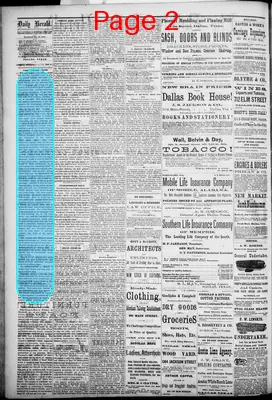
Story
December 24, 1875
The Dallas Daily Herald
Dallas, Dallas County, Texas
What is this article about?
An article advocating for narrow-gauge (three-foot) railways in prairie regions like Texas, highlighting cost savings (25% less operation), comparable speeds, reduced construction (40% less), lighter equipment, and faster build times compared to broad-gauge systems.
Clipping

OCR Quality
95%
Excellent
Full Text
NARROW-GAUGE ROADS.
The advantages of three-feet gauge railways are manifold in an undulating prairie country like ours. The narrow-gauge may be operated for about twenty-five per cent. less than the broad-gauge, and when the proportion of expenses to gross receipts is seventy per cent., the ratio of the narrow-gauge expenses to receipts would annually be two and one half per cent. and, with strict economy, probably as low as forty-five. The narrow-gauge cars attain a speed nearly, if not fully equal to the broad-gauge, although it has been asserted that fifty and sixty miles an hour is beyond their capacity. A speed of sixty miles per hour has never been introduced yet except by one road of three feet gauge in England. This rapid speed pleased travelers amusingly, and they willingly paid the extra charge for the luxury of being shot through the country with a rapidity so great as to render even the landscape valuable to the occupants of the train; but the railway company sold too dearly for the enjoyment of the patrons. The rapidity was also found to be a great error, for the wear and tear on road and rolling stock was beyond the endurance of finances, and this high speed was consequently abandoned. There are but a few trains now in Iowa that make regular time at fifty miles an hour; the express passenger traffic is done at from thirty-five to forty miles, and the general traffic at about twenty-five. In our own country the lightning trains on some of our roads have scarcely reached thirty-four miles an hour, average speed; and even the approach to this rate has been discontinued, so that our fastest trains do not now average more than thirty miles, while our general passenger business is done at a speed not exceeding twenty-five miles an hour and coal and freight trains have been wisely brought down as low as eight and twelve miles. The wear and tear of the little eight-wheel locomotives have forced this change. Here in Texas our express trains only average about twenty miles an hour—freight about ten.
Surely the narrow gauge light engines can equal this and give satisfaction to the people. One of the largest items of expense in broad gauge roads is this crushing out of the track before the rails are one-third worn by monster locomotives which carry on each driving wheel from ten thousand to seventeen thousand pounds more of weight than the narrow gauge engine, and two thousand pounds more on each wheel of passenger coaches than those of the smaller gauge.
The cutting and filling of narrow gauge beds through our prairie country is nearly one-half less than that of the wider gauge; curves can be used and successfully operated as sharp as two hundred feet radius, thus reducing the cost of construction nearly forty per cent.
The rail will be reduced from eighty pounds per yard to twenty-five and thirty, and their durability increased from five to fifteen years.
The locomotives can be reduced in weight from twenty and sixty tons to six and fifteen tons.
Passenger cars can be reduced from sixteen and thirty tons to four and six and a half tons, while freight cars can be reduced from six and fourteen tons to one and two and a half tons.
All buildings can be reduced in proportion. Turn-tables and fixtures at least three-fifths and this system of road can be constructed in one-half the time required to construct the present system and return an interest on vested capital proportionately enhanced.
The advantages of three-feet gauge railways are manifold in an undulating prairie country like ours. The narrow-gauge may be operated for about twenty-five per cent. less than the broad-gauge, and when the proportion of expenses to gross receipts is seventy per cent., the ratio of the narrow-gauge expenses to receipts would annually be two and one half per cent. and, with strict economy, probably as low as forty-five. The narrow-gauge cars attain a speed nearly, if not fully equal to the broad-gauge, although it has been asserted that fifty and sixty miles an hour is beyond their capacity. A speed of sixty miles per hour has never been introduced yet except by one road of three feet gauge in England. This rapid speed pleased travelers amusingly, and they willingly paid the extra charge for the luxury of being shot through the country with a rapidity so great as to render even the landscape valuable to the occupants of the train; but the railway company sold too dearly for the enjoyment of the patrons. The rapidity was also found to be a great error, for the wear and tear on road and rolling stock was beyond the endurance of finances, and this high speed was consequently abandoned. There are but a few trains now in Iowa that make regular time at fifty miles an hour; the express passenger traffic is done at from thirty-five to forty miles, and the general traffic at about twenty-five. In our own country the lightning trains on some of our roads have scarcely reached thirty-four miles an hour, average speed; and even the approach to this rate has been discontinued, so that our fastest trains do not now average more than thirty miles, while our general passenger business is done at a speed not exceeding twenty-five miles an hour and coal and freight trains have been wisely brought down as low as eight and twelve miles. The wear and tear of the little eight-wheel locomotives have forced this change. Here in Texas our express trains only average about twenty miles an hour—freight about ten.
Surely the narrow gauge light engines can equal this and give satisfaction to the people. One of the largest items of expense in broad gauge roads is this crushing out of the track before the rails are one-third worn by monster locomotives which carry on each driving wheel from ten thousand to seventeen thousand pounds more of weight than the narrow gauge engine, and two thousand pounds more on each wheel of passenger coaches than those of the smaller gauge.
The cutting and filling of narrow gauge beds through our prairie country is nearly one-half less than that of the wider gauge; curves can be used and successfully operated as sharp as two hundred feet radius, thus reducing the cost of construction nearly forty per cent.
The rail will be reduced from eighty pounds per yard to twenty-five and thirty, and their durability increased from five to fifteen years.
The locomotives can be reduced in weight from twenty and sixty tons to six and fifteen tons.
Passenger cars can be reduced from sixteen and thirty tons to four and six and a half tons, while freight cars can be reduced from six and fourteen tons to one and two and a half tons.
All buildings can be reduced in proportion. Turn-tables and fixtures at least three-fifths and this system of road can be constructed in one-half the time required to construct the present system and return an interest on vested capital proportionately enhanced.
What sub-type of article is it?
Technical Advocacy
Infrastructure Comparison
What keywords are associated?
Narrow Gauge Railways
Cost Savings
Construction Advantages
Train Speeds
Locomotive Weights
Prairie Terrain
Where did it happen?
Prairie Country, Texas, Iowa, England
Story Details
Location
Prairie Country, Texas, Iowa, England
Story Details
Advocates narrow-gauge railways for lower operating costs, similar speeds, reduced construction expenses, lighter equipment, and faster build times in undulating prairies, contrasting with broad-gauge systems.