Thank you for visiting SNEWPapers!
Sign up free
Story
July 5, 1928
The Gordon Journal
Gordon, Sheridan County, Nebraska
What is this article about?
Article describes elephants in Indo-China, similar to Indian species (Elephas maximus), contrasting with African elephants in physical traits like smaller ears, flexible trunk, convex back, and larger brain. Praises elephants as true kings of beasts for their strength and peaceful jungle mastery.
Clipping
OCR Quality
98%
Excellent
Full Text
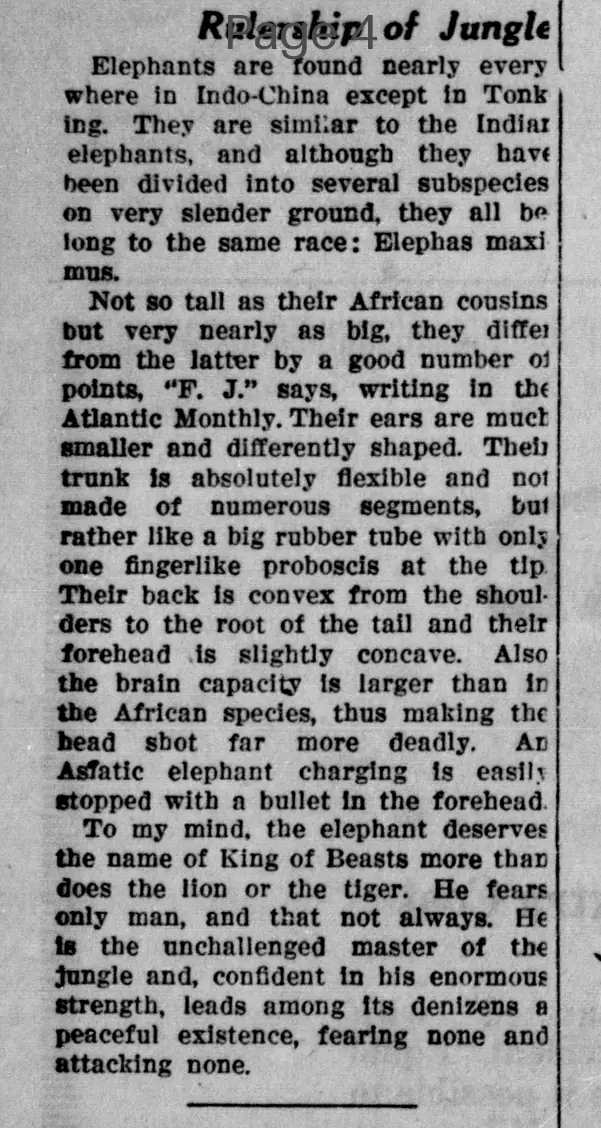
Elephants are found nearly everywhere in Indo-China except in Tonking. They are similar to the Indian elephants, and although they have been divided into several subspecies on very slender ground, they all belong to the same race: Elephas maximus.
Not so tall as their African cousins but very nearly as big, they differ from the latter by a good number of points, "F. J." says, writing in the Atlantic Monthly. Their ears are much smaller and differently shaped. Their trunk is absolutely flexible and not made of numerous segments, but rather like a big rubber tube with only one fingerlike proboscis at the tip. Their back is convex from the shoulders to the root of the tail and their forehead is slightly concave. Also the brain capacity is larger than in the African species, thus making the head shot far more deadly. A Asiatic elephant charging is easily stopped with a bullet in the forehead.
To my mind, the elephant deserves the name of King of Beasts more than does the lion or the tiger. He fears only man, and that not always. He is the unchallenged master of the jungle and, confident in his enormous strength, leads among its denizens a peaceful existence, fearing none and attacking none.
Not so tall as their African cousins but very nearly as big, they differ from the latter by a good number of points, "F. J." says, writing in the Atlantic Monthly. Their ears are much smaller and differently shaped. Their trunk is absolutely flexible and not made of numerous segments, but rather like a big rubber tube with only one fingerlike proboscis at the tip. Their back is convex from the shoulders to the root of the tail and their forehead is slightly concave. Also the brain capacity is larger than in the African species, thus making the head shot far more deadly. A Asiatic elephant charging is easily stopped with a bullet in the forehead.
To my mind, the elephant deserves the name of King of Beasts more than does the lion or the tiger. He fears only man, and that not always. He is the unchallenged master of the jungle and, confident in his enormous strength, leads among its denizens a peaceful existence, fearing none and attacking none.
What sub-type of article is it?
Animal Story
Curiosity
What themes does it cover?
Nature
What keywords are associated?
Asian Elephants
Indo China Elephants
Elephant Anatomy
King Of Beasts
What entities or persons were involved?
F. J.
Where did it happen?
Indo China, Tonking
Story Details
Key Persons
F. J.
Location
Indo China, Tonking
Story Details
Elephants in Indo-China resemble Indian elephants, belonging to Elephas maximus, differing from African elephants in size, ears, trunk, back, forehead, and brain capacity. The author argues elephants deserve the title King of Beasts over lions or tigers due to their strength and peaceful dominance in the jungle.