Thank you for visiting SNEWPapers!
Sign up free
Gazette Of The United States
New York, New York County, New York
What is this article about?
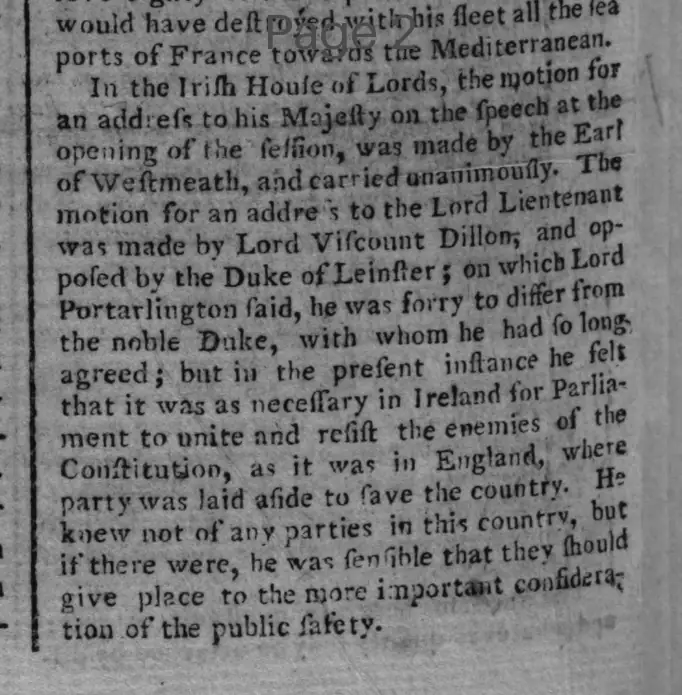
In the Irish House of Lords, the Earl of Westmeath moved an address to the King on the opening speech, carried unanimously. Lord Viscount Dillon moved an address to the Lord Lieutenant, opposed by the Duke of Leinster but supported by Lord Portarlington for national unity; it passed with the Duke as the sole dissenter. Commentary highlights Ireland's loyalty frustrating Jacobin divisions.
Merged-components note: These components continue the narrative of the debate in the Irish House of Lords, forming a single coherent foreign news report.
Clippings
1 of 2
OCR Quality
Full Text
On the question being put, the Duke was the only dissentient.
[Dence which we expected he would display,] Ireland, with that loyalty and political prudence, but which the English Jacobins hoped she would not, has given the finishing blow to faction. The incendiaries of France, and the perturbed spirits of the phalanx, have now their prospects blasted. Their diabolical endeavors to divide Great-Britain and Ireland, have been frustrated; and France and Faction have now to dread the united exertions of Britannia and Hibernia to suppress anarchy and Jacobin politics.
What sub-type of article is it?
What keywords are associated?
What entities or persons were involved?
Where did it happen?
Foreign News Details
Primary Location
Ireland
Key Persons
Outcome
motions carried unanimously and with one dissent (duke of leinster); emphasized unity against enemies of the constitution and jacobin faction.
Event Details
Motion for address to the King made by Earl of Westmeath and carried unanimously. Motion for address to Lord Lieutenant made by Lord Viscount Dillon, opposed by Duke of Leinster; Lord Portarlington supported unity for public safety despite differing from Duke. Duke sole dissentient. Commentary on Ireland's loyalty frustrating Jacobin efforts to divide Britain and Ireland.