Thank you for visiting SNEWPapers!
Sign up free
Literary
April 14, 1908
The Monroe Journal
Monroe, Union County, North Carolina
What is this article about?
Nostalgic memoir of 1850s Monroe, GA, by A. S. McCollum, describing childhood scenes: whipping post and stocks, old jail, town tavern, post office park with children's games including song lyrics, Jewish neighbors like teacher Noah Moses who later founded a stammering school, Maj. Covington's home with musical instrument, and horse-powered saw mill.
Clipping
OCR Quality
98%
Excellent
Full Text
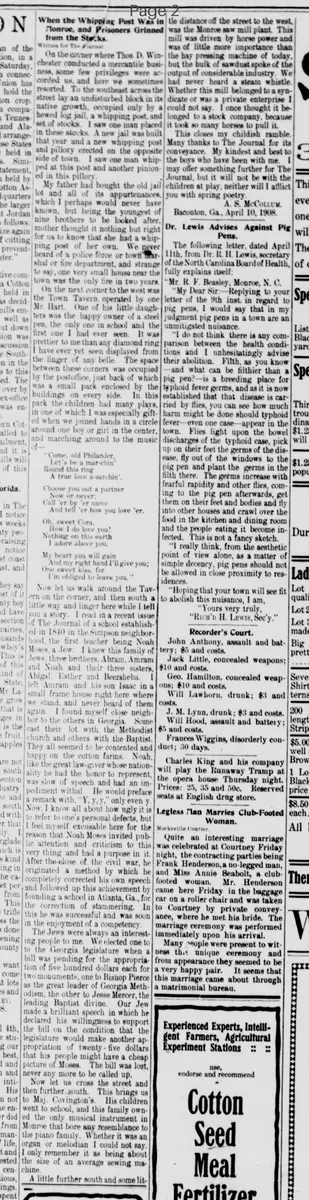
When the Whipping Post Was in Monroe, and Prisoners Grinned from the Stocks.
Written for The Journal.
On the corner where Thos. D. Winchester conducted a mercantile business, some few privileges were accorded us, and here we sometimes resorted. To the southeast across the street lay an undisturbed block in its native growth, occupied only by a hewed log jail, a whipping post, and set of stocks. I saw one man placed in these stocks. A new jail was built that year and a new whipping post and pillory erected on the opposite side of town. I saw one man whipped at this post and another pinioned in this pillory.
My father had bought the old jail lot and all of its appurtenances, which I perhaps would never have known, but being the youngest of nine brothers to be looked after, mother thought it nothing but right for us to know that she had a whipping post of her own. We never heard of a police force or town marshal or fire department, and strange to say, one very small house near the town was the only fire in two years.
On the next corner to the west was the Town Tavern, operated by one Mr. Hart. One of his little daughters was the happy owner of a steel pen, the only one in school and the first one I had ever seen. It was prettier to me than any diamond ring I have ever yet seen displayed from the finger of any belle. The space between these corners was occupied by the post office, just back of which was a small park enclosed by the buildings on every side. In this park the children had many plays, in one of which I was especially gifted when we joined hands in a circle around one boy or girl in the center, and marching around to the music of
"Come, old Philander,
Let's be a mar-chin
Round this ring
A true love a-sarchin'.
(hoose you out a partner
Now or never.
Call 'er by 'er name
And tell 'er how you love 'er.
Oh, sweet Cora,
How I do love vou!
Nothung on this earth
I adore above you.
My heart vou will gain
And my right hand I'll give you;
One sweet kiss, for
I'm obliged to leays."
Now let us walk around the Tavern on the corner, and then south a little way and linger here while I tell you a story. I read in a recent issue of The Journal of a school established in 1850 in the Simpson neighborhood, the first teacher being Noah Moses, a Jew. I knew this family of Jews, three brothers, Abram, Amram and Noah and their three sisters, Abigal, Isther and Beersheba. I left Amram and his son Isaac in a small frame house right here where we stand, and never heard of them again. I found myself close neighbor to the others in Georgia. Some cast their lot with the Methodist church and others with the Baptist. They all seemed to be contented and happy on the cotton farms. Noah, like the great law-giver whose nationality he had the honor to represent, was slow of speech and had an impediment withal. He would preface a remark with, "Y, y, y," only even y.
Now, I know all about how ugly it is to refer to one's personal defects, but I feel myself excusable here for the reason that Noah Moses invited public attention and criticism to this very thing and had a purpose in it. After the close of the civil war, he originated a method by which he completely corrected his own speech and followed up this achievement by founding a school in Atlanta, Ga., for the correction of stammering. In this he was successful and was soon in the enjoyment of a competency.
The Jews were always an interesting people to me. We elected one to the Georgia legislature when a bill was pending for the appropriation of five hundred dollars each for two monuments, one to Bishop Pierce as the great leader of Georgia Methodism, the other to Jesse Mercer, the leading Baptist divine. Our Jew made a brilliant speech in which he declared his willingness to support the bill on the condition that the legislature would make another appropriation of twenty-five dollars that his people might have a cheap picture of Moses. The bill was lost, never any more to be called up.
Now let us cross the street and then further south. This brings us to Maj. Covington's. His children went to school, and this family owned the only musical instrument in Monroe that bore any resemblance to the piano family. Whether it was an organ or melodeon I could not say. I only remember it as being about the size of an average sewing machine.
A little further south and some little distance off the street to the west, was the Monroe saw mill plant. This mill was driven by horse power and was of little more importance than the hay pressing machine of today, but the bulk of sawdust spoke of the output of considerable industry. We had never heard a steam whistle. Whether this mill belonged to a syndicate or was a private enterprise I could not say. I once thought it belonged to a stock company, because it took so many horses to pull it.
This closes my childish ramble. Many thanks to The Journal for its conveyance. My kindest and best to the boys who have been with me. I may offer something further for The Journal, but it will not be with the children at play, neither will I afflict you with spring poetry.
A. S. McCOLLUM.
Baconton, Ga., April 10, 1908.
Written for The Journal.
On the corner where Thos. D. Winchester conducted a mercantile business, some few privileges were accorded us, and here we sometimes resorted. To the southeast across the street lay an undisturbed block in its native growth, occupied only by a hewed log jail, a whipping post, and set of stocks. I saw one man placed in these stocks. A new jail was built that year and a new whipping post and pillory erected on the opposite side of town. I saw one man whipped at this post and another pinioned in this pillory.
My father had bought the old jail lot and all of its appurtenances, which I perhaps would never have known, but being the youngest of nine brothers to be looked after, mother thought it nothing but right for us to know that she had a whipping post of her own. We never heard of a police force or town marshal or fire department, and strange to say, one very small house near the town was the only fire in two years.
On the next corner to the west was the Town Tavern, operated by one Mr. Hart. One of his little daughters was the happy owner of a steel pen, the only one in school and the first one I had ever seen. It was prettier to me than any diamond ring I have ever yet seen displayed from the finger of any belle. The space between these corners was occupied by the post office, just back of which was a small park enclosed by the buildings on every side. In this park the children had many plays, in one of which I was especially gifted when we joined hands in a circle around one boy or girl in the center, and marching around to the music of
"Come, old Philander,
Let's be a mar-chin
Round this ring
A true love a-sarchin'.
(hoose you out a partner
Now or never.
Call 'er by 'er name
And tell 'er how you love 'er.
Oh, sweet Cora,
How I do love vou!
Nothung on this earth
I adore above you.
My heart vou will gain
And my right hand I'll give you;
One sweet kiss, for
I'm obliged to leays."
Now let us walk around the Tavern on the corner, and then south a little way and linger here while I tell you a story. I read in a recent issue of The Journal of a school established in 1850 in the Simpson neighborhood, the first teacher being Noah Moses, a Jew. I knew this family of Jews, three brothers, Abram, Amram and Noah and their three sisters, Abigal, Isther and Beersheba. I left Amram and his son Isaac in a small frame house right here where we stand, and never heard of them again. I found myself close neighbor to the others in Georgia. Some cast their lot with the Methodist church and others with the Baptist. They all seemed to be contented and happy on the cotton farms. Noah, like the great law-giver whose nationality he had the honor to represent, was slow of speech and had an impediment withal. He would preface a remark with, "Y, y, y," only even y.
Now, I know all about how ugly it is to refer to one's personal defects, but I feel myself excusable here for the reason that Noah Moses invited public attention and criticism to this very thing and had a purpose in it. After the close of the civil war, he originated a method by which he completely corrected his own speech and followed up this achievement by founding a school in Atlanta, Ga., for the correction of stammering. In this he was successful and was soon in the enjoyment of a competency.
The Jews were always an interesting people to me. We elected one to the Georgia legislature when a bill was pending for the appropriation of five hundred dollars each for two monuments, one to Bishop Pierce as the great leader of Georgia Methodism, the other to Jesse Mercer, the leading Baptist divine. Our Jew made a brilliant speech in which he declared his willingness to support the bill on the condition that the legislature would make another appropriation of twenty-five dollars that his people might have a cheap picture of Moses. The bill was lost, never any more to be called up.
Now let us cross the street and then further south. This brings us to Maj. Covington's. His children went to school, and this family owned the only musical instrument in Monroe that bore any resemblance to the piano family. Whether it was an organ or melodeon I could not say. I only remember it as being about the size of an average sewing machine.
A little further south and some little distance off the street to the west, was the Monroe saw mill plant. This mill was driven by horse power and was of little more importance than the hay pressing machine of today, but the bulk of sawdust spoke of the output of considerable industry. We had never heard a steam whistle. Whether this mill belonged to a syndicate or was a private enterprise I could not say. I once thought it belonged to a stock company, because it took so many horses to pull it.
This closes my childish ramble. Many thanks to The Journal for its conveyance. My kindest and best to the boys who have been with me. I may offer something further for The Journal, but it will not be with the children at play, neither will I afflict you with spring poetry.
A. S. McCOLLUM.
Baconton, Ga., April 10, 1908.
What sub-type of article is it?
Essay
What themes does it cover?
Social Manners
What keywords are associated?
Monroe Georgia
Childhood Reminiscence
Whipping Post
Stocks
Jewish Family
Noah Moses
Civil War
Town Tavern
Saw Mill
What entities or persons were involved?
A. S. Mccollum
Literary Details
Title
When The Whipping Post Was In Monroe, And Prisoners Grinned From The Stocks.
Author
A. S. Mccollum
Subject
Reminiscences Of Childhood In Monroe, Georgia
Form / Style
Personal Memoir In Prose
Key Lines
Come, Old Philander,
Let's Be A Mar Chin
Round This Ring
A True Love A Sarchin'.
(Hoose You Out A Partner
Now Or Never.
Call 'Er By 'Er Name
And Tell 'Er How You Love 'Er.
Oh, Sweet Cora,
How I Do Love Vou!
Nothung On This Earth
I Adore Above You.
My Heart Vou Will Gain
And My Right Hand I'll Give You;
One Sweet Kiss, For
I'm Obliged To Leays.