Thank you for visiting SNEWPapers!
Sign up free
The New York Journal, And Daily Patriotic Register
New York, New York County, New York
What is this article about?
Elbridge Gerry's detailed explanation of debates and compromises in the 1787 federal convention on legislative representation, published alongside reports of the Massachusetts state convention's proceedings and ratification of the U.S. Constitution with nine proposed amendments in early February 1788.
Merged-components note: Merged continuations of the article detailing Mr. Gerry's letter on the federal convention and the Massachusetts ratification news.
Clippings
1 of 2
OCR Quality
Full Text
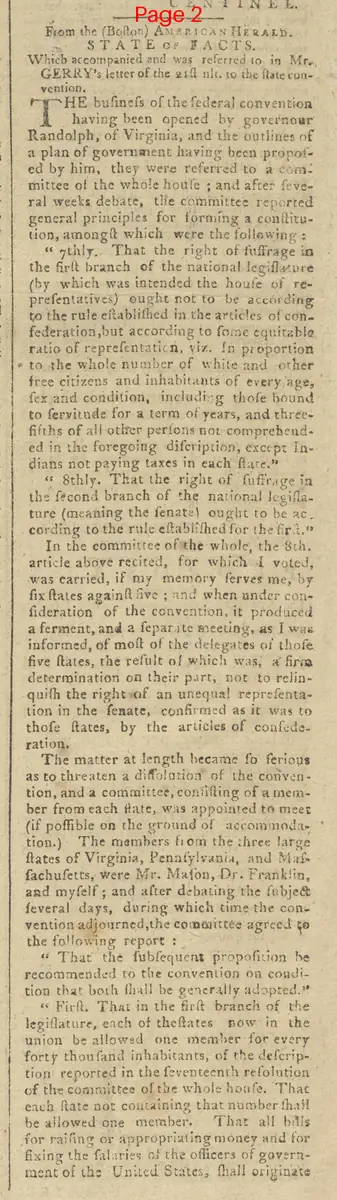
STATE OF FACTS.
Which accompanied and was referred to in Mr. GERRY's letter of the 21st ult. to the state convention.
THE business of the federal convention having been opened by governor Randolph, of Virginia, and the outlines of a plan of government having been proposed by him, they were referred to a committee of the whole house; and after several weeks debate, the committee reported general principles for forming a constitution, amongst which were the following:
"7thly. That the right of suffrage in the first branch of the national legislature (by which was intended the house of representatives) ought not to be according to the rule established in the articles of confederation, but according to some equitable ratio of representation, viz. In proportion to the whole number of white and other free citizens and inhabitants of every age, sex and condition, including those bound to servitude for a term of years, and three-fifths of all other persons not comprehended in the foregoing description, except Indians not paying taxes in each state."
"8thly. That the right of suffrage in the second branch of the national legislature (meaning the senate) ought to be according to the rule established for the first."
In the committee of the whole, the 8th. article above recited, for which I voted, was carried, if my memory serves me, by six states against five; and when under consideration of the convention, it produced a ferment, and a separate meeting, as I was informed, of most of the delegates of those five states, the result of which was, a firm determination on their part, not to relinquish the right of an unequal representation in the senate, confirmed as it was to those states, by the articles of confederation.
The matter at length became so serious as to threaten a dissolution of the convention, and a committee, consisting of a member from each state, was appointed to meet (if possible on the ground of accommodation.) The members from the three large states of Virginia, Pennsylvania, and Massachusetts, were Mr. Mason, Dr. Franklin, and myself: and after debating the subject several days, during which time the convention adjourned, the committee agreed to the following report:
"That the subsequent proposition be recommended to the convention on condition that both shall be generally adopted."
"First. That in the first branch of the legislature, each of the states now in the union be allowed one member for every forty thousand inhabitants, of the description reported in the seventeenth resolution of the committee of the whole house. That each state not containing that number shall be allowed one member. That all bills for raising or appropriating money and for fixing the salaries of the officers of government of the United States, shall originate in the first branch of the legislature, and shall not be altered or amended by the second branch; and that no money shall be drawn from the treasury of the United States, but in pursuance of appropriations to be originated by the first branch."
"Secondly. That, in the second branch of the legislature each state shall have an equal vote."
The number of forty thousand inhabitants to every member in the house of representatives, was not an object of much debate, or a subject insisted on, as some of the committee were opposed to it. Accordingly on the 10th of July a motion was made "to double the number of representatives, being sixty-five," and it passed in the negative.
The admission however, of the smallest states to an equal representation in the senate, never would have been agreed to by the committee, or by myself as a member of it, without the provision, "That all bills for raising or appropriating money, and for fixing the salaries of the officers of government, &c. should originate in the house of representatives, and not be altered or amended by the senate. And that no money should be drawn from the treasury, but in pursuance of such appropriations."
This provision was agreed to by the convention at the same time and by the same vote, as that which allows to each state an equal voice in the senate, and was afterwards referred to the committee of detail, and reported by them as a part of the constitution, as will appear by documents in my possession. Nevertheless, the smaller states having attained their object, of an equal representation in the senate, a new provision, now in the constitution, was substituted; whereby the senate have a right to propose amendments, to reverse bills, and the provision reported by the committee was effectually destroyed.
It was conceived by the committee to be highly unreasonable and unjust, that a small state, which would contribute but one sixty-fifth part of any tax, should nevertheless, have an equal right with a large state, which would contribute eight or ten sixty-fifths of the same tax, to take money from the pockets of the latter, more especially as it was intended, that the powers of the new legislature should extend to internal taxation—it was likewise conceived that the right of expending, should be in proportion to the ability of raising money; that the larger states should not have the least security for their property, if they had not the due command of their own purses; that they would not have such command, if the lesser states in either branch, had an equal right with the larger to originate or even to alter money bills; that if the senate should have the power of proposing amendments, they may propose, that a bill originated by the house to raise one thousand, should be increased to one hundred thousand pounds; that though the house may negative amendments proposed by the senate, yet the giving them power to propose amendments, would enable them to increase the grants of the house, because the senate (as well as the house) would have a right to adhere to their votes, and would oblige the house to consent to such an increase, on the principle of accommodation; that the lesser states would thus have nearly as much command of the property of the greater, as they themselves; that even if the representation in the senate had been according to numbers, in each state, money bills should not be originated or altered by that branch, because by their appointments, the members would be farther removed from the people, would have a greater and more independent property in their offices, would be more extravagant, and not being so easily removed, would be ever in favor of higher salaries than members of the house; that it is not reasonable to suppose, the aristocratical branch would be as saving of the public money as the democratical branch; but that on the other hand, should the senate have only the power of concurrence or non-concurrence of such bills, they would pass them although the grants should not equal their wishes, whilst with the power of amendment, they would never be satisfied with the grant of the house: that the commons of Great-Britain had ever strenuously and successfully contended for this important right, which the lords had often but in vain endeavored to exercise; that the preservation of this right, the right of holding the purse strings, was essential to the preservation of liberty; that to this right, perhaps, was principally owing, the liberty that still remains in Great-Britain.
These are the facts and reasons whereon was grounded the admission of the smaller states to an equal representation in the senate; and it must appear, that there is an essential difference between an unqualified admission of them to an equal representation
tion in the senate, and admitting them from necessity, on the express condition provided in the recited report of the committee—it must also appear, that had that provision been preserved in the constitution, and the senate precluded from a right to alter or amend money or revenue bills, agreeably to the said report, the lesser states would not have had that undue command of the property of the larger states which they are now to have by the constitution; and that I never consented to an equal representation of the states in the senate, as it now stands in the new system.
E. GERRY.
The Hon. Judge Cushing,
Vice-President of the convention
of Massachusetts.
New-York, February 11.
By papers received on Saturday evening, the following interesting intelligence was communicated:
On Thursday, the 31st ult. the hon. convention finished the discussion of the federal constitution, by paragraphs, on which Mr. Parsons moved, "That this convention do assent to, and ratify, the constitution of the United States of America, proposed by the federal convention." And the consideration of the motion immediately commenced.
In the afternoon his excellency the president communicated propositions, which were under consideration Friday and Saturday.
Friday, Feb. 1, on motion, the hon. convention voted, That the final decision on the question to accept or reject the constitution in debate, be not taken until Tuesday next.
Saturday, Feb. 2, a committee of the hon. convention, consisting of two members from each county, sat at the representative's chamber, to consider of, and amend the following propositions of his excellency, above referred to, and make report.
Commonwealth of Massachusetts.
In Convention of the Delegates of the People of the Commonwealth of Massachusetts, 1788.
THE convention having impartially discussed, and fully considered the constitution of the United States of America, reported to Congress by the convention of delegates from the United States of America, and submitted to us by a resolution of the general court of the said commonwealth, passed the twenty-fifth day of October last past; and acknowledging with grateful hearts the goodness of the supreme ruler of the universe, in affording the people of the United States, in the course of his providence, an opportunity deliberately and peaceably, without fraud or surprise, of entering into an explicit and solemn compact with each other, by assenting to, and ratifying a new constitution, in order to form a more perfect union, establish justice, insure domestic tranquility, provide for the common defence, promote the general welfare, and secure the blessings of liberty to themselves and their posterity; do, in the name and in behalf of the commonwealth of Massachusetts, assent to and ratify the said constitution of the United States of America.
And as it is the opinion of this convention, that certain amendments and alterations in the said constitution, would remove the fears and quiet the apprehensions of many of the good people of this commonwealth, and more especially guard against an undue administration of the federal government; the convention do therefore recommend, that the following alterations and provisions be introduced into the said Constitution.
First, That it be explicitly declared, that all powers not expressly delegated to Congress, are reserved to the several states, to be by them exercised.
Secondly, That there shall be one representative to every thirty thousand persons, until the whole number of representatives amount to
Thirdly, That Congress do not exercise the powers vested in them by the 4th sect. of 1st art. but in cases where a state shall neglect or refuse to make adequate provision for an equal representation of the people, agreeably to this constitution.
Fourthly, That Congress do not lay direct taxes but when the monies arising from the impost and excise are insufficient for the public exigencies.
Fifthly, That Congress erect no company of merchants, with exclusive advantages of commerce.
Sixthly, That no person shall be tried for any crime by which he may incur an infamous punishment, or loss of life, until he be first indicted by a grand jury, except in such cases as may arise in the government and regulation of the land and naval forces.
Seventhly, The supreme judicial federal court shall have no jurisdiction of causes between citizens of different states, unless the matter in dispute be of the value of
dollars at least.
Eighthly, In civil actions, between citizens of different states, every issue of fact arising in actions at common law, may be tried by a jury, if the parties, or either of them request it.
Ninthly, That the words "without the consent of Congress," in the last paragraph in the ninth section, of the first article, be stricken out.
AND the convention do, in the name and in behalf of the people of this commonwealth, enjoin it upon their representatives in Congress, at all times, until the alterations and provisions aforesaid have been considered, agreeably to the fifth article of the said constitution, to exert all their influence, and use all reasonable and legal methods to obtain a ratification of the said alterations and provisions, in such manner as is provided in the said article.
And that the United States in Congress assembled, may have due notice of the assent and ratification of the said constitution, by this convention.
It is resolved, That the assent and ratification aforesaid, be engrossed on parchment, together with the recommendation and injunction aforesaid, and with this resolution, and that his excellency John Hancock, Esq. president, and the hon. William Cushing, Esq. vice-president, of this convention, transmit the same, countersigned by the secretary of the convention, under their hands and seals, to the United States in Congress assembled.
What sub-type of article is it?
What keywords are associated?
What entities or persons were involved?
Where did it happen?
Domestic News Details
Primary Location
Massachusetts
Event Date
Late January To Early February 1788
Key Persons
Outcome
massachusetts ratifies the u.s. constitution with recommendations for nine amendments addressing representation, taxation, trials, jurisdiction, and reserved powers; gerry clarifies he did not consent to equal senate representation without restrictions on money bills.
Event Details
Elbridge Gerry details debates in the federal convention on proportional representation in the House and equal state representation in the Senate, explaining compromises and his opposition to the final version allowing Senate amendments to money bills. The Massachusetts convention discusses and ratifies the Constitution on January 31 to February 2, 1788, proposing amendments to limit federal powers and protect state rights.