Thank you for visiting SNEWPapers!
Sign up free
The Rhode Island American, And General Advertiser
Providence, Providence County, Rhode Island
What is this article about?
The Tyrolese and Vorarlbergers mounted a fierce rebellion against French and Bavarian forces in 1809, achieving key victories like the April 11 defeat of 27,000 invaders and repelling Marshal Lefebvre despite his atrocities. They aided Austrian escapees and advanced into enemy territories humanely, vowing eternal resistance post-armistice amid heavy losses.
Merged-components note: This is a continuation of the foreign news story about the Tyroleans, spanning from page 1 to page 2, as indicated by the sequential reading order and the text flow.
Clippings
1 of 2
OCR Quality
Full Text
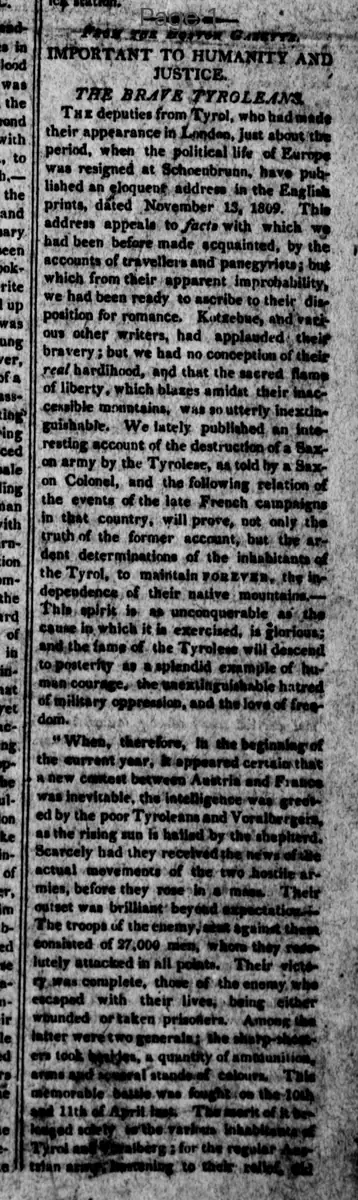
IMPORTANT TO HUMANITY AND
JUSTICE.
THE BRAVE TYROLEANS
The deputies from Tyrol, who had made
their appearance in London, just about three
period, when the political life of Europe
was resigned at Schoenbrunn, have pub-
lished an eloquent address in the English
prints, dated November 13, 1809. This
address appeals to facts with which we
had been before made acquainted, by the
accounts of travellers and panegyrists; but
which from their apparent improbability
we had been ready to ascribe to their dis-
position for romance. Kotzebue, and vari-
ous other writers, had applauded their
bravery: but we had no conception of their
real hardihood, and that the sacred flame
of liberty, which blazes amidst their inac-
cessible mountains, was so utterly inextin-
guishable. We lately published an inter-
esting account of the destruction of a Sax-
on army by the Tyrolese, as told by a Sax-
on Colonel, and the following relation of
the events of the late French Campaigns
in that country, will prove, not only the
truth of the former account, but the ar-
dent determinations of the inhabitants of
the Tyrol, to maintain FOR EVER, the in-
dependence of their native mountains.
This spirit is as unconquerable as the
cause in which it is exercised, is glorious;
and the fame of the Tyrolese will descend
to posterity as a splendid example of hu-
man courage, the unextinguishable hatred
of military oppression, and the love of free-
dom.
When, therefore, in the beginning of
the current year, it appeared certain that
a new contest between Austria and France
was inevitable, the intelligence was greet-
ed by the poor Tyroleans and Vorarlbergians,
as the rising sun is hailed by the shep-
herd. Scarcely had they received the news
of the actual movements of the two hostile ar-
mies, before they rose in mass. Their out-
set was brilliant beyond expectation.
The troops of the enemy sent against them
consisted of 27,000 men, whom they resolutely attacked in all points. Their victo-
ry was complete, those of the enemy who
escaped with their lives, being either
wounded or taken prisoners. Among the
latter were two generals; the sharp-shooters took besides, a quantity of ammunition
arms and several standards of colours The
memorable battle was fought on the 11th of April inst. The merit of it be-
longs equally to the various inhabitants of
Tyrol and Vorarlberg: for the regular Ba-
varian army stemming to their relief
not join them before the 13th of April; it was received by the conquerors with drum beating and colours flying, while shouts of joy and "long live our beloved Emperor Francis," rent the air.
Those who know the mildness of Bonaparte's temper, will be able to conceive an idea of the impression which this news made upon him. He instantly directed Marshal Lefebvre, supported by the Bavarian Generals Wrede, Deroy, and Siebein at the head of 24,000 men, to march against the Tyrolese by the way of Salzburg. General Rusca, with 8,000 men, was ordered to advance from Italy, while General Ferron approached from Carinthia, and General Marmont from Bavaria and Suabia, with 5 to 7,000 troops more.
This was certainly a formidable force, which would have conquered, and even annihilated any other two nations of equal number. The conflict, indeed, was obstinate and terrible; but the enemies were defeated, all but Lefebvre, whose force was too large, and whose devastations and cruelties, were such as to spread terror everywhere. He burnt towns and villages and gave quarter to no one. The aged were suspended from trees, and then shot. The pregnant women were ripped open and their breasts cut off, while their embryos were crammed down their throats, to put an end to the shrieks and moanings of the wretched victims. If a Tyrolese or Voralberger, bearing arms, had the misfortune to fall into their hands, they immediately tore out his tongue. The children were cut down without mercy, and most frequently carried about, transfixed with bayonets. A number of these innocents, when returning from school were met with and driven by these monsters into some barns and burnt alive.
Lefebvre and his cannibals, imagined to be able to intimidate the Tyrolese and Voralbergers by such cruelties; but they had the very opposite effect. The Tyrolese's sharp-shooters now resembled blood-thirsty lions; they rushed upon Lefebvre and totally defeated him; thousands of the enemy were slain and the general, accompanied only by a few remnants of his great force sought safety in an ignominious flight, directed towards Vienna.
The result of this complete victory was, that the Tyrol and Voralberg, being now free from their invaders, served as an asylum to those Austrian prisoners who had been taken by the French at Ratisbon, Aspern, and Esslingen, and who found little difficulty in making their escape. About 10,000 profited by this opportunity; they were nearly naked, and the expense of clothing and arming them anew, proved no small burden to their hospitable friends.
Another advantage of this victory displayed itself in the superior courage with which it inspired the conquerors. They pushed forth beyond their frontier to seek the enemy: In Bavaria they advanced of Munich, the capital city. In Suabia they took Kempten, pushing-on beyond Memmingen and Ulm. In Italy, they proceeded to within a few miles of Verona; and some corps overran Carinthia and Salzburg, then already in the power of the enemy, so as to become to a great degree masters of those countries.
Notwithstanding these successes, the conquerors were guilty of no cruelties or acts of oppression. Not a single house was pillaged by them, not a barn laid in ashes. No peasant was ever taken prisoner or insulted. The wounded enemies were particularly taken care of. It was the usual practice to carry them on their shoulders into some house. The Tyrolese and Voralbergers acted throughout from an honourable ambition, to shame their cruel enemies, and convince them of the superior humanity of poor German mountaineers.
Neither France, nor any of her allies can adduce a single instance of their prisoners having been ill treated, either in the Tyrol or Voralberg, though the prisoners from either country, were tortured, murdered, or ill used by the French.
All these glorious achievements, however, could not arrest the progress of the enemy in other quarters. In fine, an armistice was again concluded. The corps of Austrian troops left in the Tyrol, and consisting for the most part of the above mentioned refugees, was suddenly recalled, and carried away all the ordnance and ammunition which the Tyrolese had taken. Thus the latter found themselves compelled to abandon their conquests, and satisfy themselves with guarding their own frontiers.
N. Lefebvre, Rusca, Ferron, and other Generals penetrated once more as far as Innspruck, the capital of the Tyrol, repeating their former devastations and cruelties. But the indignation excited by the re-appearance of those inhuman chiefs was such, that the very women, whose business had hitherto been confined by conveying the prisoners to places of safety, assembled in numbers, and put to death 640 of the enemy near Lamdeck, and though the whole force of the enemy amounted to about 30,000, they were attacked by the Tyrolese and Voralbergers, who had risen en masse, with such irresistible fury, that those who saved themselves by flight, were pursued to a great distance, so as to be unable, during the space of 24 hours, to allay their thirst with a draught of water.
It was in vain that Bonaparte, on bearing this new disaster of his arms, detached marshals Macdonald and Bessieres, with picked troops, against the Tyrolese. They were routed and obliged to return.
From the concurring accounts in the Dutch, German and French papers, which are copied into the daily prints of London, it is placed beyond all doubt, that the Tyrolese and Voralbergers, persevere in their obstinate resistance to the French and their allies.
They are indeed now free, but at the expense of very uncommon sacrifices. Numbers of them mourn their fathers and sons; not slain in battle, but for the most part murdered in an inhuman manner. Four towns and twenty-six flourishing villages are reduced to heaps of ashes—not to mention the destruction of a large number of detached cottages. These calamities are felt more sensibly in a climate which is very far from being mild: The mountains of the Tyrol and Voralberg have ever since the beginning of October been covered with snow and ice. The inhabitants, though accustomed to subsist upon the hardest fare, can, after so many devastations, pillages, conflagrations, and hardships, of every kind, scarcely get wherewithal to satisfy the cravings of nature. Multitudes, at this moment are happy in being allowed some little corner in a crowded barn, stable or hut.
In spite of all these sufferings, they are fully determined, never to listen to any accommodation with Bonaparte, or consent to be again governed by the iron sceptre of Bavaria. This determination, though it appears rash, can be satisfactorily accounted for, from the above stated cruelties, exactions and oppressions. All, to a man, trained to the most skilful use of the rifle; inured to the inclemencies of the season; defended by huge mountains, accessible to none but themselves; surrounded by, and allied to mountaineers that are animated with the same love of independence; reared up and happy in poverty; religious; virtuous from habit; utter strangers to luxury; preferring their barren mountains to the most fruitful soils—and, above all, remembering the horrible outrages committed by the order of Bonaparte, to whom they have to oppose one hundred and fifty thousand sharp-shooters, in a country where no regular army can act, and where they, and they alone, know the paths to procure supplies, if they have but the means to purchase them. Such a hardy, stubborn, and athletic race of men are very formidable enemies. Such they have certainly proved to France, and no peace which their beloved Prince may have been compelled to enter into, will induce them to become a party to it.
They are firmly resolved either to conquer or die.
What sub-type of article is it?
What keywords are associated?
What entities or persons were involved?
Where did it happen?
Foreign News Details
Primary Location
Tyrol And Vorarlberg
Event Date
1809, Particularly April 11
Key Persons
Outcome
tyrolese defeated 27,000 enemy troops on april 11, capturing two generals, ammunition, arms, and standards; later defeated lefebvre's 24,000, with thousands slain; rusca, ferron, and others repelled; 640 enemies killed near lamdeck; macdonald and bessieres routed; tyrol freed but at cost of towns and villages burned, many murdered; continued resistance despite armistice.
Event Details
Tyrolese and Vorarlbergers rose against French and allies in early 1809, defeating initial 27,000 invaders on April 11. Lefebvre's force of 24,000 committed atrocities but was defeated. Tyrolese aided escaped Austrian prisoners, advanced into Bavaria, Suabia, Italy, Carinthia, Salzburg without cruelty. Armistice recalled Austrian troops, leaving Tyrol vulnerable; invaders returned but were repelled again, including by women near Lamdeck. Despite sacrifices, Tyrolese resolved to resist Bonaparte indefinitely with 150,000 sharp-shooters in mountains.