Thank you for visiting SNEWPapers!
Sign up free
Editorial
July 31, 1809
The National Intelligencer And Washington Advertiser
Washington, District Of Columbia
What is this article about?
Editorial from New-York Evening Post analyzes British disavowal of David M. Erskine's April agreement with the US, which revoked Orders in Council in exchange for lifting the embargo and non-intercourse against Britain. Speculates disapproval stemmed from US refusal to maintain restrictions on France, reviewing historical trade disputes.
Clipping
OCR Quality
95%
Excellent
Full Text
From the New-York Evening Post.
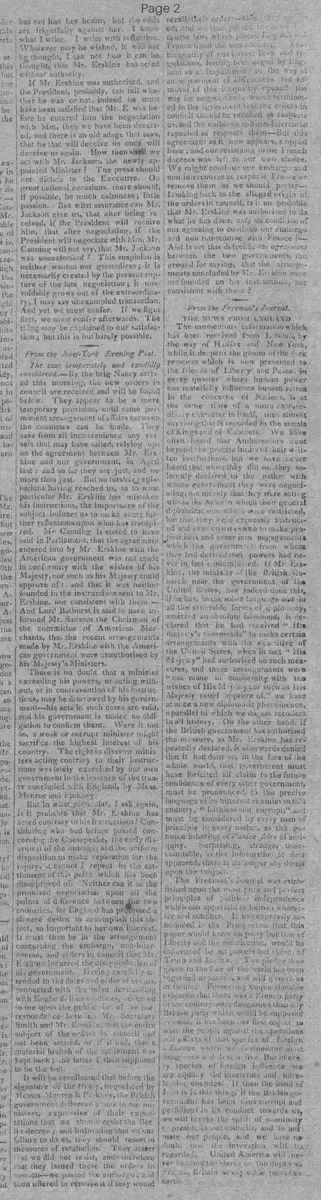
The case temperately and candidly considered.-By the brig Nancy arrived this morning, the new orders in council are received and will be found below. They appear to be a mere temporary provision, until some permanent arrangement of affairs between the countries can be made. They save from all inconvenience any vessels that may have sailed, relying upon the agreement between Mr. Erskine and our government, in April last : and so far they are just, and no more than just. But no further explanations having reached us, as to what particular Mr. Erskine has mistaken his instructions, the importance of the subject induces us to make some further reflections upon what has transpired. Mr Canning is stated to have said in Parliament, that the agreement entered into by Mr. Erskine with the American government was not made in conformity with the wishes of his Majesty, nor such as his Majesty could approve of: and that it was neither founded in the instructions sent to Mr. Erskine, nor consistent with them.- And Lord Bathurst is said to have informed Mr. Sansom the Chairman of the committee of American Merchants, that the recent arrangements made by Mr. Erskine with the American government were unauthorised by his Majesty's Ministers.
There is no doubt that a minister exceeding his powers, or acting without, or in contravention of his instructions, may be disavowed by his government-his acts in such cases are void, and his government is under no obligation to confirm them. Were it not so, a weak or corrupt minister might sacrifice the highest interest of his country. The right to disavow ministers acting contrary to their instructions was lately exercised by our own government in the instance of the treaty concluded with England, by Mess. Monroe and Pinkney.
But in what particular, I ask again, is it probable that Mr. Erskine has acted contrary to his instructions? Considering what had before passed concerning the Chesapeake, the early disavowal of the outrage, and the uniform disposition to make reparation for the injury, it cannot I repeat be the settlement of this point which has been disapproved of. Neither can it be the promised negociation upon all the points of difference between the two countries, for England has professed a sincere desire to accomplish this object, so important to her own interest. It must then be in the arrangement concerning the embargo, non-intercourse, and orders in council that Mr. Erskine incurred the disapprobation of his government. Having carefully attended to the dates and order of events, connected with the misunderstanding with England, it immediately occurred to me upon the public notice of the correspondence between Mr. Secretary Smith and Mr. Erskine. that the entire subject of the orders in council had not been settled, or if it had, that a material branch of the settlement was kept back; the latter I then supposed to be the fact.
It will be recollected that before the signature of the treaty, negociated by Messrs. Monroe & Pinkney, the British government delivered a note to our ministers, expressive of their expectations that we should resist the Berlin decree ; and intimating that on our failure to do so, they should resort to measures of retaliation. They assert that we did not resist, and-therefore that they issued these the orders in council--we passed the embargo; and then offered to remove it if they would recall their orders--this they refused, and we then passed the non intercourse law, which placed England and France upon the same footing. The inequality of our former laws and regulations, having been urged by England as an impediment in the way of an adjustment of differences the removal of this inequality opened the way for negociation, which terminated in the agreement that the orders in council should be revoked as respects us, and the embargo and non-intercourse repealed as respects them-But this agreement as it now appears, stopped here ; and our resistance to the French decrees was left to our own choice.
We might continue our embargo and non intercourse as respects France or remove them as we should prefer-- Looking back to the alleged origin of the orders in council, is it no probable that Mr. Erskine was authorised to do what he has done, only on condition of our agreeing to continue our embargo and non intercourse with France ?-- And is not this defect in the agreement between the two governments, the ground for saying, that the arrangements concluded by Mr. Erskine were not founded on his instruction, nor consistent with them?
The case temperately and candidly considered.-By the brig Nancy arrived this morning, the new orders in council are received and will be found below. They appear to be a mere temporary provision, until some permanent arrangement of affairs between the countries can be made. They save from all inconvenience any vessels that may have sailed, relying upon the agreement between Mr. Erskine and our government, in April last : and so far they are just, and no more than just. But no further explanations having reached us, as to what particular Mr. Erskine has mistaken his instructions, the importance of the subject induces us to make some further reflections upon what has transpired. Mr Canning is stated to have said in Parliament, that the agreement entered into by Mr. Erskine with the American government was not made in conformity with the wishes of his Majesty, nor such as his Majesty could approve of: and that it was neither founded in the instructions sent to Mr. Erskine, nor consistent with them.- And Lord Bathurst is said to have informed Mr. Sansom the Chairman of the committee of American Merchants, that the recent arrangements made by Mr. Erskine with the American government were unauthorised by his Majesty's Ministers.
There is no doubt that a minister exceeding his powers, or acting without, or in contravention of his instructions, may be disavowed by his government-his acts in such cases are void, and his government is under no obligation to confirm them. Were it not so, a weak or corrupt minister might sacrifice the highest interest of his country. The right to disavow ministers acting contrary to their instructions was lately exercised by our own government in the instance of the treaty concluded with England, by Mess. Monroe and Pinkney.
But in what particular, I ask again, is it probable that Mr. Erskine has acted contrary to his instructions? Considering what had before passed concerning the Chesapeake, the early disavowal of the outrage, and the uniform disposition to make reparation for the injury, it cannot I repeat be the settlement of this point which has been disapproved of. Neither can it be the promised negociation upon all the points of difference between the two countries, for England has professed a sincere desire to accomplish this object, so important to her own interest. It must then be in the arrangement concerning the embargo, non-intercourse, and orders in council that Mr. Erskine incurred the disapprobation of his government. Having carefully attended to the dates and order of events, connected with the misunderstanding with England, it immediately occurred to me upon the public notice of the correspondence between Mr. Secretary Smith and Mr. Erskine. that the entire subject of the orders in council had not been settled, or if it had, that a material branch of the settlement was kept back; the latter I then supposed to be the fact.
It will be recollected that before the signature of the treaty, negociated by Messrs. Monroe & Pinkney, the British government delivered a note to our ministers, expressive of their expectations that we should resist the Berlin decree ; and intimating that on our failure to do so, they should resort to measures of retaliation. They assert that we did not resist, and-therefore that they issued these the orders in council--we passed the embargo; and then offered to remove it if they would recall their orders--this they refused, and we then passed the non intercourse law, which placed England and France upon the same footing. The inequality of our former laws and regulations, having been urged by England as an impediment in the way of an adjustment of differences the removal of this inequality opened the way for negociation, which terminated in the agreement that the orders in council should be revoked as respects us, and the embargo and non-intercourse repealed as respects them-But this agreement as it now appears, stopped here ; and our resistance to the French decrees was left to our own choice.
We might continue our embargo and non intercourse as respects France or remove them as we should prefer-- Looking back to the alleged origin of the orders in council, is it no probable that Mr. Erskine was authorised to do what he has done, only on condition of our agreeing to continue our embargo and non intercourse with France ?-- And is not this defect in the agreement between the two governments, the ground for saying, that the arrangements concluded by Mr. Erskine were not founded on his instruction, nor consistent with them?
What sub-type of article is it?
Foreign Affairs
Trade Or Commerce
Economic Policy
What keywords are associated?
Erskine Agreement
Orders In Council
Embargo
Non Intercourse
British Disavowal
Trade Negotiations
French Decrees
What entities or persons were involved?
Mr. Erskine
Mr. Canning
Lord Bathurst
Mr. Sansom
Monroe And Pinkney
British Government
American Government
Editorial Details
Primary Topic
British Disavowal Of Erskine's Agreement On Orders In Council And Us Trade Restrictions
Stance / Tone
Temperate And Candid Analysis Questioning The Reasons For Disavowal
Key Figures
Mr. Erskine
Mr. Canning
Lord Bathurst
Mr. Sansom
Monroe And Pinkney
British Government
American Government
Key Arguments
New Orders In Council Are Temporary And Protect Vessels Under Erskine's April Agreement
British Disavowal Of Erskine's Agreement Due To Non Conformity With Instructions
Ministers Can Be Disavowed If Exceeding Powers, As Us Did With Monroe Pinkney Treaty
Disapproval Unlikely Over Chesapeake Or General Negotiations
Likely Issue Is Us Not Committing To Continue Embargo And Non Intercourse Against France
Historical Context: British Orders In Council Retaliated Against French Berlin Decree
Us Embargo And Non Intercourse Equalized Treatment Of Britain And France
Erskine's Agreement Revoked Orders But Left French Restrictions To Us Choice