Thank you for visiting SNEWPapers!
Sign up free
Story
June 15, 1928
The Mahnomen Pioneer
Mahnomen, Mahnomen County, Minnesota
What is this article about?
Scientific article on how sharp-edged dust particles from occupations like granite cutting and activities like dry sweeping or driving on dusty roads damage respiratory membranes, leading to diseases; prevention via chemicals like calcium chloride discussed. (214 characters)
Clipping
OCR Quality
98%
Excellent
Full Text
SHARP DUST PARTICLES 'HOOK' THEIR WAY
INTO MEMBRANES AND DISEASE RESULTS
Science Tells Why Some Trades, Dry Sweeping and Motoring on Certain Highways Are Dangerous to Health in Bringing on Respiratory Maladies.
Scientific research is gradually finding out why dust kills one out of every seven persons.
The Harvard Medical School, the United States Public Health Service, various insurance companies and the great labor organizations of the country are all interested in the problem.
For example, according to Dr. L. R. Thompson, of the United States Public Health Service, the sickness record of granite workers shows that the greater part of illness proceeds from respiratory conditions and that respiratory diseases are three times as prevalent among granite workers as among workers in general industry.
"It is clear," said Dr. Thompson, "that wherever there is a great amount of granite dust there is a dangerous hazard, a mortality which seems inevitable and which is rising all the time."
Incidentally, according to Federal statistics, from 4,500,000 to 5,000,000 persons are employed in the dusty trade, but everyone, from the man who fears "dry sweeping" by housewives on their front steps to the motorist who must find his way through clouds of dust on the highway, is affected by the menace of fine particles in the air.
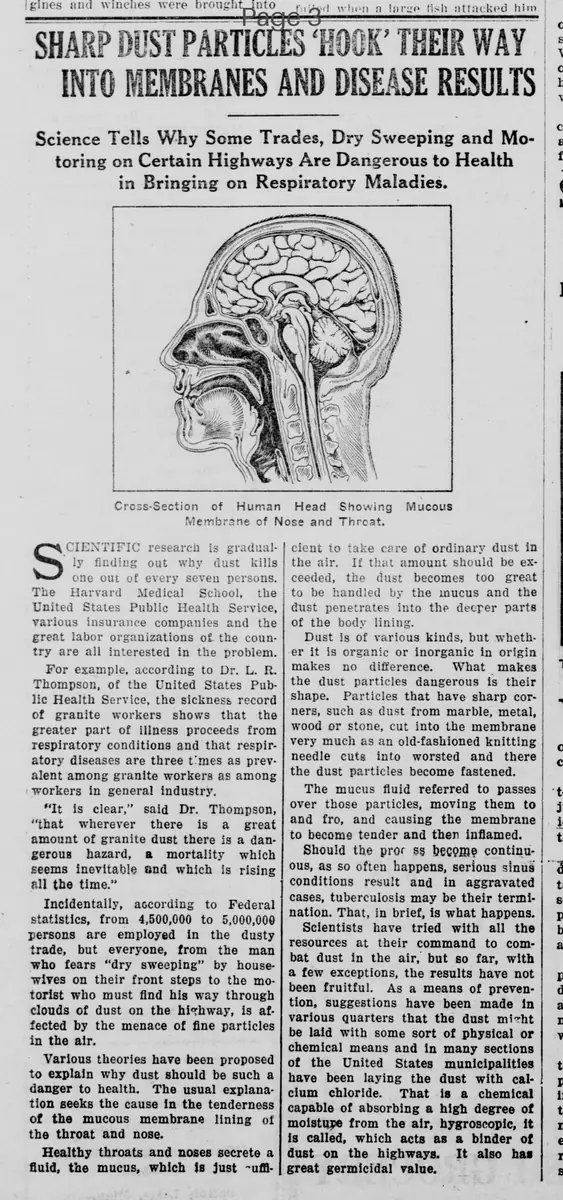
Various theories have been proposed to explain why dust should be such a danger to health. The usual explanation seeks the cause in the tenderness of the mucous membrane lining of the throat and nose.
Healthy throats and noses secrete a fluid, the mucus, which is just sufficient to take care of ordinary dust in the air. If that amount should be exceeded, the dust becomes too great to be handled by the mucus and the dust penetrates into the deeper parts of the body lining.
Dust is of various kinds, but whether it is organic or inorganic in origin makes no difference. What makes the dust particles dangerous is their shape. Particles that have sharp corners, such as dust from marble, metal, wood or stone, cut into the membrane very much as an old-fashioned knitting needle cuts into worsted and there the dust particles become fastened.
The mucus fluid referred to passes over those particles, moving them to and fro, and causing the membrane to become tender and then inflamed.
Should the process become continuous, as so often happens, serious sinus conditions result and in aggravated cases, tuberculosis may be their termination. That, in brief, is what happens.
Scientists have tried with all the resources at their command to combat dust in the air, but so far, with a few exceptions, the results have not been fruitful. As a means of prevention, suggestions have been made in various quarters that the dust might be laid with some sort of physical or chemical means and in many sections of the United States municipalities have been laying the dust with calcium chloride. That is a chemical capable of absorbing a high degree of moisture from the air, hygroscopic, it is called, which acts as a binder of dust on the highways. It also has great germicidal value.
INTO MEMBRANES AND DISEASE RESULTS
Science Tells Why Some Trades, Dry Sweeping and Motoring on Certain Highways Are Dangerous to Health in Bringing on Respiratory Maladies.
Scientific research is gradually finding out why dust kills one out of every seven persons.
The Harvard Medical School, the United States Public Health Service, various insurance companies and the great labor organizations of the country are all interested in the problem.
For example, according to Dr. L. R. Thompson, of the United States Public Health Service, the sickness record of granite workers shows that the greater part of illness proceeds from respiratory conditions and that respiratory diseases are three times as prevalent among granite workers as among workers in general industry.
"It is clear," said Dr. Thompson, "that wherever there is a great amount of granite dust there is a dangerous hazard, a mortality which seems inevitable and which is rising all the time."
Incidentally, according to Federal statistics, from 4,500,000 to 5,000,000 persons are employed in the dusty trade, but everyone, from the man who fears "dry sweeping" by housewives on their front steps to the motorist who must find his way through clouds of dust on the highway, is affected by the menace of fine particles in the air.
Various theories have been proposed to explain why dust should be such a danger to health. The usual explanation seeks the cause in the tenderness of the mucous membrane lining of the throat and nose.
Healthy throats and noses secrete a fluid, the mucus, which is just sufficient to take care of ordinary dust in the air. If that amount should be exceeded, the dust becomes too great to be handled by the mucus and the dust penetrates into the deeper parts of the body lining.
Dust is of various kinds, but whether it is organic or inorganic in origin makes no difference. What makes the dust particles dangerous is their shape. Particles that have sharp corners, such as dust from marble, metal, wood or stone, cut into the membrane very much as an old-fashioned knitting needle cuts into worsted and there the dust particles become fastened.
The mucus fluid referred to passes over those particles, moving them to and fro, and causing the membrane to become tender and then inflamed.
Should the process become continuous, as so often happens, serious sinus conditions result and in aggravated cases, tuberculosis may be their termination. That, in brief, is what happens.
Scientists have tried with all the resources at their command to combat dust in the air, but so far, with a few exceptions, the results have not been fruitful. As a means of prevention, suggestions have been made in various quarters that the dust might be laid with some sort of physical or chemical means and in many sections of the United States municipalities have been laying the dust with calcium chloride. That is a chemical capable of absorbing a high degree of moisture from the air, hygroscopic, it is called, which acts as a binder of dust on the highways. It also has great germicidal value.
What sub-type of article is it?
Medical Curiosity
Curiosity
What themes does it cover?
Misfortune
What keywords are associated?
Dust Particles
Respiratory Diseases
Granite Workers
Mucous Membrane
Tuberculosis
Calcium Chloride
What entities or persons were involved?
Dr. L. R. Thompson
Where did it happen?
United States
Story Details
Key Persons
Dr. L. R. Thompson
Location
United States
Story Details
Scientific research explains how sharp dust particles from trades like granite work, dry sweeping, and highway motoring penetrate mucous membranes, causing inflammation, sinus conditions, and potentially tuberculosis. Prevention efforts include using calcium chloride to lay dust.