Thank you for visiting SNEWPapers!
Sign up free
Phenix Gazette
Alexandria, Virginia
What is this article about?
Defense of Secretary of State Henry Clay against opposition claims of large unpaid debts from Kentucky mortgages, revealing most are satisfied or reduced, including a bank debt now at $4,000 soon to be paid and a $20,000 obligation to John Jacob Astor fully settled years ago.
Clipping
OCR Quality
Full Text
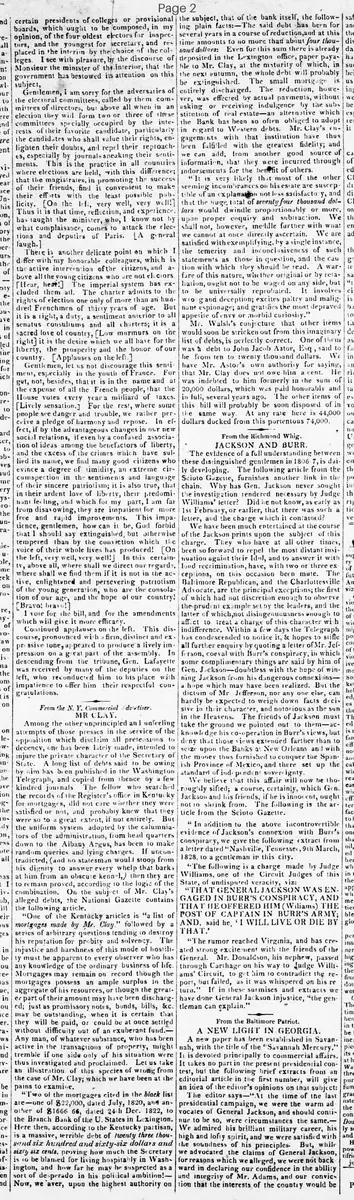
MR. CLAY.
Among the other unprincipled and unfeeling attempts of those presses in the service of the opposition which disclaim all pretensions to decency, one has been lately made, intended to injure the private character of the Secretary of State. A long list of debts said to be owing by him has been published in the Washington Telegraph, and copied from thence by a few kindred journals The fellow who searched the records of the Register's office in Kentucky for mortgages, did not care whether they were satisfied or not, and probably knew that they were so to a great extent, if not entirely. But the uniform system adopted by the calumniators of the administration, from head quarters down to the Albany Argus, has been to make random queries and lying charges. If uncontradicted, (and no statesman would stoop from his dignity to answer every whelp that barks at him from an obscure kennel,) then they are to remain proved, according to the logic of the combination. On the subject of Mr. Clay's alleged debts, the National Gazette contains the following article.
"One of the Kentucky articles is 'a list of mortgages made by Mr. Clay' followed by a series of arbitrary questions tending to destroy his reputation for probity and solvency. The injustice and harshness of this mode of hostility must be apparent to every observer who has any knowledge of the ordinary business of life. Mortgages may remain on record though the mortgager possess an ample surplus in the aggregate of his resources, or though the greater part of their amount may have been discharged; just as promissory notes, bonds, bills, &c. may be outstanding, when it is certain that they will be paid, or could be at once settled without difficulty out of an exuberant fund.—Any man, of whatever substance, who has been active in the transactions of property, might tremble if one side only of his situation were thus investigated and proclaimed. Let us take an illustration of this species of wrong from the case of Mr. Clay: which we have been at the pains to examine.
"Two of the mortgages cited in the black list are—one of $22,000, dated July, 1820, and another of $1666 66, dated 24th Dec. 1822, to the Branch Bank of the U. States in Lexington. Here then, according to the Kentucky partisan, is a massive, terrible debt of twenty three thousand six hundred and sixty-six dollars and sixty six cents, proving how much the Secretary is to be blamed for living hospitably in Washington, and how far he may be suspected as a sort of desperado in his political ambition!—Now, we aver, upon the highest authority on the subject, that of the bank itself, the following plain facts:—The said debt has been for several years in a course of reduction, and at this time amounts to no more than about four thousand dollars: Even for this sum there is already deposited in the Lexington office, paper payable to Mr. Clay, at the maturity of which, in the next autumn, the whole debt will probably be extinguished. The small mortgage is entirely discharged. The reduction, however, was effected by actual payments, without asking or receiving indulgence by the substitution of real estate—an alternative which the Bank has been so often obliged to adopt in regard to Western debts. Mr. Clay's engagements with that institution have thus been fulfilled with the greatest fidelity; and we can add, from another good source of information, that they were incurred through indorsements for the benefit of others.
"It is very likely that most of the other seeming incumbrances on his estate are susceptible of an explanation not less satisfactory, and that the huge total of seventy four thousand dollars would dwindle proportionably or more, upon proper enquiry and subtraction. We shall not, however, meddle further with what we cannot at once directly ascertain. We are satisfied with exemplifying, by a single instance the temerity and inconclusiveness of such statements as those in question, and the caution with which they should be read. A warfare of this nature, whether original or by retaliation, ought not to be waged on any side, but to be universally reprobated. It involves wrong and deception; excites paltry and malignant espionage; and gratifies the most depraved appetite of envy or morbid curiosity."
Mr. Walsh's conjecture that other items would soon be stricken out from this imaginary list of debts, is perfectly correct. One of them was a debt to John Jacob Astor, Esq., said to be from ten to twenty thousand dollars. We have Mr. Astor's own authority for saying, that Mr. Clay does not owe him a cent. He was indebted to him formerly in the sum of 20,000 dollars, which was paid honorably and in full, several years ago. The other items of this bill will probably be soon disposed of in the same way. At any rate here is 44,000 dollars docked from this portentous 74,000.
What sub-type of article is it?
What keywords are associated?
What entities or persons were involved?
Where did it happen?
Domestic News Details
Primary Location
Kentucky
Key Persons
Outcome
alleged debts of $74,000 reduced; specific mortgage of $23,666.66 now about $4,000 and soon to be extinguished; small mortgage discharged; debt to astor of $20,000 paid in full years ago; other items expected to be similarly resolved.
Event Details
Opposition presses published a list of alleged debts and mortgages by Secretary of State Mr. Clay from Kentucky records to damage his reputation. The National Gazette refutes this, explaining mortgages may remain on record despite being paid or reduced, citing bank authority that a major mortgage is nearly paid via actual payments from endorsements for others, and Astor confirms no debt owed.