Thank you for visiting SNEWPapers!
Sign up free
The Hillsborough Recorder
Hillsboro, Orange County, North Carolina
What is this article about?
Farmer J. C. W. from Onancock, Accomack Co., Va., describes wire grass prevalent in his area, debates its desirability, and shares experiments in controlling it for crops like turnips and sweet potatoes using late fall plowing and wood-mould covering.
Clipping
OCR Quality
Full Text
Exuberant nature's better blessing, o'er every land."
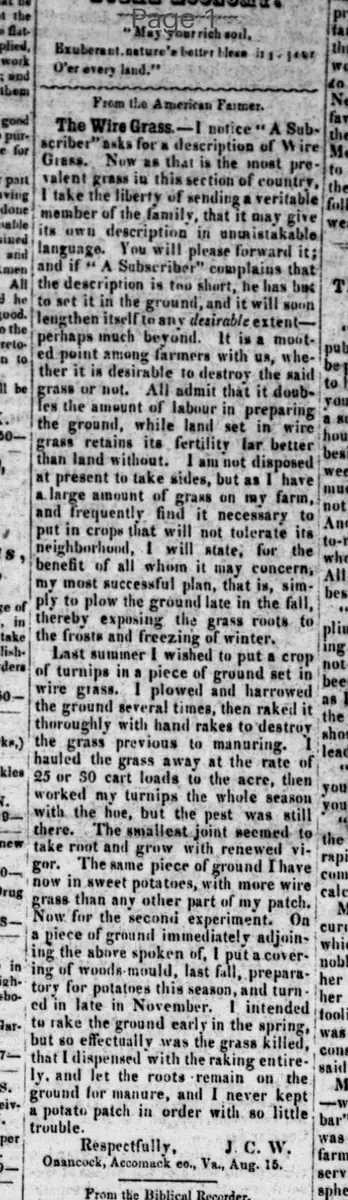
From the American Farmer.
The Wire Grass.—I notice "A Subscriber" asks for a description of Wire Grass. Now as that is the most prevalent grass in this section of country, I take the liberty of sending a veritable member of the family, that it may give its own description in unmistakable language. You will please forward it; and if "A Subscriber" complains that the description is too short, he has but to set it in the ground, and it will soon lengthen itself to any desirable extent—perhaps much beyond. It is a mooted point among farmers with us, whether it is desirable to destroy the said grass or not. All admit that it doubles the amount of labour in preparing the ground, while land set in wire grass retains its fertility far better than land without. I am not disposed at present to take sides, but as I have a large amount of grass on my farm, and frequently find it necessary to put in crops that will not tolerate its neighborhood, I will state, for the benefit of all whom it may concern, my most successful plan, that is, simply to plow the ground late in the fall, thereby exposing the grass roots to the frosts and freezing of winter.
Last summer I wished to put a crop of turnips in a piece of ground set in wire grass. I plowed and harrowed the ground several times, then raked it thoroughly with hand rakes to destroy the grass previous to manuring. I hauled the grass away at the rate of 25 or 30 cart loads to the acre, then worked my turnips the whole season with the hoe, but the pest was still there. The smallest joint seemed to take root and grow with renewed vigor. The same piece of ground I have now in sweet potatoes, with more wire grass than any other part of my patch.
Now for the second experiment. On a piece of ground immediately adjoining the above spoken of, I put a covering of woods-mould, last fall, preparatory for potatoes this season, and turned in late in November. I intended to rake the ground early in the spring, but so effectually was the grass killed, that I dispensed with the raking entirely, and let the roots remain on the ground for manure, and I never kept a potato patch in order with so little trouble.
Respectfully,
J. C. W
Onancock, Accomack co., Va., Aug. 15.
What sub-type of article is it?
What keywords are associated?
What entities or persons were involved?
Where did it happen?
Domestic News Details
Primary Location
Onancock, Accomack Co., Va.
Event Date
Aug. 15.
Key Persons
Outcome
successful control of wire grass in potato patch using wood-mould covering; persistent grass in turnip and sweet potato plots despite efforts.
Event Details
Description of wire grass as prevalent, labor-intensive but fertility-retaining; debate on desirability; methods to control via late fall plowing and wood-mould covering; experiments with turnips (failed control) and potatoes (successful).